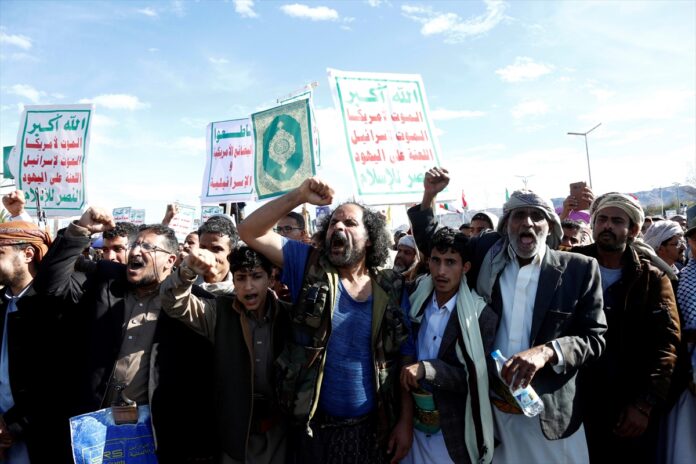
As Yemen’s Houthi-backed forces secure major gains in a headline-grabbing rapid advance across Yemen’s Red Sea coast, 5Pillars takes a look at the background of the Arab group which continues to cause major upsets for regional and global powers.
This week, Yemen’s Houthi-backed forces have made a dramatic advance along Yemen’s Red Sea coast, capturing the strategically important port of Mocha and the strategic island of Perim, which sits in the Bab al-Mandab, gaining total control over one of the world’s most important shipping chokepoints.
The offensive has seemingly sparked panic in Saudi Arabia, with Riyadh reportedly pleading for U.S. military assistance and shutting down its East-West oil pipeline following attacks on the line – most likely from Yemen. The return of the conflict in Yemen has now raised fears that the long-running war between Saudi Arabia and the Houthis could escalate into a much wider conflict.
But who exactly are the Houthis, where did they come from, and how did a relatively small religious and political movement from northern Yemen become one of the most powerful armed groups in the Middle East?
Who are the Houthis?

The Houthis, officially known as Ansar Allah (“Supporters of God”), are a Yemeni political and military movement that emerged from the Zaydi Muslim community in northern Yemen.
Zaydis are a branch of Shia Islam that has existed in Yemen for centuries. They are distinct from the Twelver Shia tradition dominant in Iran, although the Houthis have developed increasingly close political and military relations with Tehran.
Subscribe to our newsletter and stay updated on the latest news and updates from around the Muslim world!
The key difference is their doctrine of religious leadership, or Imamate. Twelver Shia believe there were 12 divinely appointed Imams, beginning with Ali ibn Abi Talib R.A and continuing through his descendants, ending with Imam Muhammad al-Mahdi, who they believe entered occultation and will return.
Zaydis recognise a different Imam from the descendants of Ali, branching off with Imam Zayd ibn Ali, and generally believe that a qualified descendant of Ali R.A and Fatimah R.A who rises against injustice can become Imam. They do not accept the doctrine of 12 infallible Imams or the occultation of the 12th Imam.

There are also many differences in theology and religious law, and Zaydi beliefs are in some respects closer to Sunni Islam than Twelver Shia beliefs.
The movement takes its name from the founding family, particularly Hussein Badr al-Din al-Houthi, who became the group’s leading figure in its early years.
The roots of the movement go back to the 1980s and 1990s, when Zaydi activists in northern Yemen became increasingly concerned about corruption, poverty and the weakness of the Yemeni state.
Things changed dramatically after the U.S. invasion of Iraq in 2003.
Hussein al-Houthi became increasingly critical of Yemen’s long-serving president, Ali Abdullah Saleh, particularly because of Saleh’s close relationship with the United States.
In 2004, the Yemeni government attempted to arrest al-Houthi in response to his harsh condemnation of the regime. Instead, an insurgency erupted.
Hussein al-Houthi was killed that year, but the movement survived under the leadership of his family, eventually fighting six wars against the Yemeni government between 2004 and 2010. The fighting was concentrated primarily in the northern province of Saada.
The Houthis also fought Saudi forces in 2009 after clashes spilled across the Yemeni-Saudi border.
By the end of this period, the Houthis had transformed from a relatively small religious movement into a hardened armed organisation with considerable support among sections of Yemen’s Zaydi population and tribal networks.
The Arab Spring
The next major turning point came in 2011, when protests swept across the Arab world. Yemen was no exception.
After months of demonstrations, President Saleh eventually agreed to step down in 2012. His deputy, Abdrabbuh Mansur Hadi, became president as part of a Gulf-backed political transition.
But the transition failed to resolve Yemen’s fundamental problems.
The country remained desperately poor, divided along regional, tribal and political lines, while Al-Qaeda’s Yemeni branch was also expanding due to the chaos.
The Houthis also took advantage of the instability, expanding beyond their traditional strongholds and beginning to capture territory in northern Yemen. By 2014, they had become powerful enough to march on the capital.
The Houthis seize Sana’a
In September 2014, Houthi forces entered Sana’a, Yemen’s capital. Initially, the Houthis demanded political reforms and a greater share of power. But their military advance continued.
One of the most important developments was their alliance with their former enemy, Ali Abdullah Saleh. It was essentially a marriage of convenience: Saleh wanted to remove his successor Hadi, while the Houthis wanted to expand their power.
Together, their forces overran large parts of the country.
In January 2015, the Houthis seized the presidential palace and placed President Hadi under house arrest. Hadi eventually escaped and fled to the southern port city of Aden before leaving the country.

The Houthis had effectively become Yemen’s dominant power in the north. However, they did not succeed in capturing all of Yemen — although they came incredibly close.
Southern separatists, some tribal forces, Al-Qaeda and other factions continued to oppose them. This is where the conflict became international.
In March 2015, Saudi Arabia assembled a coalition of Arab states and launched a military intervention in Yemen. The stated objective was to restore the internationally recognised government of President Hadi and push the Houthis back.
The United Arab Emirates became another major player, backing and training various anti-Houthi forces, particularly in southern Yemen. Today, their influence remains strongest with the STC southern separatist movement. While Saudi Arabia backs the internationally recognised government of Yemen, at the time it was headed by the exiled leader Mansour Hadi.
Saudi and Emirati-backed forces managed to prevent the Houthis from taking the entire country and pushed them out of Aden and parts of southern Yemen. But they could not defeat them.
The war instead developed into one of the world’s worst humanitarian crises.
Saudi-led airstrikes hit Houthi positions but also caused significant civilian casualties, while the coalition’s restrictions on imports and access to Yemen contributed to severe shortages of food, fuel and medicine.
At the same time, the Houthis fired missiles and drones into Saudi Arabia and later the UAE, targeting military infrastructure and energy facilities.
The Saudis fail to defeat the Houthis
The war continued for years with neither side achieving a decisive victory.
In 2017, the Houthis turned against their former ally Saleh after he attempted to switch sides and open negotiations with Saudi Arabia. Houthi fighters killed Saleh as he attempted to flee Sana’a.
By then, the Houthis had consolidated their control over much of northern Yemen, including Sana’a and territory containing the majority of the country’s population.
In 2022, a UN-backed truce brought a significant reduction in fighting. Although it did not produce a final peace agreement, the front lines largely froze. Saudi Arabia subsequently began pursuing negotiations with the Houthis rather than attempting to defeat them militarily.
The Houthis and Iran
One of the most controversial aspects of the Houthi movement is its relationship with Iran.
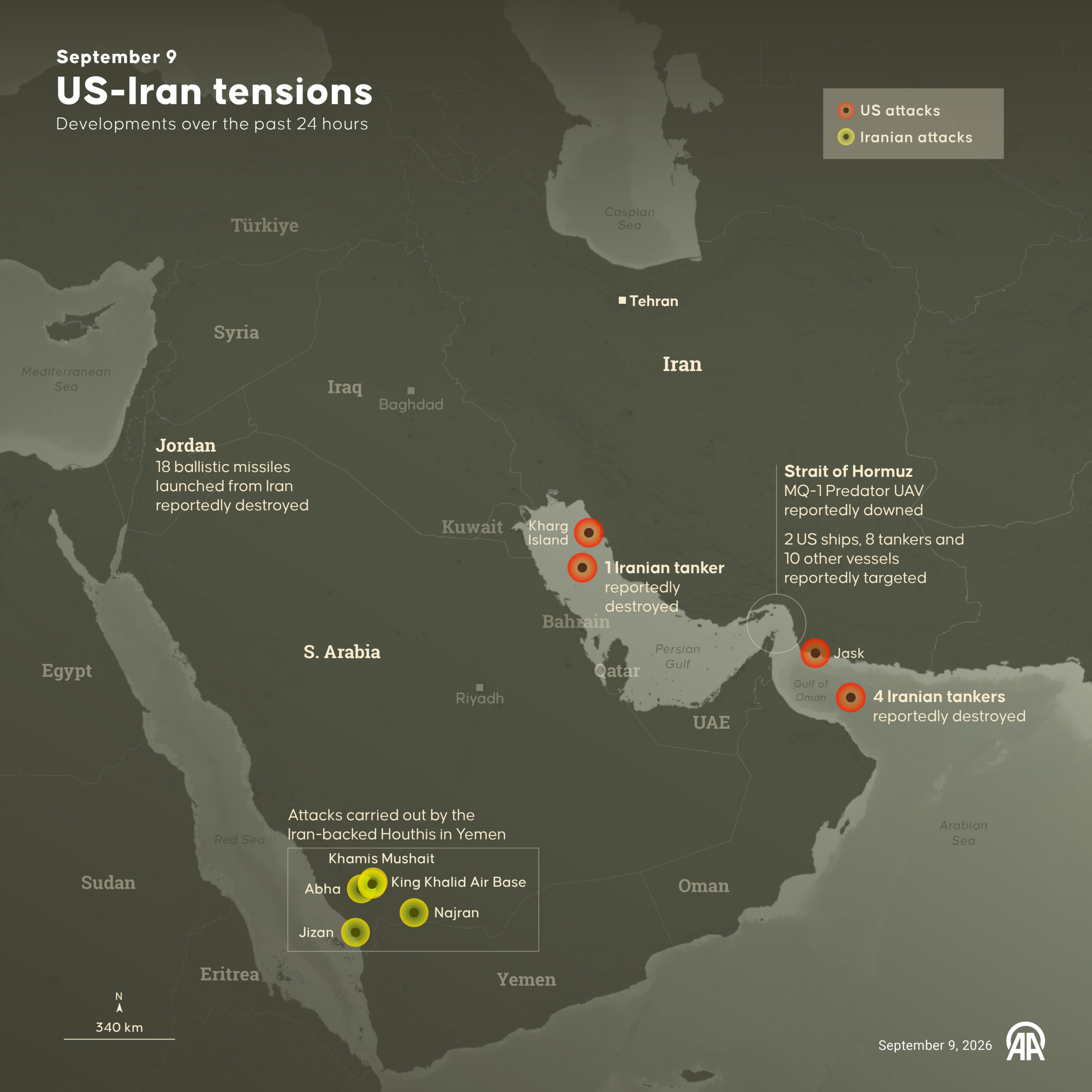
Iran has provided the Houthis with varying degrees of military, financial and technical assistance, and the relationship has become increasingly close over the years. Western governments and analysts generally describe the Houthis as an Iran-aligned group.
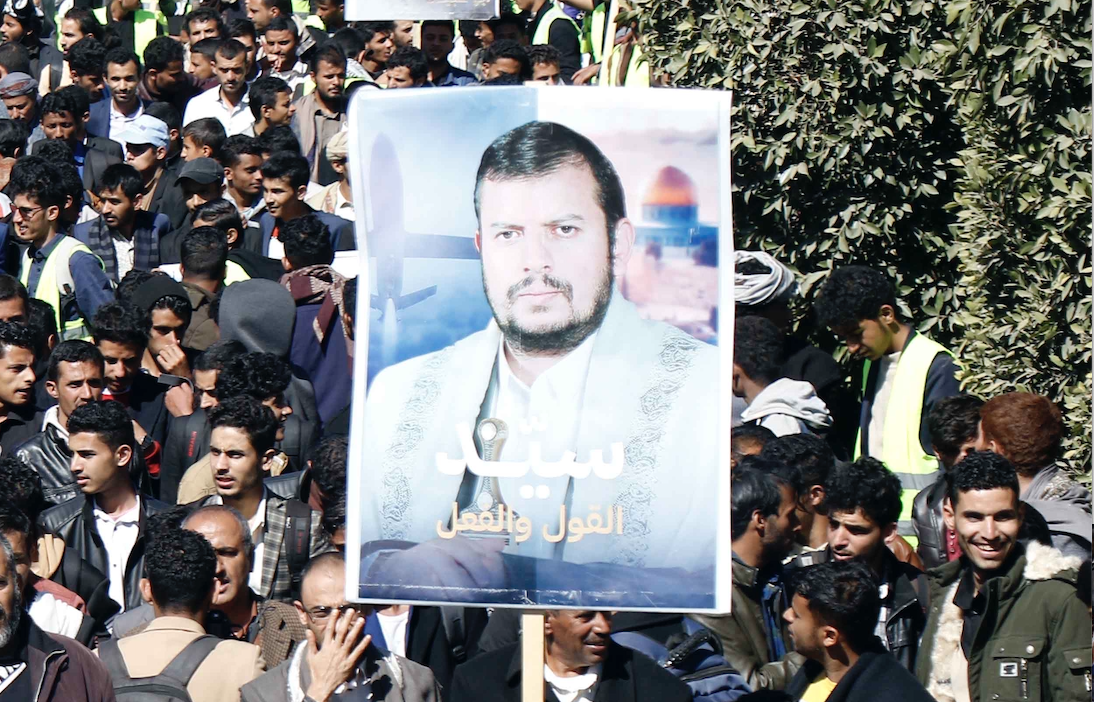
However, it would be misleading to portray the Houthis simply as an Iranian creation. The movement is indigenous to Yemen and has shown signs that it is a unique group, different from a typical Iranian-founded proxy such as those found elsewhere in Lebanon and Iraq.
Iranian support has nevertheless helped the Houthis develop sophisticated missile and drone capabilities, transforming them into a much more formidable regional military force.
Iran remains one of the very few countries which recognises the Houthi-led government in Sana’a and has been accused by Saudi Arabia of shipping weapons to the group, which it uses to attack Saudi infrastructure.
The Houthis hold similar political beliefs which mirror the Iranian “Resistance Axis” style of anti-imperialism. Their famous slogan includes the chant “Death to America.”
The current leader of the group is Abdul-Malik Badr al-Din al-Houthi, commonly known as Abdul-Malik al-Houthi. He has become a major figure in the region and now sits as one of the last surviving recognisable faces in the Axis of Resistance after other figures were killed following a string of assassinations by the U.S. and Israel.
The Houthis’ legal status varies between countries. The United States and Australia designate Ansar’Allah as a terrorist organisation, while the UK does not proscribe the group as a terrorist organisation but has imposed sanctions against it. The UN has also imposed sanctions and an arms embargo on the group and sanctions on senior Houthi figures.
The justification for the U.S. and Australia’s proscription is primarily claims of the groups attacks on civilian and commercial shipping, attacks against foreign states, and use of violence against civilians and infrastructure.
The Gaza genocide
Gaza brings the Houthis back onto the world stage after a period of relative calm which occurred following the end of fighting between Saudi Arabia and the Yemeni group.
The Houthis gained a completely new level of international attention after Israel’s war on Gaza began in October 2023, declaring their full solidarity with the Palestinians. The Houthis then began launching missiles and drones towards Israel and attacking commercial shipping in the Red Sea, particularly vessels they said were connected to Israel.
The attacks caused many shipping companies to divert vessels away from the Red Sea and around the Cape of Good Hope, adding considerable time and expense to journeys between Asia and Europe.
The U.S. and UK subsequently launched strikes against Houthi targets in Yemen.
For many Muslims, the Houthis’ intervention in the Red Sea has therefore been viewed through the wider context of the Palestinian cause and the devastation in Gaza.
At the same time, the attacks have also created serious risks for civilian shipping and Yemen’s already devastated population.
The move has caused harm to Yemen via large-scale airstrikes from the U.S., UK and Israel, but the group appears to have received a significant reputation boost after Yemen became the only Arab country to fight Israel amid the genocide. Their ability to hit deep inside both Saudi Arabia and the UAE, and their warnings of intervention should Israel seek to set up a military presence in the breakaway Somali territory of Somaliland, have additionally been well received by some onlookers in the wider Muslim world who see the Houthis as one of the only groups capable of upsetting Israel’s regional agenda.
That brings us to the current situation.
Major Houthi gains
The Houthis have now launched a major offensive against forces aligned with Yemen’s internationally recognised government. Their rapid advance has taken them down the Red Sea coast, including the capture of Mocha, a historically important port.
They have subsequently moved towards Dhubab and the Bab al-Mandab, while reports indicate that Houthi forces may be on the verge of capturing Marib as well, east of the capital, Sanaa.
The Bab al-Mandab is only around 30km wide at its narrowest point and connects the Red Sea with the Gulf of Aden. That makes it strategically vital. A force capable of threatening the strait can potentially disrupt one of the world’s most important maritime trade routes.
The Houthis’ latest gains therefore represent much more than another battle in Yemen’s civil war.
They demonstrate that, despite years of Saudi-led military intervention, the Houthis remain a powerful force capable of launching major offensives and reshaping the balance of power in Yemen.
Yemen’s war has involved political corruption, tribal rivalries, regional divisions, foreign intervention, religious tensions and competing geopolitical interests.
The Houthis have undoubtedly committed abuses, and their failure to achieve an end to the crippling economic siege on the country has left much of the population in a depressed state.
But the suffering of ordinary Yemenis cannot be understood without also considering the devastating Saudi-led intervention, the actions of other Yemeni factions, the involvement of foreign powers and the years of economic warfare that have helped reduce Yemen to one of the world’s poorest countries. And as the Houthis now advance along the Red Sea, Yemen’s long-running war appears to be entering another dangerous chapter.