


Secular fundamentalist states and radical feminists like to claim they champion women’s rights and bodily autonomy – until they confront a Muslim woman who proudly chooses to wear the hijab. Then the oppression starts! Suddenly, her so-called “freedom of choice” becomes a problem to be legislated away, writes Maria Akbar.
Muslim women are constantly subjected to scrutiny over how we choose to dress. We are told we are “oppressed” or “trapped and controlled.”
The very thought that wearing a hijab may be our own choice seems unfathomable to some. Irrespective of how many Muslim women speak up, defend our choices or demonstrate our freedom through our presence in education, healthcare and other public sectors, we continue to be viewed and treated differently, simply because we do not conform to society’s expectations of how women should dress.
In Western countries, societal attitudes towards clothing are constantly changing. What was once considered immodest has now become the norm, and I imagine that in another 20 or 30 years, the standards of what is considered acceptable will change again.
However, for us Muslim women, our prescribed dress is in accordance with what the Quran and Sunnah legislate, and we try our best to fulfil that obligation. Islamic teachings are not dictated by changing societal trends.

Restrictions target Muslim women only
So, who gets to decide what dress code is acceptable?
Subscribe to our newsletter and stay updated on the latest news and updates from around the Muslim world!
Surely, the whole point of freedom is that people are able to make choices for themselves, regardless of whether others agree with them. We do not all have to think alike, dress alike or share the same values. Moreover, once freedom becomes conditional upon conforming to society’s expectations, it loses its very essence.
However, this is precisely what happens when restrictions are placed on how Muslim women choose to dress in secularist governed societies. We are effectively being told that we are free to make our own decisions, but only within the parameters that society has decided are acceptable.
France was one of the forerunners in restricting the hijab, introducing legislation in 2004 prohibiting conspicuous religious symbols, including the Islamic headscarf, in state schools.
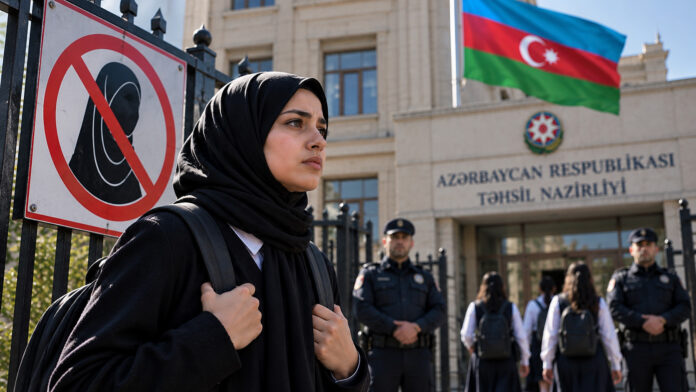
More recently, Austria has introduced legislation banning the hijab for girls under 14 in schools, while Muslim girls in Azerbaijan have reportedly been prevented from attending school because of their hijabs.
These restrictions are often justified on the grounds of protecting girls, promoting equality and encouraging integration. But how does preventing a young girl from wearing the hijab protect her freedom? How does excluding her from education because of her religious attire promote equality? And why should integration require Muslim women to compromise on their religious beliefs?
“My body, my choice” – but whose choice?
In countries such as Afghanistan and Iran, women are required to observe the hijab. These policies have faced widespread criticism in the West, particularly from those who believe that every woman should have the freedom to decide how she dresses.
In fact, the famous feminist slogan, “My body, my choice”, is used to emphasise that women should have autonomy over decisions concerning their own bodies, including how they choose to dress. But how does this principle apply to women who wish to wear the hijab but are prevented from doing so?
If forcing a woman to observe the hijab against her will is considered oppression in the West, then surely forcing a woman to remove her hijab against her will should also be recognised as oppression.
If a girl in Iran is considered oppressed because she is required to cover herself in public, then surely a girl in Azerbaijan who wishes to observe the hijab but is prevented from doing so at school should also be recognised as having her freedom restricted.
Of course, the circumstances and consequences of these policies differ, but the underlying principle remains the same. Who gets to decide what a woman can and cannot wear? Or is it really a case of “my body, my choice”, except when that choice is to wear the hijab?
There is a contradiction here that cannot be ignored. The same principle of individual freedom that is used to criticise compulsory hijab laws should also apply when governments introduce laws restricting the hijab.
The hijab is a choice that Muslim women make in order to fulfil the commands that Allah has placed upon us. It is a symbol of our faith, modesty and submission to our Creator.
Perhaps, if the very people who speak, debate and legislate over our hijabs actually listened to us, it would become clear that we observe the hijab because it is our own decision. It is a decision we are content with and have no desire to change.
So to be put in a situation where the freedom to make that decision is taken away is oppression.
For how long will a woman’s attire remain up for discussion? Why does a woman choosing to cover her hair become a matter for government legislation and public debate?
Not everyone needs to agree with the hijab or understand why Muslim women choose to wear it. But being able to do so is part of having freedom of choice.
Ultimately, societies that claim to champion freedom and tolerance do not extend those same principles to Muslim women whose choices they disagree with. And if a woman’s freedom only exists when she dresses in a way that society approves of, then how free is she really?