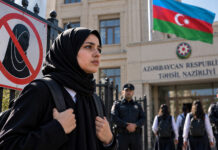

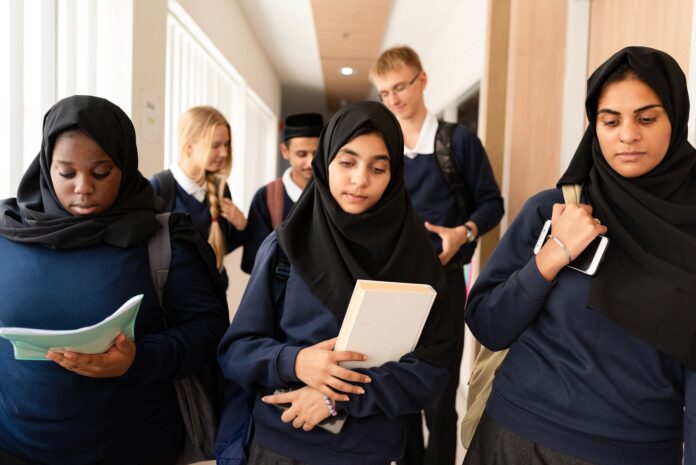
Muslim mother Juveriah Alam describes her anguish at the prospect of having to silence her own children over Palestine, fearing that new “political neutrality rules” following a review into antisemitism in schools will further suppress their identities and freedom of expression.
From the very beginning of my children’s school journey, their teachers praised them for their “strong sense of identity” and noted how they were “particularly proud of their religion.” They are deep thinkers, naturally curious about the world and excited to share their culture, faith and personal views.
As a Muslim mother, I nurtured this openness. I taught my passionate young boys to be politically vocal, to care about the world and to stand up for what is right. For years, these traits were celebrated as virtues.
But over time, the landscape has shifted. I have watched as their expressions of identity have become less welcome in the classroom. Now, following the government’s recent adoption of a review into antisemitism in schools to tighten the Department for Education’s “political impartiality guidance,” schools are being pushed to heavily restrict political symbols, flags and open discussions to maintain “neutrality.”
Faced with these looming classroom restrictions, I am handed a heartbreaking task: I am having to figure out how to dampen the passion within my own children.

Censorship
Last year, my children visited Palestine with their father and created a video diary of their experience. Eager to share it with their class — just as many of their peers do when they return from a family holiday — they were dealt a harsh lesson in censorship.
Subscribe to our newsletter and stay updated on the latest news and updates from around the Muslim world!
They were told the video could only be shown without the audio, which included an explanation of how certain areas of land had been taken over by Israeli settlers. My eldest son, aged nine, was confused and bitterly disappointed. It forced me to have a frank, difficult conversation with him about how some topics are deemed too “controversial” for school.

His teacher, a hijabi Muslim woman, quietly told me she loved the video but explained that the censorship came directly from the headteacher. Although I hated the idea of my son being silenced, I found myself feeling strangely grateful that his teacher was protecting him by discouraging him from saying or writing anything that might be considered controversial.
Sadly, this has happened on numerous occasions. The sad reality is that, even as a social media activist, my priority is keeping my kids safe at school, free from the threat of a Prevent referral.
My children now understand censorship. They have had to learn to be careful with their words, absorbing the message that certain parts of their reality are not permitted within school walls. With these new government proposals, I am genuinely fearful that the lines will blur even further, leaving them entirely unsure of what they can and cannot say.
In response, I can feel myself turning into my Indian father, whose survival strategy was simply to keep quiet and stay out of trouble. I am deeply tempted to tell my kids not to mention Palestine at school at all. Yet I know the long-term repercussions of censoring children are devastating.
Silencing Children
Under the government’s new proposals, even something as simple as wearing a Palestinian flag badge, displaying a Palestinian flag or using pro-Palestine slogans could attract greater scrutiny from schools.
There are also concerns about the Prevent programme, with schools being asked to strengthen their approach to identifying antisemitism and potential radicalisation. Although supporting Palestine does not automatically constitute extremism, I fear that children expressing anger at Israel’s actions in Gaza could find themselves facing inappropriate scrutiny or even referrals. How are parents like me supposed to encourage our children to speak openly when we cannot be certain how their words will be interpreted?
Make no mistake: these new restrictions will harm children. Forcing students and teachers to suppress their personal beliefs under the guise of “political neutrality” does not create a safe classroom. On the contrary, it inflicts deep psychological and social harm on young minds.
The political hypocrisy surrounding this issue is glaring. At a recent Labour conference, Ed Miliband told pro-Palestine activists that they were “right” all along and that the party had got it “wrong”. Yet while politicians are free to debate and change their positions on these issues in public, our children are forced into silence.
There are countless British pro-Palestine activists from all walks of life, many of whom are parents. For their children, Palestine is not a distant, abstract political theory. It is a daily topic of conversation at the dinner table. For Muslim children, it is the focus of their nightly prayers. The flag represents the plight of their brethren, whom they have witnessed suffering through an ongoing genocide.
For British Palestinian children, that flag is a fundamental part of who they are — a visual anchor that helps them process trauma through solidarity. When schools label a child’s identity as a forbidden “political stance,” they send a damaging message: who you are is inappropriate.
Young minds are being forced to grapple with a glaring inconsistency. For years, the educational curriculum has told them to be true to themselves, to be comfortable in their own skin and to be “loud and proud.” Yet now, they are expected to shy away from human rights crises that should not be controversial to oppose. This contradiction risks breaking their trust in educators, turning a place of learning into a space of anxiety and secrecy.
Instead of fostering empathy and critical thinking, schools are inadvertently training children in forced passivity. True neutrality should never come at the expense of a child’s sense of belonging. Educators must learn to distinguish between political campaigning and a genuine expression of human feeling.
We should be fanning the sparks of young people who care about justice, not teaching them how to hide who they are.