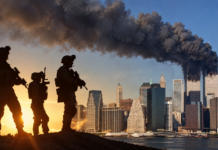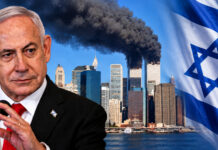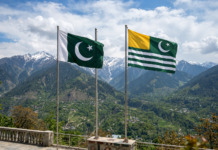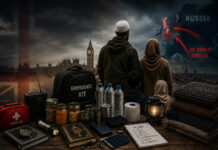



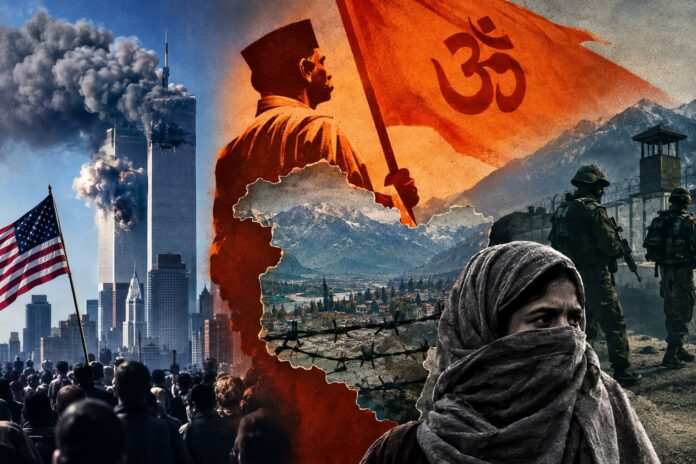
Twenty-five years after 9/11, the “war on terror” continues to shape the treatment of Muslims around the world. Prominent Kashmiri activist, Dr. Muzzammil Ayyub Thakur, traces its impact from Kashmir to Israel and now Britain, asking how counter-terrorism became a language for repression used by India and other powers.
Twenty-five years after 9/11, the language of counter-terrorism has become Hindu nationalism’s passport. This week, it was stamped in London.
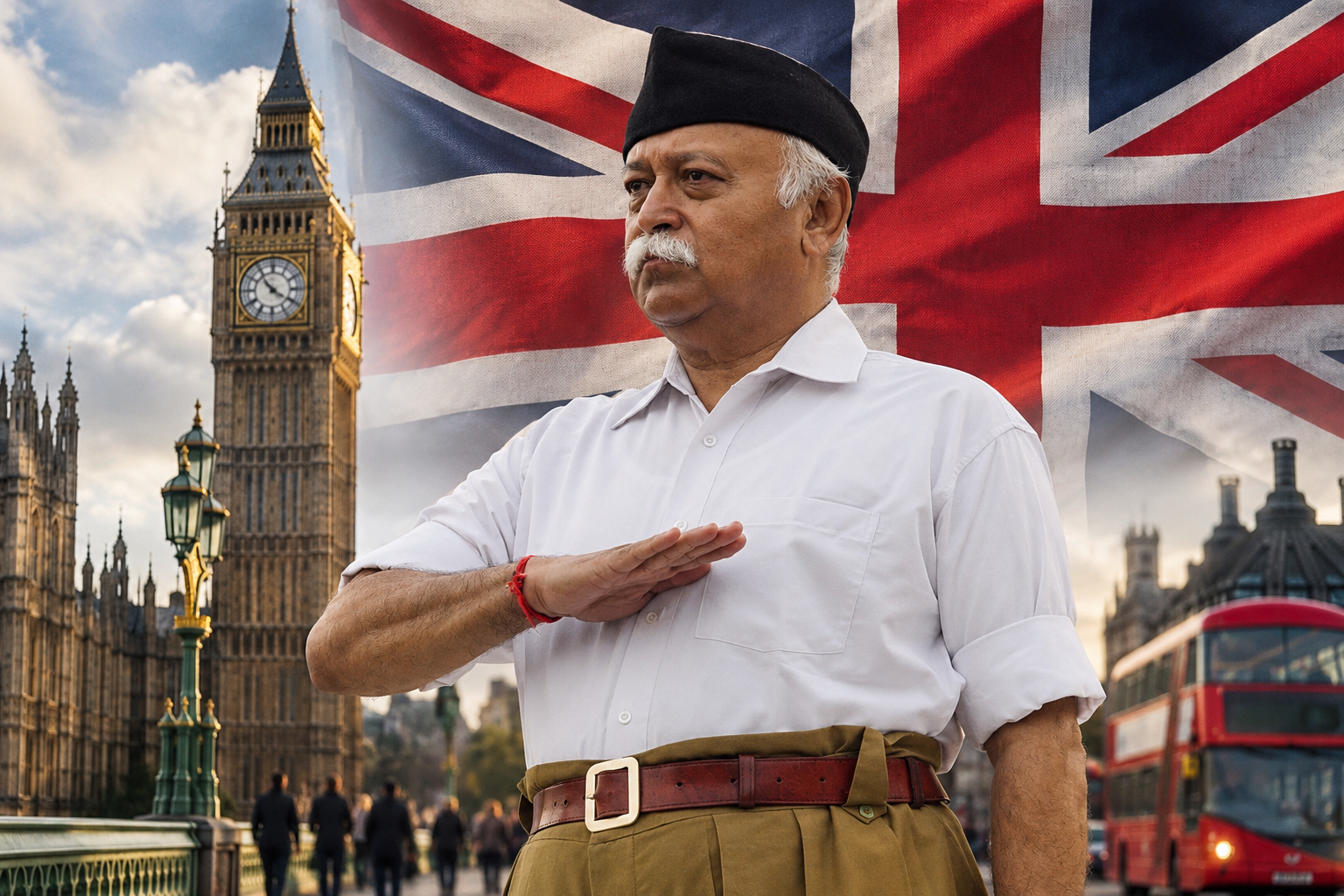
Last Sunday, Rashtriya Swayamsevak Sangh chief Mohan Bhagwat addressed a London gathering organised by its British affiliate, the Hindu Swayamsevak Sangh UK. Asked in Parliament by Labour MP Nadia Whittome whether the visit had been assessed against the government’s commitment to exclude extremists, security minister Dan Jarvis said the Home Office could not comment on individual cases.
Hundreds protested in Parliament Square, while the Sikh Federation UK objected to a London gurdwara receiving him. Today marks the 25th anniversary of 9/11, and for Kashmiris, the two events are connected.
I was a university student in London when the towers fell. I watched the pictures while at work in the World Assembly of Muslim Youth. My immediate reaction was to contact family and friends in Kashmir, knowing the attacks would have repercussions at home. The line rang into nothing, as our lines usually did.
Then Washington launched its war on terror, and New Delhi took over the franchise while the ash was still falling. It had taken over the British Empire’s colonial franchise in the same year it won its freedom, and occupied Jammu and Kashmir.
The U.S. Congressional Research Service recorded that, in the days after the attacks, India offered Washington full cooperation, including the use of its bases. Washington waived its remaining nuclear-test sanctions on India before the month was out. On 14 September, RSS-groomed Indian prime minister Atal Bihari Vajpayee went on national television, warned Indians to prepare for harsh measures and called for a review of the country’s “hobbled laws”.
Subscribe to our newsletter and stay updated on the latest news and updates from around the Muslim world!

A car bomb at the Jammu and Kashmir Assembly in Srinagar killed 38 people on 1 October, and within weeks the government had issued an anti-terror ordinance. On 9 November, Vajpayee met George W. Bush at the White House. Their joint statement cited the 11 September attacks in the United States and the 1 October bombing in Kashmir together as proof that both countries were targets of terrorism.
On 13 December, five gunmen attacked Parliament in Delhi and killed nine people before they were shot dead. The ordinance became the Prevention of Terrorism Act the following March.
The Parliament attack also produced a Kashmiri to hang. Afzal Guru was executed in Tihar jail in February 2013, after the Supreme Court had acknowledged that the evidence of his part in the conspiracy was circumstantial and cited the “collective conscience” of society in confirming his death sentence. His family was informed after the execution, and he was buried inside the prison while the Valley was placed under curfew. His case remains one of the enduring fault lines in Kashmir’s encounter with India’s post-9/11 security state.
Before 9/11, there was Chittisinghpora. On the night of 20 March 2000, as Bill Clinton arrived in India, gunmen killed 35 Sikh men in the village in Anantnag. Survivors said the killers wore army fatigues. The next day, standing beside Clinton, Vajpayee called the massacre “ethnic terrorism in the guise of Jihad”. Within days, the army announced it had killed the foreign militants responsible at Pathribal. The Central Bureau of Investigation later charged army officers with murdering five local men in a staged encounter, and in 2014 the army closed the case. Six years after the massacre, in an introduction to Madeleine Albright’s memoir, Clinton wrote that “Hindu militants” had carried it out. No one has been convicted of the killings at Chittisinghpora.
Between 2002 and 2004, while Washington and London embraced Delhi as a partner against terror, the International Committee of the Red Cross interviewed 1,491 detainees held in Indian-occupied Jammu and Kashmir and in India’s north-east. Of those, 681 described torture, including electric shocks, suspension from the ceiling, a metal roller crushed across the thighs, waterboarding and sexual abuse. In April 2005, ICRC staff told American diplomats they had concluded that New Delhi condoned torture, and said Britain would receive the same briefing. WikiLeaks published the cable recording that meeting in 2010.
The people who documented such abuse soon found themselves treated as part of the threat. Khurram Parvez spent two decades recording disappearances and torture with Kashmiri rights groups. In 2019, his Jammu Kashmir Coalition of Civil Society and the Association of Parents of Disappeared Persons (APDP) published a study of 432 cases of torture. In November 2021, he was arrested under the Unlawful Activities (Prevention) Act, which was expanded in 2004 to incorporate many of POTA’s provisions after that law was repealed. He was released on bail in July 2026, after 1,703 days in detention without trial. His bail conditions require him to live in Delhi, far from his home in Srinagar, surrender his passport and make no public statements.
The powers that silenced him outlived the emergency that produced them. POTA was repealed in 2004 and its provisions folded into the Unlawful Activities (Prevention) Act, which Modi’s government widened in 2019 to let the state brand individuals, not only organisations, as terrorists.
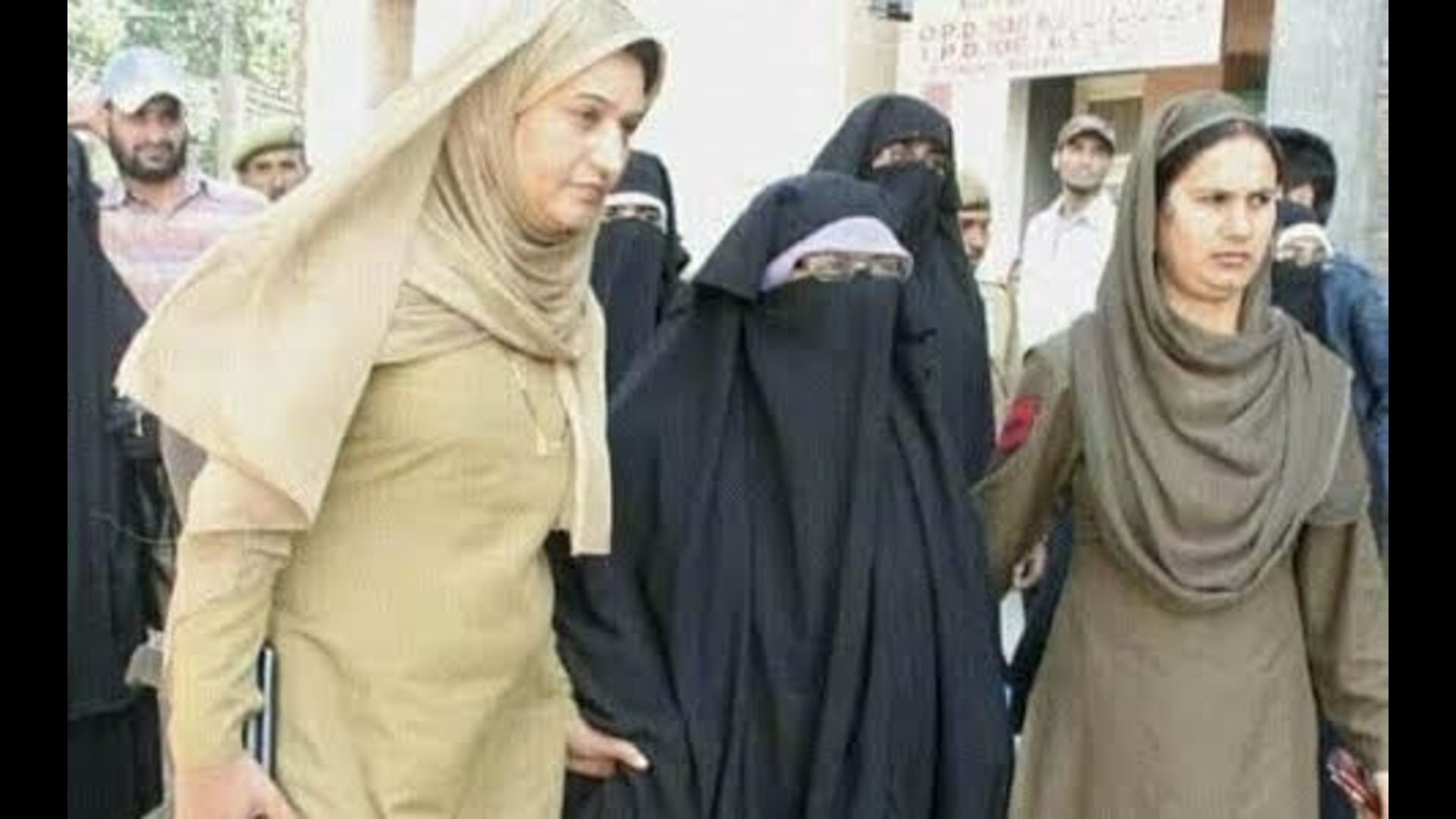
In March 2026, a special NIA court in Delhi sentenced Aasiya Andrabi, the 64-year-old grandmother who founded the women’s group Dukhtaran-e-Millat, to life imprisonment. Her associates Sofi Fehmeeda, who is 36 and uses a wheelchair due to prison medical negligence, and Nahida Nasreen, who is 61, received 30 years each. The judge found no evidence that they had financed terrorism or taken part in armed rebellion. He dropped those charges and instead convicted them on their videos, interviews and posts, literally convicting them for their opinions.
Andrabi’s husband, Muhammad Qasim Faktoo, has been in prison since 1993. Masarat Alam has been detained dozens of times under the Public Safety Act, which requires no trial. Shabir Shah has spent most of his adult life in custody. Yasin Malik is currently on death row on fabricated charges.
The movement that survived those bans is older than any American war. In 1923, V.D. Savarkar defined a Hindu nation by holy land and fatherland, and wrote that the realisation of a Jewish state in Palestine would gladden him almost as much as his Jewish friends. Two years later, the RSS was founded in Nagpur, and in 1931 its founder’s mentor, B.S. Moonje, met Mussolini and came home an admirer of fascist youth drilling.
In 1939, M.S. Golwalkar described the settlement of Jews in Palestine as an effort to “revitalise the practically dead Hebrew National life”. In the same book, he cited Germany’s purge of its Jews as proof that dissimilar races could not be assimilated, calling it “a good lesson for us in Hindusthan to learn and profit by”.
RSS’s early ideologues were studying foreign models for a nation built around one people. After 9/11, their heirs found a respectable English in which a Muslim minority could be discussed as a security file.
Gujarat’s December 2002 election was fought in that English, with the chief minister, Narendra Modi, repeatedly invoking “Mian Musharraf” on the campaign trail, purposefully using the term Mian as a derogatory term towards Muslims.
Ten months earlier, a fire on a train at Godhra had killed 59 Hindu pilgrims. Muslims as a community were blamed for the deaths, and mobs then attacked Muslim homes and neighbourhoods across the state. At Gulbarg Society in Ahmedabad, a mob killed 69 people, including former MP Ehsan Jafri. Human Rights Watch documented rape, people burned alive and attackers using voter lists to find Muslim homes and shops. The official toll was 1,044, while independent estimates approach 2,000, nearly all of them Muslim.
In 2022, India’s Supreme Court upheld a special investigation team’s clean chit for Modi and dismissed the petition of Zakia Jafri, Ehsan Jafri’s widow. The next day, Gujarat police arrested Teesta Setalvad, the activist who had supported her case. A confidential British diplomatic report, disclosed by the BBC in 2023, said Modi was “directly responsible” for the climate of impunity. Delhi blocked the documentary online, and weeks later tax officials entered the BBC’s Indian offices for what the government called a “survey”, while commentators called those actions what they were: retribution.
India’s security relationship with Israel grew in the same language. Israel had quietly armed India in its wars of 1962, 1965 and 1971 while Delhi publicly denied it. Full diplomatic ties followed in 1992, and Israel shipped ammunition again during the 1999 Kargil war.
In May 2003, Vajpayee’s national security adviser, Brajesh Mishra, told the American Jewish Committee’s annual dinner in Washington that India, Israel and the United States shared “fundamental similarities” and should form an alliance against terrorism. Ariel Sharon became the first Israeli prime minister to visit India that September.
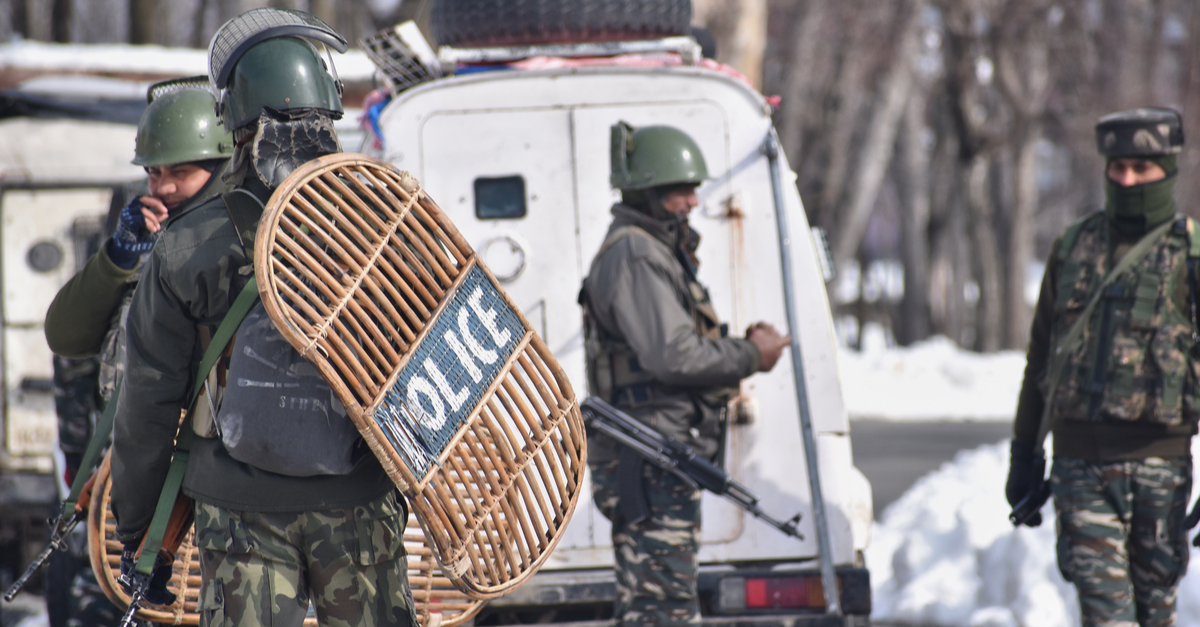
By August 2019, the franchise no longer looked borrowed. Delhi poured troops into Indian-occupied Jammu and Kashmir, cut mobile networks, internet and landlines, detained elected politicians loyal to India, and stripped the region of its constitutional autonomy. New domicile rules followed shortly after.
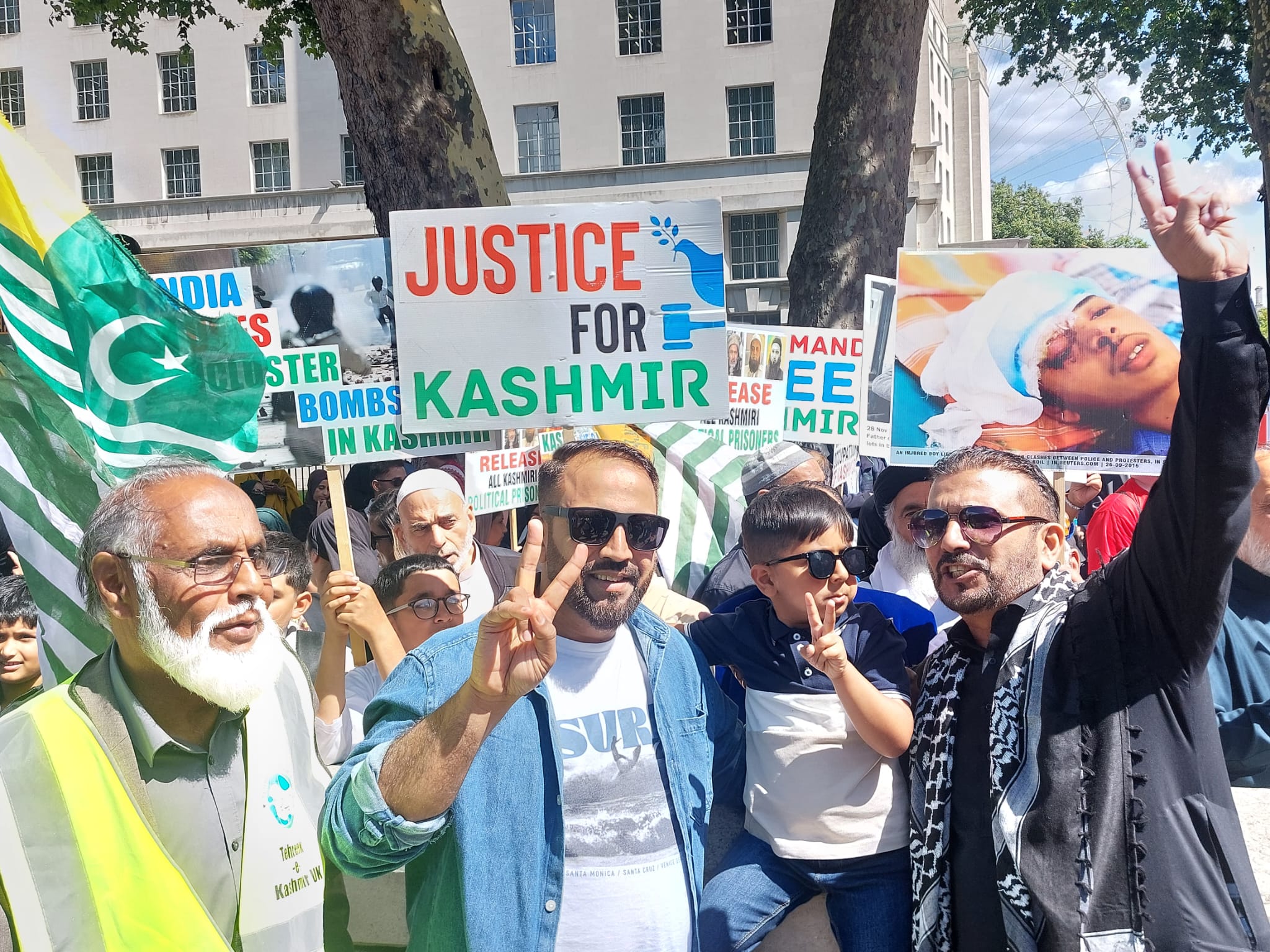
That November, India’s consul general in New York told a gathering of Kashmiri Pandits that a model for their return already existed in the Middle East. Sandeep Chakravorty said that if the Israeli people could do it, India could too. He later said his words had been taken out of context, but Kashmiri novelist Mirza Waheed commented that the comparison “cannot have any other meaning but an endorsement of a settler-colonial project”.
On 7 October 2023, Hamas engaged in a new style of warfare, which led to Israel’s assault on Gaza. In August 2025, the International Association of Genocide Scholars declared that it met the legal definition of genocide, and a month later a UN commission of inquiry concluded the same.
Gaza’s health ministry puts the number of Palestinians Israel has killed since then at more than 73,600, and a household survey published in The Lancet Global Health found the ministry’s count for the war’s first 15 months to be an undercount.
Modi was among the first world leaders to declare solidarity with Israel. India abstained on the UN General Assembly’s call for a humanitarian truce in October 2023 and voted for a ceasefire in December.
Around the same time in Srinagar, the authorities shut Jamia Masjid to Friday prayers for 10 consecutive weeks and confined its chief cleric to his home for five months. The mosque’s managing body said the ban negated the authorities’ claims of normalcy. Residents and religious leaders told the Associated Press in November 2023 that preachers had been asked not to mention the war in their sermons, least of all India’s contribution and complicity.
SIPRI’s figures show that India took 34 per cent of Israel’s arms exports between 2020 and 2024. In February 2024, Shephard Media reported that an Adani-Elbit joint venture in Hyderabad had delivered more than 20 Hermes 900 drones to Israel.
In April 2025, gunmen killed 26 people at Pahalgam in Indian-occupied Jammu and Kashmir. Within two days, Israeli ambassador Reuven Azar had likened the attack to 7 October and said terrorist groups were inspiring one another.
At the American Jewish Committee, the organisation Mishra had addressed in 2003, policy chief Jason Isaacson said the killings echoed that day. Indian forces then blew up the homes of suspected militants’ families, including families of men not named as accused in the attack. Scroll reported that such demolitions had no precedent in 36 years of war.
In November 2025, UN human rights experts reported around 2,800 detentions, among them journalists and rights defenders, and punitive demolitions carried out without court orders. The method will be familiar to anyone who has watched the West Bank.
Kashmir’s history is its own, and so is Palestine’s, but methods travel between governments that admire each other.
In February 2026, Netanyahu named India in a proposed “hexagon of alliances” against what he called radical Muslim axes, a plan no government has publicly endorsed. Three days later, Modi became the first Indian prime minister to address the Knesset and told it India stood with Israel “with full conviction”.
In May, speaking at a conference in the occupied West Bank, Netanyahu said Israel faced delegitimisation around the world but not in India, where he found an “absolutely crazy love” for Israel. Within days, Axios reported that Donald Trump, angered by Israeli strikes on Lebanon, had called Netanyahu “fucking crazy” and told him, “everybody hates you, everybody hates Israel”.
In September, Bhagwat’s centenary tour reached London. The RSS does not speak for all Hindus, no matter how many organisations it lists as welcoming its leader.
An organisation whose second leader drew lessons from Nazi race policy toured British temples and a gurdwara with the message that the world is one family. The Home Office would not say whether anyone had assessed whether the visa rules had been broken. The RSS weekly Organiser turned the minister’s general statement about the rules into confirmation that Bhagwat had met them, yet the RSS kept the entire tour secret because of the reaction his visit had elicited in the United States.
Despite the clandestine style of the visit, activists mobilised in London and disrupted his final event at the Bentley Hotel, where he escaped through the back door.
Twenty-five years ago, the language of the “war on terror” reached me through a television screen in London. The RSS and Hindutva had been speaking the language and practising it in Kashmir long before Manhattan gave it fluency. This month, it came to Britain and toured freely, while in Kashmir, speech carries a life sentence.
The franchise Delhi took out in 2001 no longer needs Washington’s name above the door.
I am tired of being the preface to someone else’s empire. The words spoken at memorials in New York commemorating 9/11 belong to the people who died there, and they were never meant as a licence for Kashmir.
I still think about the silence on that line home in September 2001. Kashmir had been speaking for decades to deaf ears. After that week, the world was ready to listen, on one condition: that Kashmir be described as terrorism, and Kashmiris as terrorists.