



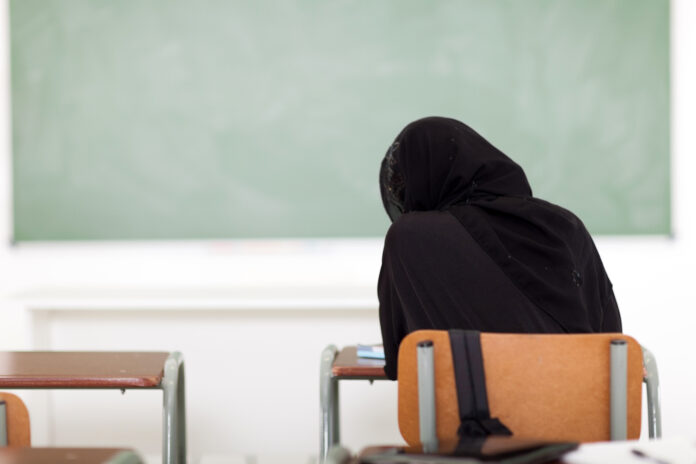
A teenage Muslim schoolgirl in India has been denied the right to wear her hijab to school after a High Court ruled she had failed to prove that wearing the headscarf constitutes an “essential religious practice” of Islam.
The ruling was issued by the Allahabad High Court in the northern Indian state of Uttar Pradesh and has renewed debate over religious freedom, Muslim women’s rights and school dress codes in India.
According to a consensus of Islamic scholars, hijab is obligatory on Muslim females once they reach puberty.
The case was brought by Sukaina Rizvi, who is 15 or 16, at Tagore Public School in Prayagraj. She had sought admission to Class 11 while asking to continue wearing a headscarf with the school uniform.
According to her petition, Rizvi had worn the hijab since childhood and had previously been allowed to wear it while studying at the same school from Classes 6 to 10.

She argued that preventing her from wearing the headscarf violated her fundamental rights under India’s Constitution, including protections for freedom of expression and freedom of religion.
A two-judge bench of the Allahabad High Court dismissed her petition.
Subscribe to our newsletter and stay updated on the latest news and updates from around the Muslim world!
The judges said that simply describing something as a religious practice was not enough to bring it within the protection of Article 25 of India’s Constitution, which guarantees freedom of conscience and the right to freely profess, practise and propagate religion, subject to constitutional restrictions.
The court said Rizvi had not provided sufficient factual or legal material to demonstrate that wearing the hijab was an essential practice of Islam, saying: “A claim, placing reliance upon Article 25 of the Constitution, cannot be accepted for the sake of mere assertion, without the necessary factual and legal foundation.”
Court backs school uniform policy
The court also upheld the school’s right to enforce its uniform policy, provided the rules are applied uniformly, genuinely and without discrimination.
It said a common uniform can help maintain discipline, institutional identity and what it described as a religion-neutral environment within an educational institution.
The school had argued that allowing an exemption for one student could create administrative and disciplinary difficulties. It also pointed out that other Muslim girls at the school were following the prescribed uniform.
The judges rejected the argument that Rizvi’s previous permission to wear the hijab meant the school could no longer change its policy.
The fact that the school had allowed her to wear the headscarf for several years, the court said, did not prevent it from subsequently enforcing its uniform rules.

India’s continuing hijab debate
The decision comes after years of legal disputes across India over Muslim students wearing the hijab in schools and colleges.
The Allahabad High Court referred to earlier judgments from the Karnataka, Kerala and Bombay High Courts.
It placed particular emphasis on a 2022 ruling by the Karnataka High Court, which held that wearing the hijab was not an “essential religious practice” of Islam and therefore did not qualify for constitutional protection under Article 25 in that case.
Meanwhile, the All India Muslim Personal Law Board has indicated that it is likely to challenge the Allahabad High Court ruling, potentially taking the case to the Supreme Court.
Maulana Khalid Rasheed Farangi Mahali, chairman of the Islamic Centre of India and an executive committee member of the AIMPLB, argued that hijab is an integral part of Islam supported by the Qur’an and Hadith, and said Muslim girls who choose to wear hijab should not be discriminated against at school. He has called for the ruling to be reviewed.
And Asaduddin Owaisi, of the All India Majlis-e-Ittehadul Muslimeen (AIMIM) and the MP for Hyderabad, described the judgment as an “attack on Islam”and questioned the judiciary’s role in determining what constitutes an essential Islamic practice.