


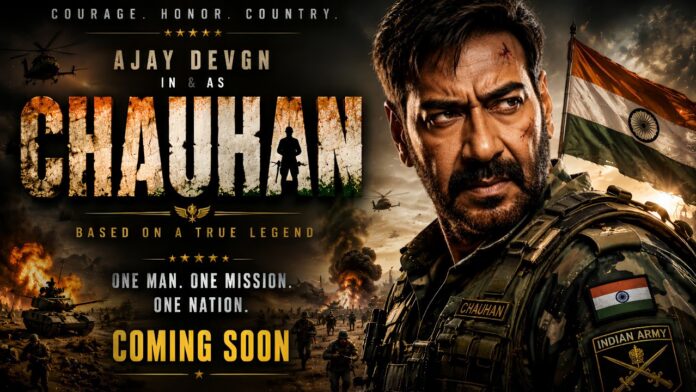
Judging by its trailer, the upcoming Bollywood movie Chauhaan looks set to turn the tragedy of Kashmir into another celebration of Indian state violence wrapped up in the language of patriotism.
When Indian billionaire Mukesh Ambani’s Jio Studios released the teaser for Chauhaan, an upcoming Bollywood film starring Ajay Devgn, it appeared to promise a familiar patriotic action drama.
Set during mass protests in Indian-occupied Kashmir, the trailer portrays Indian security forces confronting demonstrators and includes a line describing pellet guns and water cannons as causing only “limited damage.”
Within hours, the teaser had drawn sharp criticism from Kashmiris, journalists and activists, who accused the filmmakers of trivialising a weapon that has blinded or permanently injured thousands during more than a decade of unrest in the disputed region.
The debate, however, is about far more than a single line of dialogue. It raises a broader question about who gets to tell the story of Kashmir — and what happens when one of the world’s longest-running political conflicts is recast as a straightforward tale of patriotism, heroism and law enforcement.

Some critics have argued that Chauhaan will deepen hostility towards Kashmiris by portraying them primarily as violent agitators. That concern is understandable. But it is not the most compelling criticism of the film.
Depicting protesters throwing stones is not, in itself, historically inaccurate. Stone-pelting formed part of successive waves of unrest in Kashmir and has been extensively documented. The problem lies not in what the trailer shows, but in what it leaves out — and in the moral framework it asks audiences to embrace.
Subscribe to our newsletter and stay updated on the latest news and updates from around the Muslim world!
The teaser reduces a deeply-contested political conflict to an action spectacle. Protest is presented largely as criminal disorder. Security operations become uncomplicated acts of national duty.
The conflict is stripped of its political history, leaving little room for the grievances, aspirations or everyday realities of ordinary Kashmiris. Instead, viewers are invited to see the restoration of order as both the beginning and the end of the story.
Problematic framing
That framing matters because Kashmir has never been a conflict between two equal forces. It is a region that has lived under decades of heavy militarisation, with one of the world’s largest security deployments overseeing a civilian population.
Whatever one’s view of stone-pelting — and reasonable people disagree over whether it was legitimate protest or criminal violence — it is difficult to equate rocks with pellet-firing shotguns, armoured vehicles, tear gas, curfews and sweeping security powers.
The asymmetry is central to understanding the conflict. Yet the trailer transforms that imbalance into a familiar cinematic formula: heroic officers confronting violent mobs, with overwhelming state power recast as uncomplicated justice.
Its language reinforces that message. To describe pellet guns as causing only “limited damage” is not simply an imprecise turn of phrase. It sanitises one of the defining symbols of the Kashmir conflict.

Since pellet-firing shotguns were introduced for crowd control, journalists, doctors and human rights organisations have documented thousands of injuries, many involving permanent or partial blindness. Hospitals in the region became known for treating victims with hundreds of metal pellets embedded in their faces and eyes.
Behind those figures are lives irreversibly altered. To characterise such injuries as “limited” is not merely controversial; it diminishes a reality experienced by thousands of families.
Supporters of Chauhaan may argue that filmmakers have every right to tell stories from the perspective of soldiers and security personnel. They do. No conflict belongs exclusively to one side. But perspective is not the same as absolution.
Every film chooses what to illuminate and what to consign to the background. A trailer, in particular, is an exercise in persuasion. Its stirring music, triumphant dialogue and carefully staged action sequences are designed to shape emotion before audiences have seen the full story.
In Chauhaan, those emotional cues appear intended to celebrate the suppression of unrest rather than encourage reflection on the political conflict that produced it.
Impact of the film
That distinction matters because this is not an independent film with a limited audience. Backed by Jio Studios and fronted by one of Bollywood’s biggest stars, Chauhaan is likely to reach millions of viewers across South Asia, the Middle East, Africa and the global Indian diaspora.
Popular cinema does more than entertain. It shapes collective memory. For audiences with little knowledge of Kashmir, films like this often become the lens through which history itself is understood.
The casting of Mohammed Zeeshan Ayyub adds another layer to the conversation. Ayyub has earned widespread acclaim for portraying characters shaped by caste discrimination, communal violence and other forms of social injustice.
He has not publicly commented on the controversy surrounding Chauhaan, and there is no basis to speculate about his reasons for accepting the role. Nevertheless, his involvement has drawn attention because it appears to sit uneasily alongside a body of work associated with questioning dominant narratives rather than reinforcing them.

The debate also extends beyond the film itself. Chauhaan is produced by Jio Studios, part of Reliance Industries, the conglomerate controlled by Mukesh Ambani. Reliance also owns Campa, the soft drink brand that many politically conscious consumers have embraced while boycotting Coca-Cola and Pepsi over their perceived links to Israel’s war in Gaza.
Those campaigns rest on a simple principle: corporations should be held accountable not only for the products they sell but also for the political and cultural influence they exercise.
If that principle is to be applied consistently, it should not end with multinational companies operating overseas. Media corporations shape public opinion no less profoundly than consumer brands. Through the stories they finance and distribute, they influence how societies remember violence, whose suffering is recognised and whose experiences are pushed to the margins.
The comparison is not that Kashmir and Gaza are identical conflicts. Their histories, legal contexts and political trajectories are distinct. The comparison is about consistency. If consumers expect corporations to answer for narratives that normalise or legitimise violence elsewhere, it is reasonable to ask similar questions about narratives produced closer to home.
Ultimately, the question is not whether Bollywood should make patriotic films. It already does, and it likely will continue to do so. The more pressing question is what kind of patriotism contemporary Indian cinema increasingly asks audiences to celebrate.
Is patriotism strengthened by confronting uncomfortable histories in all their complexity, or by flattening them into stories of unambiguous national triumph? When popular cinema transforms political trauma into uncomplicated spectacle, it does more than tell a story. It shapes how future generations remember conflict — and, just as importantly, what they are encouraged to honour and what they are led to forget.