



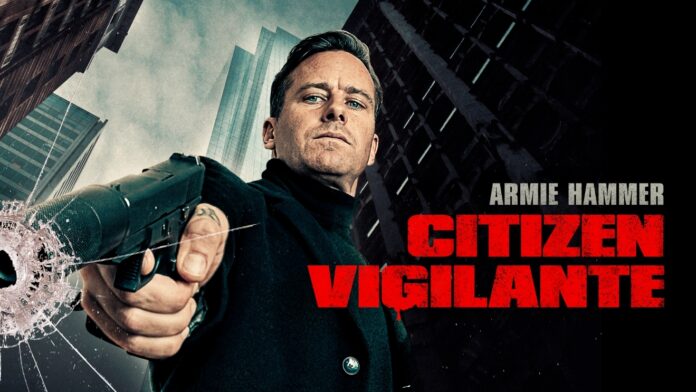
Amplified by Elon Musk, Citizen Vigilante is less an action thriller than a cinematic manifesto and call for violence against Muslims and migrants, writes Roshan Muhammed Salih.
If you live on social media, you can’t fail to have noticed the chat about Citizen Vigilante, the movie which has been banned in Germany and denied streaming platforms elsewhere. But no matter, the world’s richest man and several other far-right influencers have been streaming it for free for the viewing pleasure of the world’s racists and Islamophobes.
Citizen Vigilante is a clumsy, blood-soaked political manifesto masquerading as an action thriller, whose sole purpose is to persuade viewers that Western civilisation is under siege from migrants, Muslims and a weak liberal establishment, and that only strong government or violence can restore order.
Its central message is unmistakable: the state has failed, democracy has become impotent, and if the state doesn’t deliver justice then ordinary citizens will eventually take justice into their own hands.
Migration itself becomes synonymous with violent crime and rape, while Muslims are presented as uniquely incompatible with Western civilisation.

What makes it particularly disturbing is that the film does not merely explain why its protagonist becomes a vigilante; it repeatedly invites the audience to admire him. His actions are framed not as the tragic descent of a broken man but as the inevitable response of someone forced to do what politicians, judges and police refuse to do.
Even when he crosses obvious moral lines, the narrative repeatedly returns to the same justification: the system left him no choice or drove him to it.
Subscribe to our newsletter and stay updated on the latest news and updates from around the Muslim world!
That is what elevates Citizen Vigilante from an exploitative action movie into political propaganda. It asks viewers not merely to sympathise with its central character but to adopt his worldview: that liberal democracy has failed, immigration represents an existential threat and violence is becoming the only remaining language of justice.
The racist, Islamophobic plot
The film opens with an idyllic scene of a white mother shopping with her young child before she is brutally murdered by a black man presented as a migrant. Television news bulletins (GB News style) immediately follow, warning of rising migrant crime, creating the impression that society itself is collapsing under the weight of immigration.
Into this chaos steps Sanders, played by the American actor Armie Hammer, a former soldier and landlord who becomes a masked executioner. One by one he hunts down rapists, gangsters, extortionists and others whom he believes have escaped justice. He rapidly becomes an online folk hero, with supporters across Europe and North America celebrating his actions and demanding their own version of the “Citizen Vigilante.”

The film occasionally attempts moral complexity. Sanders also targets white criminals, stops men from drugging women and is portrayed as emotionally damaged rather than conventionally heroic. There are awkward attempts to humanise him through scenes that reveal loneliness, anger and personal flaws (like consorting with prostitutes in a building he owns).
The police detective pursuing Sanders functions as the film’s voice for the rule of law, insisting that institutions must be defended despite their imperfections. But this argument is repeatedly undermined by the narrative itself. Judges release rapists; police fail to protect victims; politicians appear weak or indifferent. Every institutional failure pushes the audience back towards Sanders’ conclusion that violence works where democracy does not.
The film’s final act removes any remaining ambiguity. Sanders confronts a Muslim family whose son has committed rape, delivers a lengthy speech attacking Islam, quotes the Qur’an as evidence of cultural incompatibility, and murders the entire family. He later delivers a final address warning of an “unfriendly takeover” by “Islamist extremists and the blindsided woke left,” urging ordinary people to take matters into their own hands if governments fail to act.
A poor film with a dangerous message
Cinematically, Citizen Vigilante is not a good film. The acting is uneven, the dialogue is frequently wooden, the production values are mediocre and many scenes drag unnecessarily. There are moments that appear inserted simply to pad the running time.
Yet dismissing the film as merely bad cinema would miss the point. Its significance lies in what it is trying to achieve.
Viewed generously, one could argue that the German director, Uwe Boll, is warning governments that when justice systems lose public confidence, vigilantism becomes an inevitable temptation.
But the film repeatedly goes further. It glorifies its vigilante, caricatures Muslims and migrants, and encourages viewers to see political violence as an understandable — even admirable — response to social change. By the closing scenes, the distinction between explaining vigilantism and advocating it has almost entirely disappeared.
If this film tells us anything, it is that the line between political fantasy and political violence is thinner than many would like to believe. The bullets fired in Citizen Vigilante are fictional; the ideas they seek to legitimise are anything but.