



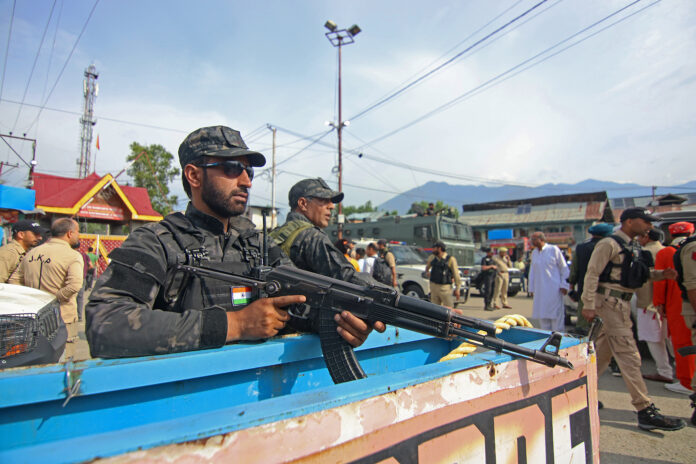
As India marks the seventh anniversary of its annexation of Kashmir, evidence is mounting that Pakistan is pursuing the same playbook in Azad Kashmir — using military force, economic exploitation and sham elections to crush a people who were promised freedom but are living under occupation, Kashmiri activist Javed Lone writes.
On August 5, 2019, India unilaterally revoked Article 370, stripping Jammu and Kashmir of its special constitutional status and formally “integrating” the region into the Indian Union. It was not merely a political or legal manoeuvre; it was backed by one of the largest military operations in the region’s modern history. India deployed 10,000 to 80,000 additional troops to the valley, imposed a total communications blackout, placed hundreds of political leaders under house arrest, and enforced a strict curfew that confined millions to their homes for weeks. The crackdown was brutal.
In the first two months, the Ministry for Home Affairs reported that 19 Kashmiri civilians had been killed. This figure increased drastically by the end of the year.
Pakistan condemned the move internationally as a “blatant violation of international law” and a “darkest day” for the Kashmiri people, describing the region as “the world’s largest open-air prison.”
Yet six years later, a parallel and equally ominous process is unfolding just across the Line of Control. The widespread protests that have engulfed Pakistan-administered Kashmir since mid-2026 have exposed a stark reality to the world: the territory many call “Azad” (Free) Kashmir is neither sovereign nor genuinely disputed, but a tightly controlled political occupation, with its final absorption into Pakistan appearing to be an accelerating, inevitable trajectory. Pakistan is replicating India’s playbook — not through a single constitutional stroke, but through the systematic dismantling of local autonomy, the violent suppression of dissent, and open declarations of intent to annex.

The legal fiction of “Azad” Kashmir
While Pakistan has long presented Azad Jammu and Kashmir (AJK) as an independent or disputed territory awaiting a UN-mandated plebiscite, its constitutional status tells a very different story. Technically, AJK is neither a province of Pakistan nor recognised under Pakistan’s 1973 Constitution. It has its own president, prime minister, and legislative assembly. Yet it lacks federal parliamentary representation and is denied the fundamental rights afforded to Pakistani provinces.
Subscribe to our newsletter and stay updated on the latest news and updates from around the Muslim world!

This arrangement has long served as a diplomatic tool for Islamabad. By preserving the “disputed” status, Pakistan could argue at the United Nations that Kashmir’s final status must be decided by a vote of the people. However, this legal fiction is rapidly crumbling under the weight of Pakistan’s own military establishment, which no longer bothers to hide its territorial ambitions.
The 2026 protests — a people’s rejection of the ‘Azad’ myth
Since early June 2026, Pakistan-administered Kashmir has been engulfed in unprecedented peaceful protests, prompting a violent response from Pakistani security forces. Between 40 and 60 civilians have been shot dead, exceeding the number of Kashmiris killed on the other side of the Line of Control during India’s annexation over the same period. What began as a movement over acute economic grievances — including crippling inflation, rising electricity tariffs, and subsidy cuts — quickly evolved into a direct and existential political challenge to Islamabad’s authority.
The Joint Awami Action Committee (JAAC) led the protests. By July, they had reached fever pitch. At a massive gathering at Rawalakot’s Eidgah Ground, protest leader Sardar Aman Khan directly challenged Pakistan’s foundational narrative. Addressing a crowd estimated at 80,000, he declared: “This is not a disputed territory… this is an occupied territory… it has been occupied.” He further asserted that “PoK is not a part of Pakistan” and that “it is Pakistan that desperately needs PoK.” Khan also stated that the region was “never truly Azad.”
The Pakistani state responded with extraordinary brutality. Federal paramilitary troops were deployed, the JAAC was banned under anti-terrorism laws, internet and communication blackouts were imposed, and main roads were blocked for weeks. These tactics mirror those used by India during its annexation of Jammu and Kashmir.
How Pakistan controlled AJK through the assembly and cabinet
To understand why the protests have escalated so violently, one must examine the elaborate illusion of autonomy that Pakistan constructed in AJK. For decades, Pakistan allowed AJK a separate president, prime minister, flag, and legislative assembly to maintain the pretence of self-governance.

However, real power has always resided exclusively in Islamabad. The federal government manages AJK’s strategic affairs through the Kashmir Council, chaired by Pakistan’s Prime Minister. The local AJK Assembly handles only basic day-to-day administration, while Pakistan retains absolute control over defence, foreign affairs, and key strategic decisions. This is the “Azad myth” — a system designed to create the illusion of freedom while ensuring Pakistan’s military establishment maintains a stranglehold over the region’s governance.
The 38 demands and the collapsing system
The JAAC presented a comprehensive 38-point charter of demands to dismantle this system of control. The demands included genuine constitutional reforms, greater local control over natural resources, electoral overhauls, and accountable governance.
In a desperate bid to de-escalate, the Pakistani government claimed to have accepted 35 of the 38 demands. However, the single unresolved issue is the deal-breaker: the abolition of 12 legislative assembly seats reserved for Kashmiri refugees currently living in Pakistan. These reserved seats allow Pakistan-based political parties to directly influence and manipulate the AJK government. Abolishing them would effectively cut Islamabad’s puppet strings and grant the territory genuine autonomy.
This is the red line Pakistan refuses to cross. Defence Minister Khawaja Asif labelled the protesters “anti-Pakistan” while speaking to journalists outside Parliament House in Islamabad, arguing that those challenging the state’s authority should be seen as “enemies of Pakistan.” The government flatly rejected all proposals for resolution. Conceding these demands would grant AJK the very sovereignty it claims to possess, and Pakistan has made it brutally clear it will never allow that. The state has chosen force over reform, revealing that its promise of freedom was always a hollow sham.
The economic and strategic chokehold — water and power
Why is Pakistan so reluctant to grant AJK autonomy? The answer lies in the rivers and mountains of the territory. Azad Kashmir is not only strategically vital as a buffer along the Line of Control; it is also Pakistan’s hydropower heartland.
The territory currently has an installed hydropower capacity exceeding 2,642 MW, connected to the national grid, including the massive 1,310 MW Mangla Dam and the 969 MW Neelum-Jhelum project. It generates approximately 3,500 MW of low-cost hydropower — roughly 10% of Pakistan’s total installed capacity — and has untapped potential to generate a staggering 9,000 MW.
Furthermore, the rivers originating in Kashmir are lifelines for Pakistan’s agriculture, industry, and economic stability. AJK sits adjacent to major infrastructure arteries linking Islamabad to the China-Pakistan Economic Corridor (CPEC) routes. Pakistan provides billions in annual grants and subsidies to AJK, but extracts far more in hydropower, water resources, and strategic positioning.
Greater autonomy would mean AJK controlling its own water and electricity — a scenario that would cripple Pakistan’s national grid and economy. Islamabad will never allow this to slip from its grasp.
The leadership’s rhetoric: The blueprint for absorption
While Pakistan’s civilian government plays for time, the military establishment has abandoned all diplomatic pretences. In recent months, Pakistani officials have openly declared that Kashmir is destined to become part of Pakistan, cementing the annexation agenda.
Army Chief’s Vision: During a visit to Muzaffarabad in July 2026, Chief of Army Staff General Syed Asim Munir reportedly stated unequivocally: “Without any doubt, Kashmir will be free one day and part of Pakistan as per the free will and destiny of the people of Kashmir.”
The ‘Jugular Vein’ Rhetoric: Railways Minister Muhammad Hanif Abbasi referred to Kashmir as the “jugular vein of Pakistan” and accused local activists of “pursuing the enemy’s agenda.”
The Military’s Internal Admission: Perhaps the most damning evidence comes from an audio leak reported by activist Shaukat Nawaz Mir, in which Muzaffarabad Sector Pakistani Army Commander Brigadier Faiq Ayub is quoted as telling local leaders: “AJK is not a country but our occupied territory. We occupied it by sending tribal men and the army. Now we are going to integrate the occupied territory into our various provinces.” This refers to Kashmir’s status as an independent princely state at partition in 1947. The tribal invasion prompted the ruling Maharajah to sign an accession to India in return for military assistance.
Annexation: The era of military occupation — India, Israel, and Pakistan
Three parallel occupations now define our era. India annexed Jammu and Kashmir through a constitutional coup in 2019, backed by the deployment of tens of thousands of troops, a total communications blackout, and a violent crackdown that left more than 300 people dead. Israel continues its brutal occupation and ethnic cleansing of Gaza and the West Bank, denying Palestinians a state. And now, Pakistan is integrating Azad Kashmir — not through a single legal amendment, but through the systematic dismantling of local autonomy, the violent suppression of dissent, sham elections, and open declarations of military intent to absorb it.
The Kashmiri people, on both sides of the Line of Control, have been manipulated under the guise of so-called autonomous assemblies. They face a cruel, unifying fate: divided by a border yet united under occupation. They are denied self-determination by powerful military states that view them not as a people with rights but as strategic assets to be exploited.
For the people of Kashmir, the dream of freedom remains forever deferred, crushed between the strategic ambitions of armies, the economic greed of hydropower projects, and the hollow promises of flags that purport to represent them. August 5, 2019, was a tragedy for Indian-held Kashmir. Yet what is unfolding today in “Azad” Kashmir shows that the Kashmiri people are destined to be pawns in a geopolitical game they never chose to play, as powerful states relentlessly carve up their homeland.
AJK Kashmiris ask why the army and government — whom they looked up to as their protectors and elder brothers — have behaved this way in recent weeks. The answer is simple: it is the beginning of annexation, India-style.
Javed Lone is a Kashmiri activist and protester.