


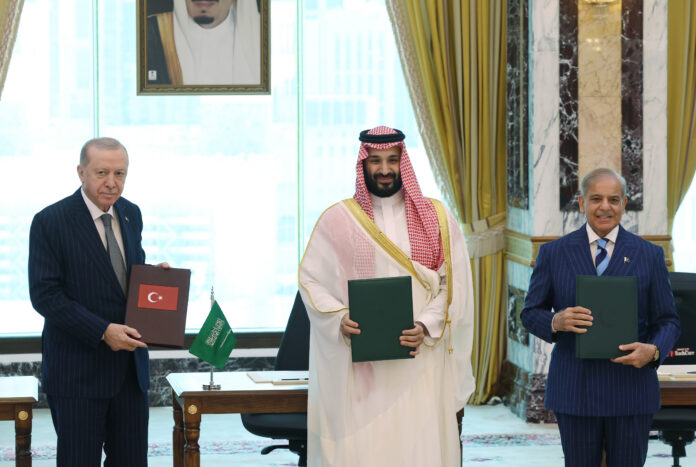
Muslim activist Abdul Wahid argues that the recent security agreement signed in Makkah between Saudi Arabia, Turkey and Pakistan has too many questions to start celebrating it as a giant step for Muslim unity.
The Muslim is, by disposition, an optimist. He believes in the Promise of Allah — that even events which appear ill-intentioned can be turned by the Almighty towards something good.
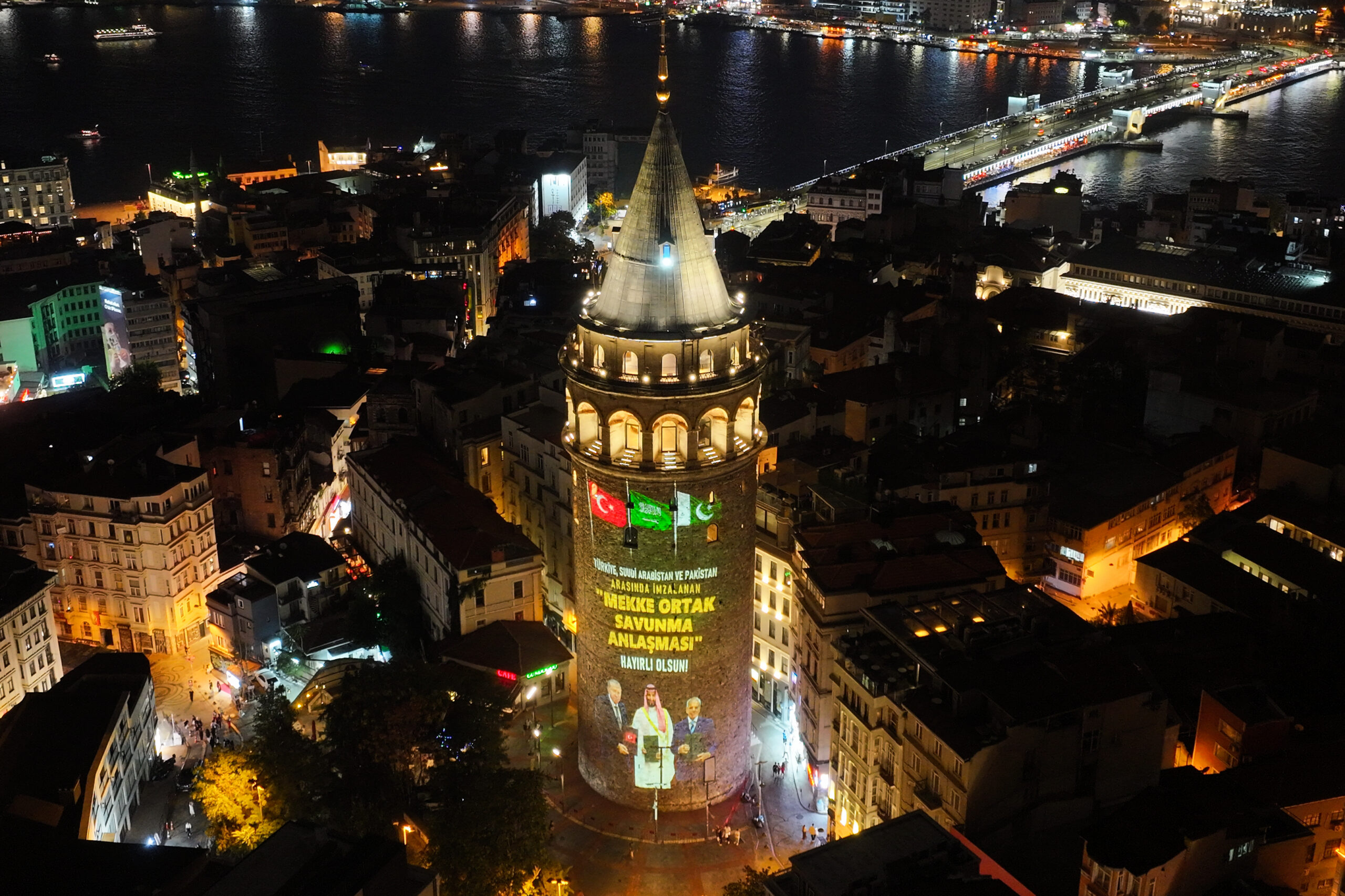
So prayers for the Makkah Joint Defence Agreement, signed on 7 August 2026 between Saudi Arabia, Turkey and Pakistan, upon this basis, are not unreasonable. We welcome anything that brings more unity among Muslims — whether that unity is security-based, economic or political.
For decades we have been told, implicitly and explicitly, that unity among Muslim-majority states is a fantasy, that the divisions created a century ago are permanent facts of geography and politics. Any development that challenges this would be seen as positive.
But welcoming the spirit of a thing is not the same as being naive about its substance. And when we turn from the language of the agreement to the politics surrounding it, a dose of realism is needed.

What, exactly, is ‘concrete’ about this deal?
Former Pakistani diplomat Asif Durrani described the pact as “first concrete building block of an emerging regional security architecture for South and West Asia.”
Subscribe to our newsletter and stay updated on the latest news and updates from around the Muslim world!
It’s a striking claim. But what, precisely, is concrete about it?
The joint statement issued in Makkah declares that an attack on one signatory will be treated as an attack on all — language that deliberately echoes Article 5 of the NATO treaty. Officials in Riyadh, Ankara and Islamabad have all stressed that the pact is purely defensive, not targeted at any state, and open to others who wish to join.
Yet beyond that headline commitment, the actual text of the agreement has not been published. Analysts covering the deal have repeatedly noted that its precise obligations — what kind of response is triggered, on what scale, under what circumstances — remain undisclosed.
A promise to treat an attack on one as an attack on all is only as solid as the mechanism that gives it teeth, and so far we have been shown no mechanism at all.
Whose Article 5 wins?
NATO itself has proved to be a fragile alliance. So to mimic NATO is a flawed strategy at the outset.
Moreover, NATO has been over-reliant on the US – the only global superpower – for its defence. The other members alone have struggled to contribute meaningfully to the war in Ukraine.
So how capable would Pakistan be to deploy support to Saudi in its conflict with Yemen? Or Saudi and Turkey, if Pakistan were in conflict with India?
And how willing would, for example, Saudi be to jeopardise its trade relations with India.
Turkey is already bound by Article 5 of the NATO treaty. Should a genuine crisis force a choice between NATO obligations and Makkah obligations, which commitment takes priority? Nobody has said. Perhaps no one needs to.
Saudi Arabia, meanwhile, continues to host American military bases, as do the other Gulf states. If this new pact is meant to represent a serious alternative security guarantee, will Riyadh now ask Washington to withdraw those forces, having concluded — as commentary around the deal suggests — that the United States has proven unwilling or unable to offer real protection? There is no sign of that happening.
Pakistan, for its part, remains tied to Washington through substantial economic assistance. Is Islamabad genuinely prepared to act independently of American interests to support Turkey — for instance, if Ankara found itself in confrontation with “Israel” over Syria? The honest answer, based on the pattern of Pakistani foreign policy over its entire existence is that it would not.
These are not idle questions. They cut to the heart of whether any of these three nation states would actually mobilise militarily to defend the others if attacked, or whether the pact amounts to what one sceptical commentator has bluntly called “deterrence theatre” — strong words on paper, but no automatic troop deployments, no joint command structure and no binding timelines behind them.
Another analyst made a similar point after the signing: even in an entirely plausible scenario of a Saudi-Iran clash, it would be unwise to assume Ankara and Islamabad would treat it as an attack on themselves – other than tweeting in each other’s support.
More troubling still is the scenario in which Pakistan and Turkey find themselves drawn into a wider confrontation with Iran — a conflict whose roots lie not in Muslim disunity but in a war effectively begun by America and Israel.
Would this agreement genuinely serve the Ummah, or would it simply conscript more Muslim countries into a fight not of their own choosing?

Who really benefits?
The deep strategic ties that all three signatories already maintain with Washington point strongly towards this being an arrangement Washington has sanctioned rather than one designed to displace it.
Commentary from a former US ambassador has framed the deal as evidence that American allies increasingly doubt US reliability — yet, tellingly, that same commentary noted the absence of any visible American “fingerprints” on it.
The Gulf states have watched, repeatedly, as the United States failed to deliver the protection it long promised. A pact like this can serve a useful function for Washington: it lets regional partners absorb more of the burden of their own defence, without requiring America to withdraw the deeper structures of influence — bases, arms sales, intelligence-sharing — that keep it embedded in the region.
That raises the real question: does this pact represent genuine appetite among these states for a security order fundamentally different from the status quo, or is it simply a more efficient way of managing that same status quo? And how, if at all, does it address the underlying stalemate between an emboldened Iran and the American-Israeli axis — a war that has already drained US missile stockpiles to the point where the Pentagon is now demanding accelerated weapons production from its own contractors?
A genuine regional security architecture — one built on more than photo opportunities in Makkah — would not treat Iran as the implicit hostile element. It would work with Tehran, not against it, for the sake of regional peace and it would recognise plainly that American power in the region is at its lowest ebb in a generation.
The irony of history
There is a bitter irony worth considering. A century ago Britain and France carved up the lands of the Ottoman state, drawing the borders that separated what is now Saudi Arabia from what is now Turkey, and consigning the wider Muslim world to division under mandates and spheres of influence.
Today, the descendants of those same divided territories stand together in Makkah, at least speaking the language of unity.
That the Muslim world has any need to reunite what was deliberately broken apart by outside powers is itself a reminder of who benefited most from disunity in the first place — and a reason for caution about accepting, once again, a security architecture built substantially on terms set by those same outside powers, however unity-shaped the packaging may be.
Optimism in the Promise of Allah does not require us to suspend judgement about the world as it is.
We can hope that any gesture of unity in Makkah could possibly turn into something better, while honestly insisting that gestures of nation states, that swim in the waters of US strategy, are not a guarantee of anything.
Abdul Wahid has been active in Muslim affairs in the UK for over 25 years. He has been published on the websites of Foreign Policy, Open Democracy, the Times Higher Educational Supplement, and Prospect Magazine. You can follow him on X/Twitter @AbdulWahid_X.
This article first appeared on his Substack.