



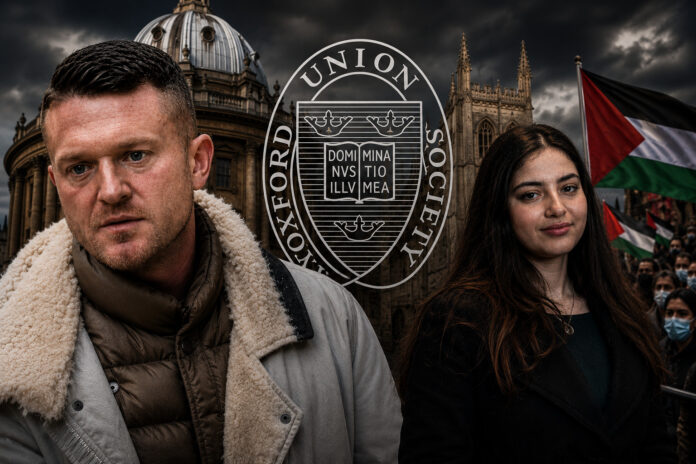
Roshan Muhammad Salih reviews the recent Oxford Union debate on Islam featuring Tommy Robinson and argues that, despite some strong contributions from the Muslim speakers, the debate should never have taken place.
Six weeks after it took place amid heated protests, the Oxford Union has finally released the “Is the West Right to be Suspicious of Islam?” debate on its YouTube channel.
But after spending two and a half hours watching the debate, I came away with exactly the same view I had before it started: it should never have taken place.
In fact, I am now convinced that it only happened because the Oxford Union student leadership wanted to platform themselves through a high-profile debate, regardless of the damage it could cause to community relations.
It was a profoundly selfish and immature decision. Not because Islam shouldn’t be debated, but because there is a difference between debating Islam in an academic setting with experts and giving a bunch of dangerous Islamophobic clowns a prestigious platform to spout their bile.

Unsurprisingly, the debate itself produced nothing intellectually new. Tommy Robinson and the other anti-Islam speakers repeated the same arguments they have been making for years, focusing on ISIS, homosexuality, Aisha, selective quotations from the Qur’an and isolated examples of Muslim extremism.
The Muslim speakers largely answered those arguments well, although I thought some of them were unnecessarily apologetic in places. Arwa Elrayess was probably the strongest speaker, while Abdullah Al Andalusi and Brother Dowie made important points about the double standard of blaming Islam for every crime committed by a Muslim while never attributing Muslims’ positive contributions to their faith.
Subscribe to our newsletter and stay updated on the latest news and updates from around the Muslim world!
So in the end, nobody learned anything new about Islam, but Tommy Robinson gained something valuable: greater legitimacy and the ability to clip his contributions at the Oxford Union for years to come.
The usual anti-Islam tropes
One thing became abundantly clear as the debate progressed: the anti-Islam speakers relied on a familiar collection of arguments that anyone who has followed discussions about Islam over the past decade has heard countless times before.
Tommy Robinson, Jonathan Sacerdoti and, to a lesser extent, Lawrence Fox focused on ISIS, homosexuality, the age of Aisha, selective quotations from the Qur’an and examples of Islamist terrorism.
More importantly, they all employed essentially the same tactic. Rather than engaging with Islam as a religion or with the lived reality of Britain’s Muslim population, they repeatedly highlighted the actions of a small number of extremists and extrapolated from those examples to Islam itself.
ISIS became representative of Islam. Terrorist attacks committed by individuals became evidence against nearly two billion Muslims. Criminal acts carried out by people who happened to identify as Muslims were presented as though they reflected the essence of the religion.

This is a profoundly flawed way of analysing any faith. No one would judge Christianity solely by the actions of Anders Breivik or the Lord’s Resistance Army. Judaism is not assessed exclusively through the actions of Israel, nor Hinduism through the crimes of Hindu nationalists.
Every other major religion is understood to contain a distinction between its teachings, its mainstream followers and its extremists. Yet Islam is routinely denied that distinction.
I also found that much of the criticism ignored an important practical reality. Tommy Robinson spent considerable time discussing traditional Islamic teachings on issues such as homosexuality, sexual morality and criminal punishments.
People are, of course, free to disagree with those teachings. But the overwhelming majority of Muslims in Britain are not attempting to impose them on wider society. Robinson blurred the distinction between theological belief and political programme, creating the impression that ordinary British Muslims are seeking to transform Britain into an Islamic state. That simply does not reflect reality.
Perhaps the most revealing aspect of the evening was the contrast between how Tommy Robinson and Lawrence Fox behaved inside the Oxford Union and how they conduct themselves online. In the debating chamber they appeared measured and courteous. Both repeatedly thanked Arwa Elrayess for giving them a platform.

Yet anyone familiar with their online presence knows that this civility is not how they normally engage with Muslims. On social media they routinely use inflammatory rhetoric that encourages hostility towards Islam and Muslims.
Seeing them adopt the language and mannerisms of respectable public intellectuals inside the Oxford Union was, if anything, more troubling than their speeches themselves. It demonstrated how a prestigious institution can sanitise figures whose public careers have otherwise been built on division.
However, one moment that particularly disturbed me was when Lawrence Fox insinuated that he was about to display an insulting cartoon of the Prophet Muhammad ﷺ. In the end, he did not show it, claiming it was merely a joke. But that was almost beside the point.
What concerned me far more was that the Oxford Union had ruled that he would have been permitted to display it. That revealed a serious failure of judgement. An institution committed to serious intellectual debate should recognise the difference between robust criticism and gratuitous provocation.
Allowing a deliberately offensive image would have contributed nothing to the discussion about Islam; it would simply have inflamed tensions and distracted from the issues under debate. More than anything else, the incident reinforced my impression that the organisers were too willing to prioritise controversy and spectacle over thoughtful discussion.
The pro-Islam speakers
The Muslim speakers generally acquitted themselves well. They successfully exposed the central weakness in the anti-Islam case: the repeated attempt to judge Islam through the actions of a tiny minority of extremists while ignoring the beliefs and conduct of the overwhelming majority of Muslims.
Time and again, they demonstrated how Qur’anic verses had been quoted selectively and how isolated examples of criminality were being unfairly extrapolated to an entire faith.
For me, Arwa Elrayess delivered the strongest speech of the evening. She systematically dismantled many of the opposition’s arguments, particularly their selective use of scripture and their attempts to conflate extremist groups with Islam itself.

However, I remain uncomfortable with the fact that she was instrumental in facilitating the debate in the first place. I also felt that her comments on the age of Aisha drifted into apologetics, attempting to make Islamic history more acceptable to modern Western sensibilities rather than defending the tradition honestly.
Brother Dowie was perhaps the most unfortunate speaker because he was interrupted so frequently that he never managed to establish a proper rhythm. Despite that, he finished strongly by highlighting the positive contribution Islam makes to society and pointing out the glaring double standard whereby every crime committed by a Muslim is blamed on Islam, while the countless good deeds performed by Muslims are never attributed to their faith.
Abdullah al-Andalusi also identified the recurring tactic employed by Islam’s critics: taking the behaviour of individual Muslims and generalising it to Islam as a whole. That observation went to the heart of the debate.
By the end of the evening, I was left with the impression that they had answered the substance of the anti-Islam case far more effectively than the opposition had engaged with the reality of Islam or the lives of ordinary Muslims.
The publicity-hungry students
One of the more surprising aspects of the evening was the prominence given to the Oxford Union students themselves. Rather than simply facilitating the debate, introducing the speakers and managing the proceedings, they were afforded considerable time to express their own opinions.
I found myself wondering why their views should carry such weight. They are entitled to their opinions, of course, but they possess no particular expertise on Islam or community relations. At times, it felt as though the organisers were as interested in showcasing themselves as they were in hosting a serious debate.

That impression only grew stronger as the evening went on. I came away with the feeling that the student leadership had organised this debate because they wanted to be associated with one of the year’s biggest controversies.
They seemed to relish the publicity and prominence that came with hosting such a high-profile event, without fully appreciating the wider consequences of their decision. Even those Muslim students who defended Islam during the debate shared responsibility for creating the platform in the first place.
The decision to invite Tommy Robinson was not simply an internal matter for a debating society. It had implications for millions of British Muslims and for the wider public discourse about Islam. I simply do not believe that a small group of undergraduate students, however intelligent or well-intentioned, should have been making a decision of that magnitude.
It was a judgement that required maturity, experience and a deeper appreciation of the responsibilities that come with conferring legitimacy on controversial public figures. In my view, the Oxford Union student leadership mistook publicity for principle, and in doing so handed Tommy Robinson exactly the mainstream platform he had been seeking.
Who really won?
Was the debate entirely without value? Some of the Muslim speakers made thoughtful and persuasive contributions, and it is also possible that some viewers unfamiliar with Islam may have been encouraged to look beyond the headlines and research the religion for themselves. If so, that would be a positive outcome.
But any such benefit has to be weighed against the cost of granting mainstream legitimacy to figures whose public careers have been built on portraying Muslims as a problem to be solved rather than fellow citizens to be understood.
In the end, I do not believe the Oxford Union advanced public understanding of Islam. I believe it gave Tommy Robinson exactly what he wanted: another opportunity to present himself as a legitimate participant in mainstream public life. For me, that is the lasting legacy of this debate.
And although supporters of the motion may ultimately have lost the debate inside the chamber, they arguably won the battle that mattered most. If the measure of success is influence and exposure rather than the result of a vote, then Tommy Robinson emerged as the evening’s biggest beneficiary.
In the days following the debate, his speech attracted by far the largest audience on the Oxford Union’s YouTube channel, far exceeding the attention given to the other speakers. That was entirely predictable.
Whatever happened inside the debating chamber, the debate handed him a prestigious platform and vastly amplified his message. I have little doubt that he and his supporters will regard that as a victory. In that sense, the Oxford Union gave him exactly what he wanted: not necessarily a debating triumph, but greater legitimacy and a wider audience.