

Fero Imen urges the leaders of Afghanistan to stand firm in rejecting imperial feminism but to also follow Islam’s commands to educate everyone, regardless of gender.
We Afghans are a peculiar people – hard to understand, harder still to break. Politically fragmented yet inwardly bound by pride, honour and faith, we are a multi-ethnic nation that has resisted every empire that tried to tame us. None of them – not the British, the Soviets, nor the Americans – ever truly grasped Afghanistan’s heart.
As former U.S. President Donald Trump once remarked: “The Taliban — they’re good fighters, I will tell you, good fighters. You have to give them credit for that.” (Fox News, August 17, 2021).
He acknowledged what many of us have always known: this land is not easily conquered, and its defenders are shaped by more than force alone. For the Afghan heart beats with Islam, echoing through the mountains and the minds of those who guard their principles like sacred trust.
I am Pashtun – daughter of a man who once served as a prosecutor in the Communist Party, granddaughter of a scholar and fighter, niece of a mujahid who fought against the Russians. In this fusion of book and rifle, of intellect and defiance, lies the Afghan spirit. We are a people who have never fully bowed – not to foreign powers, nor to foreign ideas. And despite all upheaval, we have never turned our backs on faith.

I grew up in the West, far from the land of my ancestors. Many of my generation have lost their roots – our language faded, our traditions softened, our beliefs blurred. But I could never forget. For Islam was never merely a religion to me; it was a bridge – a living connection to the women who came before me: proud, resilient, God-conscious.
Imperial feminism
Subscribe to our newsletter and stay updated on the latest news and updates from around the Muslim world!
The war that was sold as a “fight against terror” carried another, more insidious mission – that of imperial feminism: the notion that Muslim women must be saved from their men, their culture, and their religion.
What was framed as liberation was, in truth, another layer of occupation – cultural this time. Afghan women were made into symbols, props in a Western narrative of salvation. But many of us saw through that illusion. We understood that beneath the veil of “women’s rights” lay a familiar colonial pattern: the conquest of the native mind through the body of its women.

Feminism – a word more than a century old – has never carried a single meaning. It has always reflected its context. In Europe, it arose from industrial struggles and social reform; elsewhere, it took on local faces.
But in Afghanistan, it was an import – a framework alien to the rhythm of our lives. For Afghan women have always known strength. Their resilience was never born of slogans, but of faith and survival.
In Islam, dignity does not mean copying men or dismantling hierarchy. It means assuming responsibility, seeking knowledge, and embodying justice.
Islam does not flatten difference; it harmonises it. Men and women are distinct, yet equally vital.
Allah says in the Qur’an: “Men are protectors and maintainers of women because Allah has given one more (strength) than the other and because they support them from their means.” [4:34]
This is not a declaration of superiority but a charge of responsibility. Where men abandon that duty, injustice follows. Where women forget their dignity, chaos grows. Islam is not the problem; the corruption of its principles is.
Pashtunwali
The Pashtun code of honour, Pashtunwali, carries echoes of the same ideals: honour, justice, hospitality, and protection of the weak. But years of war, illiteracy, and power abuse have warped both tribal and religious values. Somewhere between guns and decrees, mercy was lost.
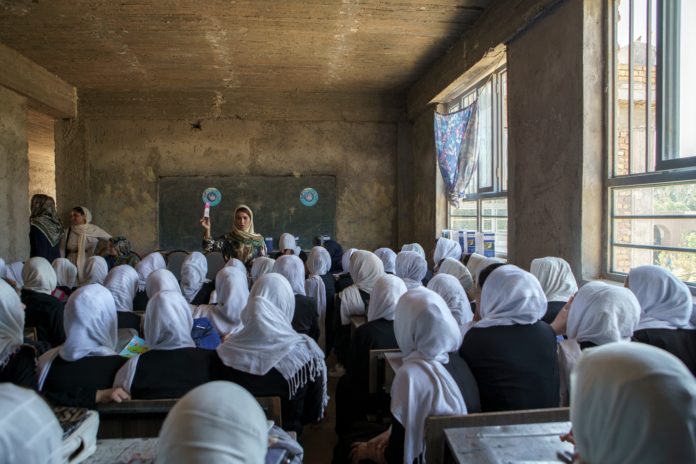
I once spoke with a Taliban spokesman on the day the ban on girls’ education was announced. To my surprise, his tone was sorrowful. “This decision,” he said, “does not represent us all.” Even within the movement, there are men who know that education is not a Western privilege but an Islamic command.
The Prophet Muhammad ﷺ said: “Seeking knowledge is an obligation upon every Muslim, male and female.”

That is the heart of the matter. Education is not rebellion against tradition; it is its lifeblood. Yet Afghanistan today is torn between two visions: one that sees Islam as dynamic and renewing, and another that imprisons it within the fears of the past.
Can Pashtunwali and Islamic education coexist? I believe they can – if we return to intention, knowledge and justice. No society thrives in ignorance. No woman fulfils her potential in darkness. And no man leads rightly without understanding.
Authority, as Islam defines it, is not power but stewardship. It is inseparable from mercy, loyalty and humility. When these virtues disappear, authority decays into tyranny. Then the critics are right.
Western feminism, reacting to patriarchal abuse, sought absolute equality – but absolute equality is neither natural nor possible. Men and women are different not in worth, but in essence and purpose. When all roles dissolve, responsibility dissolves with them. A world where everyone is everything becomes a world where no one is accountable.
Islam teaches balance – between hierarchy and compassion, between authority and love. A society that preserves this balance does not need imported ideologies; it needs knowledge, both sacred and worldly.
The tragedy of Afghanistan lies not in its tradition, but in its stagnation. Learning became a threat instead of a source of strength. Yet the real enemy was never education – it was fear. Fear of losing control, fear of foreign influence, fear of thinking beyond the familiar.
Two extremes
Today, Afghan women stand between two extremes. On one side, Western voices that turn them into symbols of liberal triumph – independent but uprooted. On the other, those who confine them behind walls – protected but silenced.
Both miss the essence: knowledge. Knowledge is light. It is the difference between authority and arrogance, between faith and fanaticism.
Islam began with a single word: “Iqra” – “Read.” That was not a command to men alone, but to all humanity.
And so I say to my sisters – in Kabul, Herat, Kandahar, Hamburg, Toronto and Istanbul: Do not forget who you are. We are the daughters of women who sought knowledge when learning was forbidden. We are the heirs of a faith that sanctifies understanding. We are not Western constructs, not victims, not ornaments of resistance. We are believers – and our power lies not in opposing Islam, but in living it fully.
If we wish to change the world around us, we must learn, think and act – with clarity, humility, and purpose. The future of Afghanistan does not belong to those who rule by force, but to those who enlighten through knowledge.
Fero Imen is an Afghan writer and researcher whose work explores the intersections of Islam, politics, and identity in post-colonial societies.