An antisemitism inquiry into the National Health Service has sparked headlines over the banning of pro-Palestine symbols, but its real significance is its far-reaching proposals that aim to crack down on political dissent, writes Omar Hassan.
The Mann Inquiry, released last Thursday, is a government-commissioned review into antisemitism and other forms of racism in the NHS, led by Lord John Mann.
It found evidence of antisemitism affecting some Jewish NHS staff and patients and made a series of recommendations aimed at tackling discrimination across the health service.
Its most controversial proposals include restricting political symbols in patient-facing settings, strengthening regulatory oversight, and giving bodies such as the General Medical Council and Professional Standards Authority greater powers in disciplinary matters.
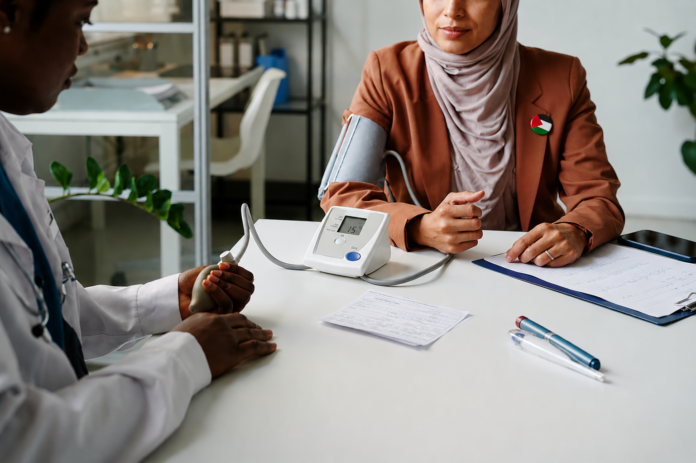
Much of the media coverage has focused on one recommendation: that NHS staff should not display political symbols, whether related to Palestine, Israel, political parties or other causes, while engaged in patient-facing work.

The reaction has been predictable. Some see it as an attack on freedom of expression. Others welcome it as a necessary step to ensure patients feel safe and confident when seeking healthcare.
Many healthcare professionals appear willing to accept a blanket prohibition. If the principle is that NHS staff should not display political affiliations while caring for patients, then consistency demands that all political symbols be treated equally.
Subscribe to our newsletter and stay updated on the latest news and updates from around the Muslim world!
Yet by focusing almost entirely on badges and symbols, we risk overlooking recommendations that could have far greater consequences for healthcare professionals and the regulation of medicine.
Why is antisemitism more important than other forms of racism?
Perhaps the most revealing aspect of the inquiry is its title: The Mann Review of Antisemitism and Other Forms of Racism.
The wording appears to establish a hierarchy in which antisemitism is treated separately from, and implicitly above, other forms of racism. This is despite evidence within the report showing that discrimination affects multiple groups within the NHS workforce, including Muslim, Black and other ethnic minority staff.
If the objective is truly to tackle racism in all its forms, it is legitimate to ask why one form of racism is singled out while others are grouped together as an apparent afterthought. The result is an impression that the inquiry is not primarily concerned with racism as a whole, but with a particular form of racism that has been given greater prominence.
That perception matters. Effective anti-racism work depends on consistency. Staff and patients who experience Islamophobia, anti-Black racism or other forms of discrimination may reasonably question why their experiences appear to attract less attention despite evidence that such problems are also widespread.
If all forms of racism are to be treated equally, they should receive equal prominence, scrutiny and urgency.

Why just the NHS?
The inquiry was commissioned in the aftermath of the horrific attack on a synagogue in Manchester. While antisemitism is a serious issue that deserves investigation wherever it occurs, there remains a legitimate question about the connection between that attack and the NHS regulatory system.
The inquiry argues that evidence from NHS data, Home Office statistics and regulatory cases justified scrutiny of healthcare institutions. However, if concerns exist about discrimination across public life, why has the NHS become the primary focus? Are equivalent investigations taking place across other major public institutions?
The NHS is undoubtedly an important institution to examine. Yet many healthcare professionals will view the inquiry through the context of recent complaints campaigns and disciplinary referrals linked to political expression surrounding Israel and Palestine.
For them, the inquiry may appear less like a broad examination of racism and more like an extension of an already highly-politicised debate.
The false assumption of bias
A central argument of the inquiry is that some patients may avoid seeking care because they perceive NHS staff to be politically biased.
Everyone would agree that patients should feel safe accessing healthcare. Jewish patients should have confidence that they will receive exactly the same standard of care as everyone else. Equally, Muslim, Hindu, Sikh, Christian, atheist and all other patients deserve the same reassurance.
However, the inquiry appears to make a significant leap: that displaying a political symbol can reasonably lead patients to question whether a clinician will provide impartial care.
If a Palestine badge creates anxiety for one patient, what about an Israel badge for another? What about religious symbols, LGBT lanyards, poppies, national flags or political party insignia?
At what point does concern about perception become an assumption that healthcare professionals cannot separate their personal beliefs from their professional duties?
The overwhelming majority of NHS staff provide care to people whose beliefs, politics and lifestyles differ from their own every day.
Free speech and the IHRA definition of antisemitism
The inquiry’s endorsement of the controversial International Holocaust Remembrance Alliance (IHRA) definition of antisemitism also raises concerns.
While true antisemitism must be identified and challenged wherever it occurs, critics have long argued that the IHRA definition can blur the distinction between genuine antisemitism and legitimate criticism of Israel or Zionist political ideology.
This is particularly relevant where healthcare professionals expressing support for Palestinian rights insist their criticism is directed at government actions rather than Jewish people.
If anti-Zionism, opposition to Israeli government policies or advocacy for Palestinian self-determination are increasingly treated as evidence of antisemitism, there is a risk that legitimate political expression will be chilled and disciplinary processes politicised.
The broader concern is freedom of expression. NHS staff are rightly expected to provide impartial care, but there is an important distinction between regulating conduct that affects patient care and restricting lawful personal beliefs.
Recommendations relating to political symbols, social media activity and public expressions of support for controversial causes risk creating uncertainty about where the boundaries of acceptable speech lie. In practice, this may encourage self-censorship among healthcare professionals who fear complaints, investigations or regulatory action.
The challenge is ensuring that efforts to tackle racism do not inadvertently create a framework that discourages lawful speech and legitimate political expression.
The real issue: Expanding regulatory powers
So the badge debate may be a distraction and the more consequential recommendations concern professional regulation.
Among them are proposals to strengthen the ability of bodies such as the GMC and the Professional Standards Authority (PSA) to challenge decisions made by independent fitness-to-practise tribunals.
The purpose of these tribunals is to provide an impartial assessment of evidence. If an independent tribunal reaches a decision, why should regulators be given greater powers to challenge outcomes they dislike?
The justification may be accountability. However, many doctors, particularly ethnic minority doctors, will see a different issue: who exercises that power and whether sufficient safeguards exist.
We already know that ethnic minority doctors are disproportionately referred to the GMC and more likely to face sanctions once referred. Concerns have also been raised about how cases are handled after entering the regulatory system.
If racism within healthcare regulation is genuinely a concern, then reform of the GMC itself should arguably be central to the discussion. Instead, the inquiry appears to recommend expanding the powers of institutions that many already perceive as lacking fairness and proportionality.
The inquiry also broadens the scope for investigations beyond clinical performance and proposes removing the five-year limitation period, allowing historical allegations to be revisited indefinitely.
Measures introduced in the name of tackling discrimination could therefore risk reinforcing existing inequalities.

Politics in the NHS — or Politics Through Regulation?
The inquiry repeatedly calls for politics to be removed from the NHS. Yet some recommendations move decision-making closer to bodies ultimately connected to government structures. For example, the PSA oversees healthcare regulators and is accountable through the Department of Health and Social Care.
This creates an obvious question: how can we claim to be removing politics from healthcare while simultaneously increasing the influence of bodies that sit closer to government oversight?
The badge recommendation has become the headline because it is visible, emotive and easy to understand. Yet the debate is too important to be reduced to what NHS staff wear.
The larger questions concern regulatory overreach, due process and institutional fairness. These recommendations may ultimately have far greater consequences for healthcare than any badge ever could, particularly for those who already feel disproportionately targeted by complaints processes.
Whether one supports or opposes restrictions on political symbols, the public should be asking a larger question: are these recommendations genuinely about protecting patients from discrimination, or are they creating mechanisms that make it easier to pursue healthcare professionals for expressing controversial views?
That is the debate we should be having.
Omar Hassan is a pseudonym for a medic that wrote this article under condition of anonymity out of fear of being reprimanded by the NHS.