



The Global Sumud Flotilla is a critical test of international law, humanitarian access, and the credibility of President Donald Trump’s so-called ‘peace plan’, writes Imam Adil Tagari.
In the next 24-48 hours, as the world holds its breath and watches on the edge of their seats, the pathways available for Trump’s “peace plan” (or diplomatic mirage) will either widen or shrink, and by extension, the endgame of the Gaza genocide.
Trump’s 20-Point Plan reads more like unilateral capitulation terms or a green light for veiled Israeli colonisation, rather than a genuine attempt at resolving the conflict. A host of Arab and Muslim countries have ratified the floating proposition and lauded Trump as if he were a prophet of peace.
Could this be the end of any political autonomy for the Gaza Strip, and the onset of the Palestinian Authority’s client regime?
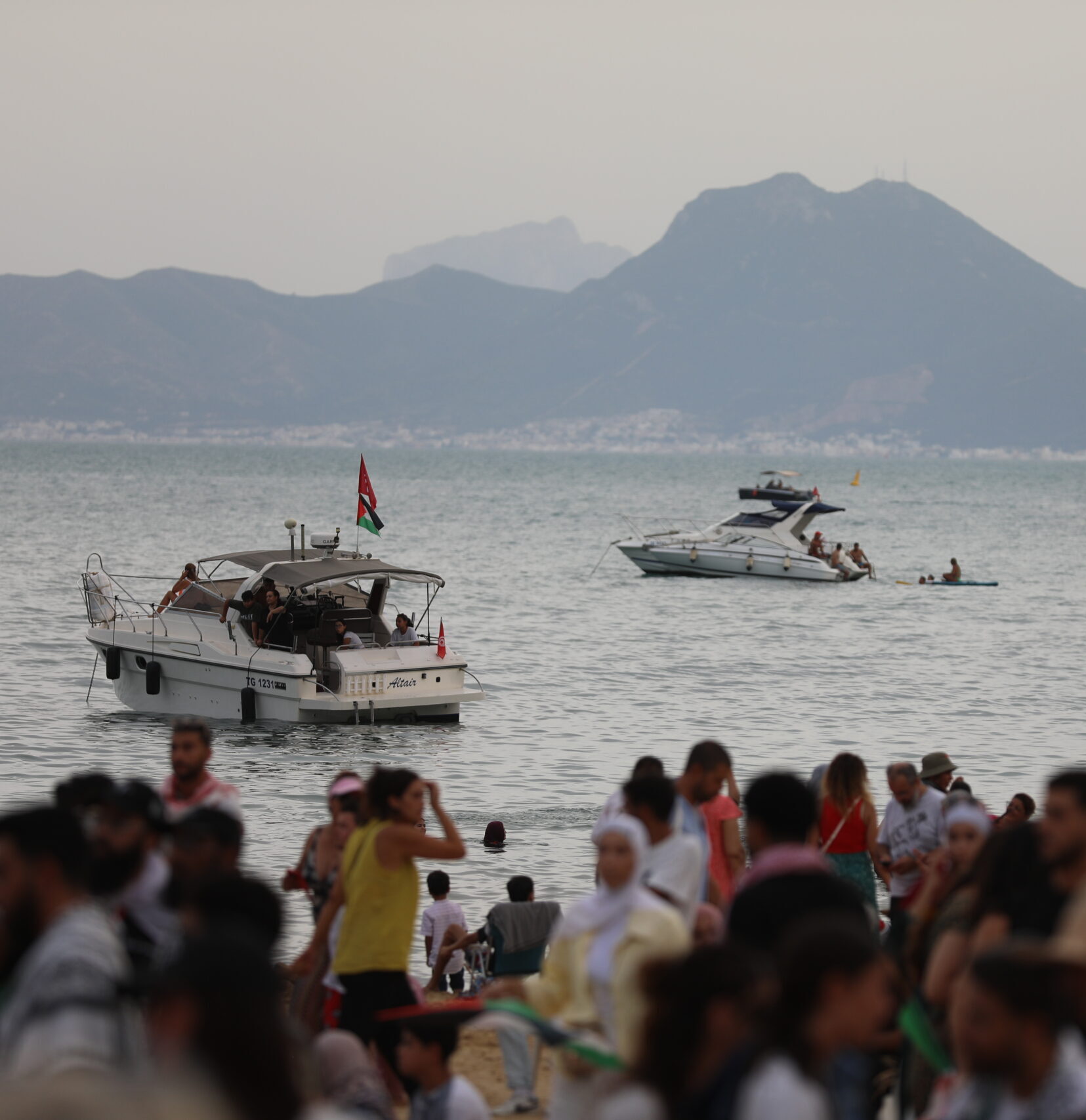
Flotillas are critical as tangible stress tests. They compress abstract legal and humanitarian conventions into a visible arena. If the Trump plan, with the purported agreement of Israel, genuinely believes in a Gazan rebuilding effort, the Global Sumud Flotilla (GSF) is the litmus test.

This time, no UN grandstanding, public relations sophistry, or gilded communique can evade the question: will lifesaving aid and civilian passage be allowed, or will they be violently dislocated? The waterline between a genuine day-after plan for Gaza or diplomatic camouflage for crypto-annexation will be drawn here.
The credibility of any attempt to “end the war” that begins by thwarting civilian relief will be seriously dented. The fig leaf of a “peace plan” will fall and expose a “piece plan”. We now stand at a crossroads, staring down three paths: the “humanitarian,” the “escalation,” and the “managed stalemate.”
Subscribe to our newsletter and stay updated on the latest news and updates from around the Muslim world!
Three Possible Outcomes
If Israel allows the flotilla safe passage, relatively unmolested, as a gesture of goodwill, the architecture of the Trump plan would be redrawn, providing it with more benign undertones. Currently, the plan frames “security” and “disarmament” as primary, whilst aid remains secondary. This outcome would provide assurance to skeptics that humanitarianism is in fact the categorical imperative of the plan’s proponents.

It could also politically disarm the most potent critique: lip service is being paid to the Palestinians, whilst a militarily maximalist policy is still being prosecuted.
Global public confidence could be salvaged with conviction in the international order slowly being reinstated. Hamas may be pressured to acquiesce in light of Israel’s newfound benevolence. In this case, reconstruction and public welfare would top the new agenda.
Trump’s envoys would also redraft sections to include enforceable aid corridors, or risk the plan being seen as irrelevant. However, this permutation seems unlikely in light of Israel’s harassment of the convoy thus far: deploying drones, flash grenades, and even itching powder.
If Israel violently intercepts the flotilla with naval boardings, mass detentions, or worse, the message to the world would be unmistakable: material aid is not on the table. The searing image of civilians in zip-tied restraints would do more damage than sanctimonious talking points could compensate for. The plan would be stripped of its moral cover.
With possible European casualties, Western enablers of Israel would face mounting domestic pressure.
States that hedge their language would be forced to harden their positions. International bodies would be forced to reassess Israel.
It is unlikely that the Arab states will reconsider their support for the programme as it closes the Gaza crisis, which represents a thorn in their side.
Public outcry across the globe cannot be underestimated, just as pressure mounted on states during protests after the 2010 Mavi Marmara debacle.
Global demonstrations could trigger a more vigorous wave of boycotts and divestments, further isolating Israel on the global stage.
The planners may be forced to adopt more punitive measures to secure compliance. Inside Israel, escalation would validate hardliners who argue that only permanent dominance can secure quiet; inside Gaza, it validates the belief that only resistance compels attention. Escalation doesn’t just kill the flotilla; it quietly kills the plan, with the “peace” framework seeming hollow if aid ships are intercepted or sunk.
If the flotilla is blocked nonviolently, a “managed stalemate” could arise out of the clamour. It would be plausible to assume that this method, which would entail silently diverting, delaying or minimally disrupting, would be the optimum for the plan’s purveyors. Despite involving no bloodshed, this would erode credibility, but would likely not elicit a wave of feverish condemnation. The antagonists would likely cite complex legal conventions for derailing the flotilla.
The Flotilla’s crucial role
In all three scenarios, one truth becomes unavoidable: no diplomatic blueprint can survive if it ignores the flotilla. Trump’s plan, heavy on security clauses and light on humanitarian guarantees, already suffers from serious flaws. The flotilla has thrown it into sharp relief.
The Trump administration may prefer to talk about hostages, borders, or demilitarisation, but the sea does not lie. In the coming days, the world will learn of Gaza’s fate. The answer to that question will decide not only the fate of the flotilla, but also the fate of the plan, and perhaps the genocide itself.
Adil Tagari is an Islamic scholar with an MA in Sociology/History. He teaches Higher Islamic Studies and lectures on Muslim history online.