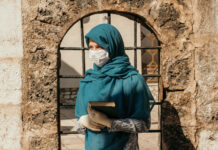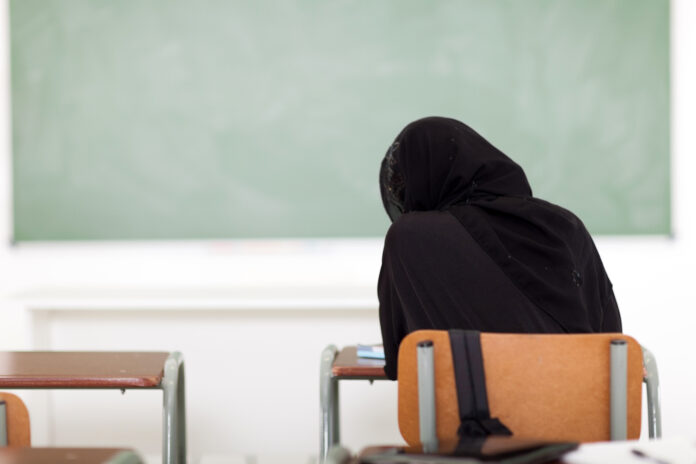
The Austrian Interior Minister, Claudia Plakolm, has said the Islamic headscarf is a “sign of oppression” which has “no place in our schools.”
Plakolm, a member of the ruling coalition Austrian People’s Party (OVP), said on Sunday in an Instagram video: “The headscarf is a symbol of oppression. Girls are hidden behind headscarves at a critical stage in their personality and physical development, and extremist tendencies, particularly among children, have no place in our schools.”
Plakolm’s statement is apparently connected to a bill proposed by the Austrian government to prohibit headscarves in kindergartens and schools for girls under 14. According to Plakolm, the law will be passed in the fall of 2025.
In response, the Islamic Religious Community in Austria (IGGO) criticised Plakolm, saying: “We are deeply disturbed by a recent statement by Minister of Culture Claudia Plakolm on the Islamic headscarf.”
The IGGO said that “linking the headscarf, which is an expression of the religious practice of a religious community recognised by law in Austria, with ‘extremist tendencies’ unsettles not only many young Muslim women but also all those who trust in the protection of religious freedom and equal treatment.”

According to the IGGO: “Those who deny girls religious self-determination across the board are missing the core of child protection.”
The organisation also expressed its willingness to engage in dialogue by inviting the minister to have a private discussion with Muslim educators, parents, and youth.
Subscribe to our newsletter and stay updated on the latest news and updates from around the Muslim world!
“If the statement was misleading, a public clarification would be urgently needed, also in the interests of respectful social dialogue,” according to the IGGO statement.
History of Islamophobia
The Austrian government has a history of attempting to regulate the wearing of hijabs in schools.
In 2019, Austria passed a law banning headscarves in primary schools for girls up to the age of 10, which was framed as prohibiting “ideologically or religiously influenced clothing” covering the head.
This law was criticised for targeting Muslim girls specifically, as it explicitly exempted Jewish yarmulkes and Sikh patkas.
The Austrian Constitutional Court overturned this ban in December 2020, ruling it discriminatory and a violation of religious freedom, as it disproportionately affected Muslim girls.

More broadly, Islamophobia in Austria has intensified in recent years, driven by political rhetoric, discriminatory legislation, and societal attitudes targeting the country’s Muslim population, estimated at 8-9% (700,000-800,000 people, mostly of Turkish, Bosnian, and Arab descent).
Beyond hijab bans, institutional measures have fueled Islamophobia. The 2015 Islam Law imposed strict regulations on Muslim organisations, requiring German-speaking imams and limiting foreign funding, measures not applied to other religions.
Operation Luxor (2020) saw raids on over 70 Muslim individuals and groups without resulting charges, widely criticised as a politically motivated attack.
The 2021 “Islam Map” publicised mosque addresses, stigmatising Muslims as security risks and enabling far-right harassment.
These actions reflect a broader trend of securitising Muslim communities, often justified by vague references to “political Islam.”
A 2024 EU survey ranked Austria as the most Islamophobic EU country, with 71% of Muslims reporting discrimination in employment and housing.
Schools are a hotspot, with Muslim students and teachers facing bias, particularly since the 2023 Israel-Hamas conflict.
Public opinion reflects this hostility, with 40% of Austrians supporting unequal rights for Muslims in 2021.