


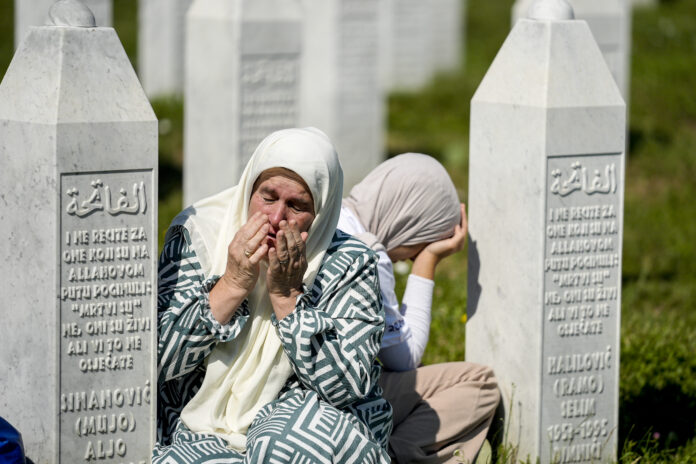
Thousands gathered in Srebrenica today to mark the 31st anniversary of the 1995 genocide, where ten newly identified victims were laid to rest. More than 8,372 Bosniak Muslim men and boys were systematically murdered by Bosnian Serb forces.
Between July 11 and July 22, more than 8,372 Bosniak Muslim men and boys were massacred by Bosnian Serb paramilitary forces.
Today marks the 31st memorial anniversary of the genocide, remembered across the world as one of Europe’s darkest chapters since the Second World War.
Every year, a collective funeral is held at the Memorial Centre in Potočari, Srebrenica, where newly identified victims are buried. Ten new victims were identified and subsequently laid to rest during this year’s ceremony.


Despite the genocide taking place over 30 years ago, new victims are still being found, as Bosnian Serb forces made concerted efforts to hide their crimes by moving the bodies of the victims into secondary and tertiary mass graves, often hundreds of miles from where they were executed.

Victims yet to be buried
It is estimated that up to 1,000 victims of the worst genocide in Europe since the Second World War have still not been found.
Subscribe to our newsletter and stay updated on the latest news and updates from around the Muslim world!
The victims buried today were aged between 20 and 56 at the time of their murders. The youngest, Senad Jusić, was 20, whilst the oldest was 56-year-old Ramo Dautović.

The other victims were Muriz Baraković, Hamed Mušić, Ramo Alić, Muhidin Osmanović, Huso Ćerimović, Nuko Nukić, Ahmet Gušter and Asim Kunić.

Their remains were recovered between 1997 and 2022 from locations including Kameničko Brdo, Budak, Rahunici, Glogova, Kamenica-Čančari, Jelovačka Česma and Turalići. Several were recovered from secondary mass graves after their bodies had been moved in a concerted attempt to hide evidence of the killings.
The Podrinje Identification Project in Tuzla still holds the remains of identified victims whose families have not yet consented to burial, as well as the remains of 36 victims identified through DNA analysis but still awaiting formal family identification.
Many families postpone burials because they remain hopeful that more bones will be discovered, rather than mere fragments, which do not give them the closure they are looking for.


Srebrenica genocide
In the spring of 1993, the UN Security Council declared Srebrenica a protected “safe area”.
Under the command of Ratko Mladić, Bosnian Serb forces overran the enclave on July 11, 1995, where some 25,000 Bosniak Muslim women and children were seeking shelter.
Women and children were forcibly transferred from the area and separated from the men and boys in their families. More than 8,000 of those men and boys would become victims of the Srebrenica genocide.


The International Court of Justice ruled in 2007 that the killings constituted genocide. The International Criminal Tribunal for the former Yugoslavia and its successor court also convicted senior Bosnian Serb political and military leaders, including Radovan Karadžić and Ratko Mladić, nicknamed the “Butcher of Bosnia” for his central role in the genocide, sentencing both to life imprisonment.
Genocide denial
Still today, many in the Balkans deny that the genocide ever took place, particularly the leadership of Republika Srpska (the Serb Republic), Bosnia’s second-largest entity, officially established in 1995 after ethnic cleansing and genocide.
Today, Srebrenica remains in Republika Srpska, under the control of those who continue to deny the genocide and protect the war criminals who carried out the massacres.