
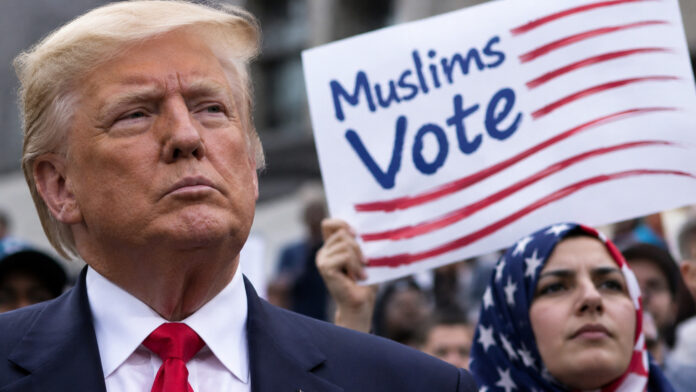
American Muslim organisations and prominent Islamic leaders are mobilising voters to deal Donald Trump a political blow in Tuesday’s US midterm elections. Furious over his pro-Israel policies, wars in the Middle East, Islamophobic rhetoric and immigration crackdown, could Muslim voters help strip Trump’s Republicans of serious power? Robert Carter reports.
With the elections set to determine control of Congress, Muslim civil rights group the Council on American-Islamic Relations (CAIR) has launched a final push to get eligible voters to the ballot box, while Islamic scholars and community leaders have also been encouraging greater political participation.
The mobilisation comes amid widespread opposition among Muslim voters to the Trump administration’s handling of Gaza and its war against Iran, as well as concerns about anti-Muslim rhetoric, immigration enforcement and civil liberties.
And Muslim voters look set to cause a significant upset in a closely fought election with key Swing States with a Muslim heavy population again possibly deciding the outcome.
A new CAIR survey suggests the president could face a significant backlash from Muslim voters. Published on October 28, the survey of 861 Muslim respondents found that 84 per cent disapproved of Trump’s job performance, compared with just six per cent who approved.

It also found that 72 per cent intended to support Democrats in their state’s November election, while only six per cent planned to vote Republican. Some 81 per cent said they would definitely vote, with another nine per cent saying they probably would.
CAIR and its political advocacy arm, CAIR Action, said: “American Muslim voters are expressing a strong intention to participate in this election.”
Subscribe to our newsletter and stay updated on the latest news and updates from around the Muslim world!
The organisations added that voters were weighing “the threat of rising anti-Muslim hate and the human consequences of U.S. policy at home and abroad, including in Gaza.”
The survey was conducted between October 16 and 25. CAIR cautioned that stated voting intentions should not be mistaken for a forecast of actual turnout.
CAIR has been urging Muslims and other eligible Americans to check their registration, make a voting plan and take advantage of early voting opportunities.
In a statement on October 30, the organisation’s Government Affairs Director, Robert S. McCaw, said: “We urge every eligible Muslim voter to visit Muslims.Vote today and make a specific plan to cast their ballot.”
The organisation has also been running a nationwide voter outreach campaign, including digital advertising and planned text messages to approximately 250,000 voters across 10 states.
Muslim leaders urge voters to make their voices heard
Islamic scholar Dr Yasir Qadhi has also featured in discussions about the importance of Muslim political participation, with a recent video of his remarks circulating online.
In a video published on social media last Friday, Qadhi passionately urged Muslims to “pray Jummah and go to vote for the Ummah.
“Subhanallah, we are undergoing perhaps the most important election season, perhaps of our entire lifetimes. And it is imperative that we as Muslims of this country, as American Muslims, we avail ourselves to the same rights, the same privileges, the same sense of civic engagement and civic duty as everybody else. Dare I say even more so in light of what is happening in the world, in light of the, the politicisation of anti-Muslim bigotry. Muslims of America, you need to vote for candidates that represent your interest and our interest. Candidates that support freedom, that support justice, that are against genocides all over the world.
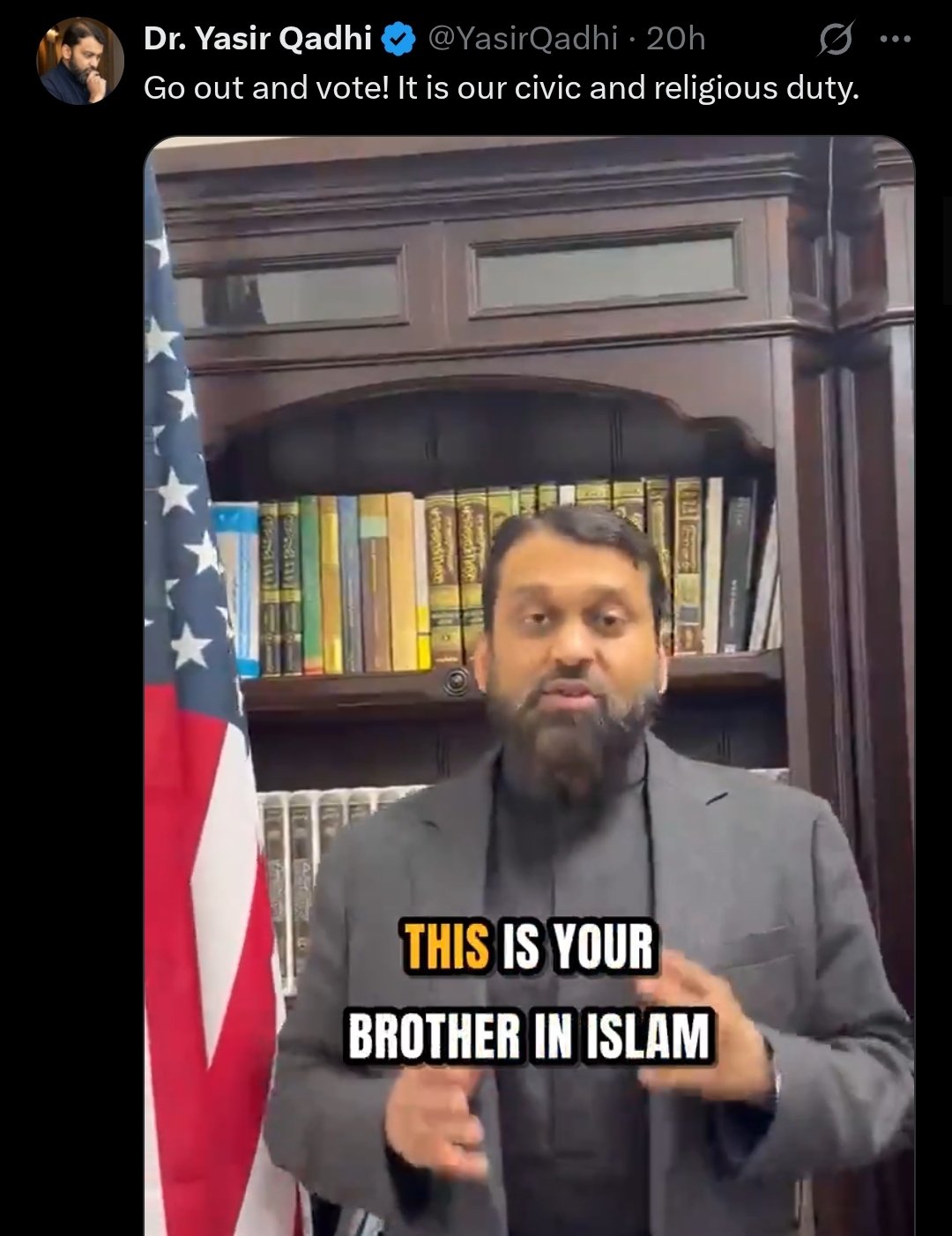
“Nobody’s perfect. No candidate is perfect, but we choose those that are clearly going to be beneficial to this country, to our country, to the entirety of the world. As Muslims, as Americans, it is our duty to get involved and to choose those people that will be better for our lands and for the globe. And so today, tomorrow, pray Jummah and go to vote for the Ummah. Jazakallah khair.”
Meanwhile, another prominent Muslim preacher and Yaqeen Institute president, Dr Omar Suleiman, has also used his social media platform to highlight the importance of political engagement after casting his vote early.
“Voting isn’t everything, but it also isn’t nothing. Especially when politicians think they can score points by picking on our community. If you can, get out and vote early. Texas & Michigan, I especially mean you!”
Suleiman, who is of Palestinian Arab origin, has been an outspoken critic of the Trump administration and its strong support for Israel amid the genocide in Gaza. He has also criticised the controversial war against Iran, which has led many Americans, including former Trump allies, to question whether Washington is fighting a pointless conflict in Israel’s interests.
Foreign policy appears to be one of the most significant issues influencing Muslim voting intentions.
CAIR’s survey found that 89 per cent of Muslim respondents considered a candidate’s position on Gaza either extremely or very important when deciding how to vote.
The findings come after more than three years of Israel’s devastating military campaign in Gaza, during which the Trump administration has continued to provide political and military support to Israel.
Trump already being punished
The president has already begun to face the consequences of policies that have alienated many Arab-American and Muslim voters.
The Muslim vote played a key role in helping pro-Palestine socialist Zohran Mamdani achieve electoral success, making him the first Shia Muslim to become mayor of New York.
Trump and his supporters attacked Mamdani in an effort to block his rise. He was repeatedly branded a communist, Islamist, antisemite and supporter of terrorism by right-wing, MAGA and pro-Israel media outlets and activists.
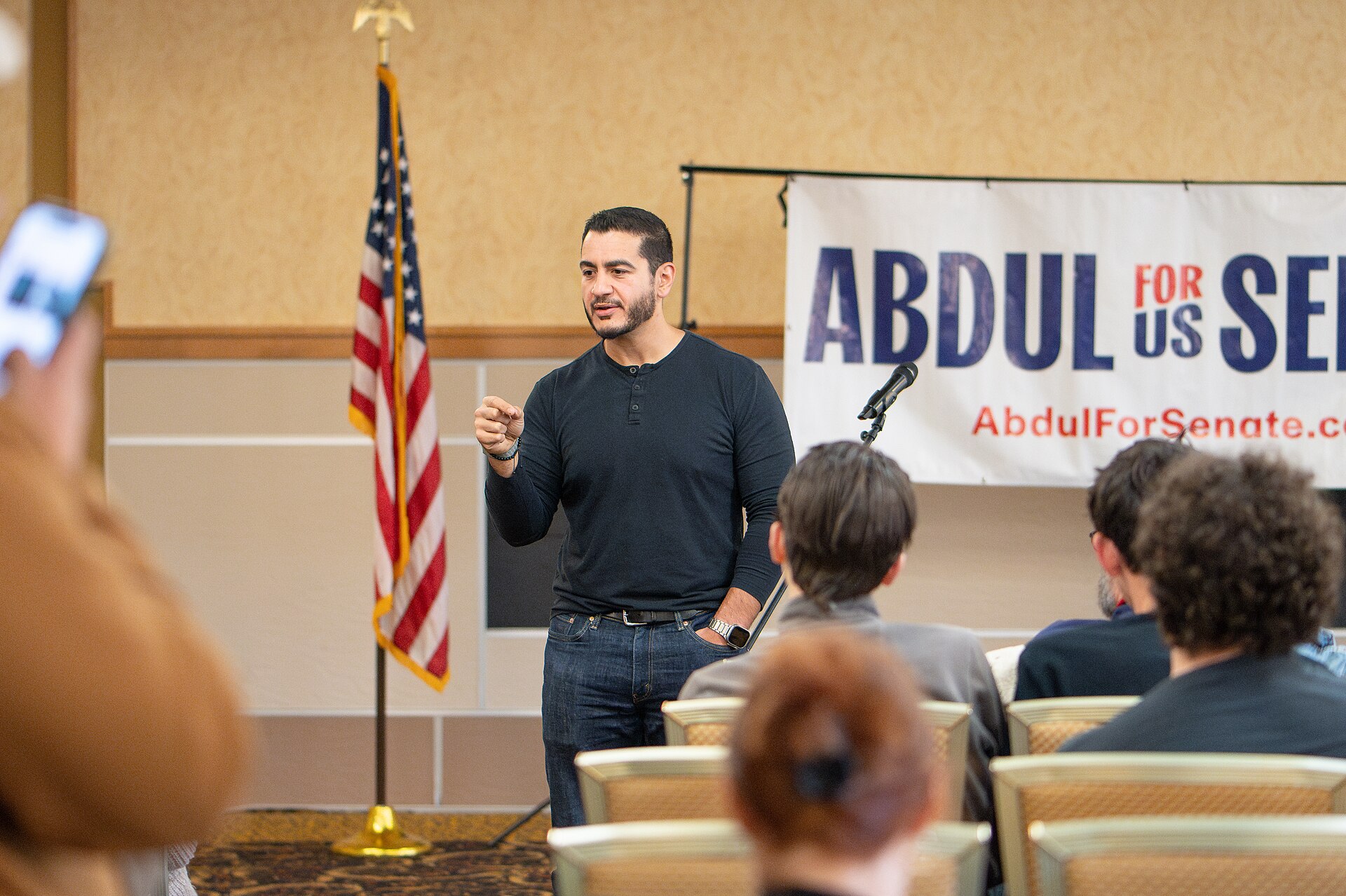
Trump himself has faced criticism over his remarks about Muslim communities and politicians. At a campaign rally in Michigan last week, he attacked Democratic Senate candidate Abdul El-Sayed over his Muslim faith, calling him a “jihadist” and repeating allegations of links to the Muslim Brotherhood, which El-Sayed denies.
El-Sayed, who is of Egyptian heritage, has faced increasing attacks from the right over his identity and background. However, his campaign appears to be gaining momentum. If elected, he would become America’s first Muslim senator. He has also campaigned on a pro-Palestine platform.
Trump has also repeatedly targeted Minnesota Congresswoman Ilhan Omar, a Somali-American Muslim, while making disparaging remarks about Somali immigrants, collectively referring to them as low-IQ scammers from a “sh*thole country”.
Immigration enforcement is another major concern for Muslim communities, particularly those with relatives or wider family networks affected by the administration’s policies.
Trump has pursued an aggressive immigration agenda, expanding deportation operations and backing tougher enforcement measures.
CAIR’s survey found that 32 per cent of respondents included immigration among their five most important domestic issues. It also found that 80 per cent believed anti-Muslim sentiment had increased.
The organisation recorded 8,683 complaints of anti-Muslim and anti-Arab discrimination during 2025 – its highest annual total since it began publishing figures in 1996.
The complaints included cases involving employment discrimination, immigration and asylum, hate incidents and travel-related discrimination.
For many Muslim voters, therefore, the election is not simply about foreign policy. It is also about the treatment of their communities, religious freedom and the right to live without discrimination or intimidation.
Michigan and Minnesota could prove important
The political significance of Muslim voters is particularly evident in states such as Michigan and Minnesota, where sizeable Muslim and Arab-American communities are concentrated in politically important areas.
Michigan is one of the most closely watched battlegrounds of the 2026 midterms. The Senate contest between Democrat Abdul El-Sayed and Republican Mike Rogers is among the races that could help determine control of the chamber.
The Detroit metropolitan area, particularly Dearborn, Dearborn Heights and Hamtramck, has a substantial Arab-American and Muslim population.
The community’s electoral influence was demonstrated during the 2024 presidential election, when frustration over the Biden administration’s support for Israel contributed to a significant protest vote and lower turnout in some heavily Arab-American areas.
The latest polling suggests that many Arab-American voters are now shifting towards Democratic congressional candidates. A Washington Post-Schar School survey conducted between August 20 and September 7 found that 58 per cent of registered Arab-American voters supported Democrats for Congress, compared with 34 per cent for Republicans.
The Arab American Institute also published a survey in October which found that 59 per cent of likely Arab-American voters planned to support Democratic congressional candidates, against 26 per cent for Republicans.
However, the Muslim and Arab-American electorate is not a single political bloc, and not all Arab Americans are Muslim. Nor does support for Democratic candidates necessarily mean unconditional loyalty to the party.
In Minnesota, the large Somali-American community and the presence of Muslim representatives, including Ilhan Omar, have also made the state an important focus of the political debate.
Trump’s repeated attacks on Somali Americans and Omar have drawn criticism from Muslim organisations and civil rights advocates, while raising the prospect that such rhetoric could further energise voters who feel targeted by the administration.
The Muslim vote strikes again?
The latest mobilisation comes after Muslim and Arab-American voters demonstrated during the 2024 election that they were prepared to punish politicians over their positions on Palestine. The result was a humiliating defeat for the Democrats, a defeat which Trump did benefit from at the time.
In 2024, many voters refused to support Joe Biden and Kamala Harris because of the Democrats’ backing for Israel’s war in Gaza made them the “part of genocide”. Muslim and Arab voters knew the issue of voting for Trump and there was never a huge amount of trust in his leadership but his generic anti-war messaging was enough to convince some that teaching the Democrats a harsh lesson was the bigger priority. However, some voters instead opted for third-party candidates, while others stayed away from the polls completely.
The latest surveys suggest that Trump’s own record on Gaza, Iran, immigration and anti-Muslim rhetoric is now contributing to a different political calculation among many of those voters who now wish to unite against Trump and cause his admin a significant setback.

CAIR estimates that there are more than three million registered Muslim voters in the United States, with communities concentrated in several states where close elections could make relatively small shifts in turnout significant.
The midterms will provide an important test of whether that dissatisfaction translates into votes – and whether Muslim voters can exert greater influence over the political direction of the country.
Trump does appear to have taken this threat seriously. In late October, Trump appointed, Amer Ghalib, the former Arab mayor of Hamtramck, Michigan, and the first Arab-American and Muslim elected official to endorse Trump in the 2024 election, as the president’s advisor on Arab-American affairs.
Ghalib, who was born in Yemen and immigrated to the U.S. in 1997, thanked Trump for the appointment, saying he would do his best to represent Arab-Americans in the White House.
For Trump and the Republicans, the message from American Muslims is increasingly clear: their votes should not be taken for granted. However, Trump’s hands are tied and he has committed heavily to policies which directly affect Muslim Americans in a very negative way.
The MAGA movement as a whole has positioned itself, much due to the so-called “Israel First” element which holds significant influence over the President, into an existential threat to the survival of Muslims in American society, therefore, Muslims who engage in politics have little option but to rally behind the effort to politically punish Trump. A feat which has already been achieved against the Democrats in 2024.