
American Muslims are celebrating historic political victories after voters rejected several prominent anti-Muslim politicians, elected the country’s first Muslim senator and handed President Donald Trump a devastating midterm election defeat.
The results of Tuesday’s elections saw Democrats seize control of both houses of Congress, while Muslim civil rights organisations hailed the outcome as a major turning point for their community.
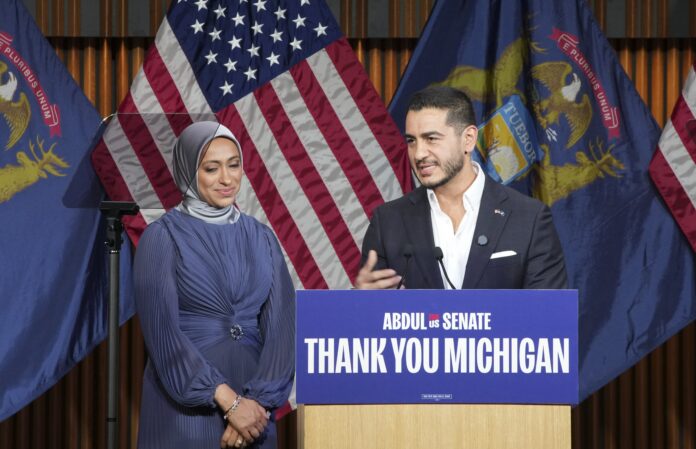
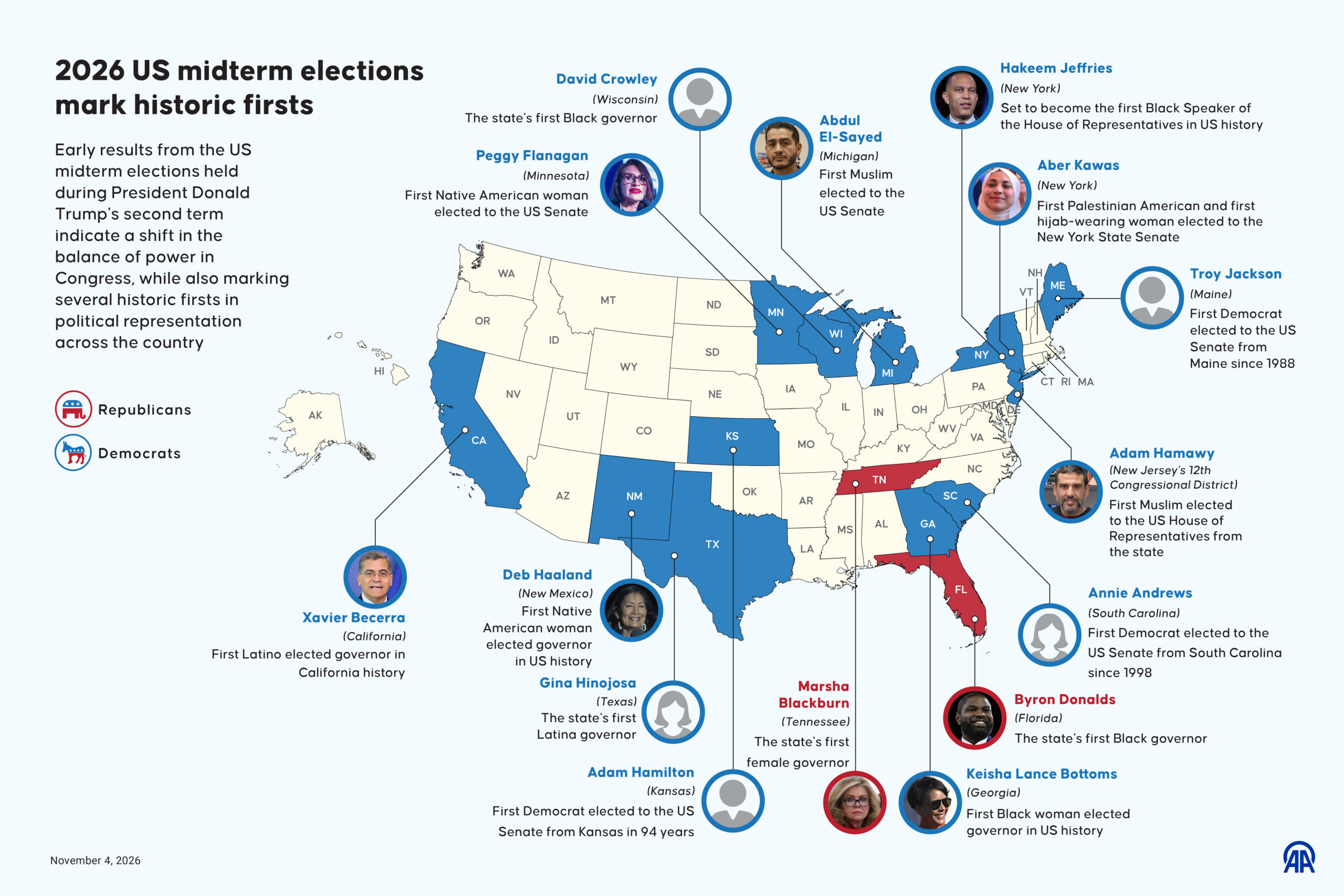
Among the biggest developments was the election of Abdul El-Sayed in Michigan, who became the first Muslim ever elected to the US Senate.
Meanwhile, in traditionally Republican Texas, several politicians accused of targeting Muslims and supporters of Palestine were defeated, prompting celebrations among Muslim advocacy groups.
The Council on American-Islamic Relations (CAIR) described the results as a rejection of Islamophobia, anti-Palestinian politics and the divisive rhetoric of the Trump administration.

America’s first Muslim senator
Dr Abdul El-Sayed made history by defeating Republican Mike Rogers in Michigan, a crucial battleground state narrowly won by Trump in the 2024 presidential election.
Subscribe to our newsletter and stay updated on the latest news and updates from around the Muslim world!
The former public health official overcame a bitter campaign in which his Muslim identity became a major political issue.
Trump and other Republican figures repeatedly attacked El-Sayed over his religious background, while campaign advertisements sought to portray him as an extremist.
El-Sayed rejected the allegations and ultimately secured victory, becoming the first Muslim elected to the upper chamber of the US Congress.
He will take office in January 2027.
CAIR National Executive Director Nihad Awad welcomed the result as a landmark moment for American Muslims.
“We congratulate Senator-Elect Dr. Abdul El-Sayed for making history as the first American Muslim elected to the U.S. Senate and for defeating both anti-Muslim hate and the anti-Palestinian lobby in the process,” he said.
“In the lead-up to this election, anti-Muslim extremists, Israel lobby groups and even the President of the United States used every smear in the book to paint Dr. El-Sayed as a Muslim boogeyman. None of it was true, and none of it worked.”
Awad added: “Anti-Muslim hate was on the ballot and it failed.”
Anti-Muslim politicians defeated in Texas
Another major development came in Texas, where Democrats scored a series of victories in a state long dominated by Republicans.
Democrat James Talarico defeated Republican Ken Paxton to become Texas’s first Democratic US senator since 1988.
Gina Hinojosa also defeated Republican Governor Greg Abbott, ending three decades of Republican control of the governorship and becoming the state’s first Latina governor.
The victories were particularly significant for Texas Muslims, who have faced a series of confrontations with the state’s Republican leadership.
CAIR accused Abbott, Paxton and other Republican politicians of deliberately targeting Muslim communities and institutions.
Among the controversies were efforts to obstruct the East Plano Islamic Center’s proposed Muslim residential development, attempts to close a Muslim funeral home, moves against CAIR and attempts to exclude Muslim private schools from a state education voucher programme.
CAIR also highlighted the defeats of Mayes Middleton and Bo French, accusing them of promoting anti-Muslim hostility.
In a joint statement, CAIR and CAIR-Texas declared: “These historic results in Texas were not only a rebuke of President Trump’s disastrous policies. The results were also a rebuke of the politics of hate.”
The organisations also praised Talarico for his criticism of Israel’s military campaign in Gaza.
They said he had repeatedly advocated a more peaceful American foreign policy and condemned the killing of Palestinian children by Israeli forces.
“These victories in a red state like Texas show that anti-Muslim hate is no longer a winning political strategy and that Texas Muslims are no longer a political football. We are equal political participants,” CAIR said.
The organisation described the victories as evidence that candidates could challenge anti-Muslim rhetoric without suffering electoral defeat.
Democrats seize control of Congress
The Muslim electoral breakthroughs formed part of a much wider Democratic victory across the United States.
According to projections reported by Anadolu Agency on Wednesday morning, Democrats had secured control of both the Senate and House of Representatives, reversing Republican majorities in both chambers.
Democrats were projected to hold a 54-44 advantage in the Senate, having captured at least seven Republican-held seats.
In the House, Democrats had secured at least 228 seats, comfortably exceeding the 218 required for a majority.
The party also achieved significant victories in gubernatorial contests, including Georgia, Texas, Ohio and Iowa.
Four incumbent Muslim members of the House of Representatives won re-election, while two new Muslim representatives were also elected.
The results represent a major setback for Trump, whose Republican Party will now face a Democratic-controlled Congress when lawmakers take office in January.
Democrats will be able to chair congressional committees, investigate the administration and block much of Trump’s domestic legislative agenda.
However, the president will retain substantial executive powers, particularly in foreign affairs and military operations.
Iran war backlash
The elections also exposed growing public dissatisfaction with Trump’s war against Iran and its economic consequences.
Rising petrol prices, inflation and the wider cost of living were among the issues that contributed to Republican losses, according to US media reports.
Trump acknowledged on Wednesday that the Iran conflict had damaged his party electorally but defended his decision to launch military action.
Asked whether he regretted the war, he told the Wall Street Journal: “I would have done it again.”
The Democratic takeover of Congress could increase pressure on Trump to pursue diplomacy with Tehran rather than further military escalation.
However, analysts warned that the president could respond to domestic political setbacks by concentrating more heavily on foreign policy.
Jack Clayton, a US foreign policy analyst, said the administration might prefer a negotiated settlement but could still launch limited strikes against Iran to strengthen its bargaining position.
John Calabrese, a senior fellow at the Middle East Institute, said Trump appeared to be pursuing diplomatic negotiations while keeping military action on the table.
“My sense is that Trump is keeping both options open: pursuing a deal while retaining the military option,” he said.
Israeli Prime Minister Benjamin Netanyahu has reportedly been pressing Washington to resume attacks against Iran, adding another complication to diplomatic efforts.
The new Democratic majority could subject further military operations to greater congressional scrutiny, although it would not automatically prevent Trump from ordering strikes.
Musk loses billions as Republicans suffer
The election results also delivered a financial blow to billionaire Elon Musk, one of the Republican Party’s most prominent financial supporters.
According to reports cited by Anadolu Agency, Musk spent an estimated $446 million supporting Republican candidates and causes, although other estimates placed his political contributions lower.
Much of his spending was directed towards Texas, where Republican candidates suffered major defeats.
The Financial Times reported that Musk lost more than $60 billion as the election results coincided with sharp declines in the value of his business holdings.
Tesla shares reportedly fell 5.7%, while SpaceX experienced a reported 7.6% decline in early trading.
The losses highlighted the risks of Musk’s close association with Trump and the Republican political establishment.

A turning point for American Muslims?
For Muslim communities across the United States, the results have significance beyond the defeat of individual Republican politicians.
The election of the country’s first Muslim senator, the victories of additional Muslim congressional candidates and the defeat of politicians accused of Islamophobia suggest that Muslim political participation is becoming increasingly influential.
The results also raise questions about the electoral effectiveness of anti-Muslim campaigning and the political influence of pro-Israel lobbying organisations.
However, the victories do not necessarily mean that American foreign policy towards Israel and Palestine will fundamentally change.
Both major US political parties have historically maintained close relationships with Israel, and Democratic control of Congress does not guarantee an end to American military assistance or diplomatic support.
Nevertheless, Muslim advocacy organisations believe the election has demonstrated that Muslim voters can organise effectively, challenge hostile politicians and influence the outcome of major elections.