



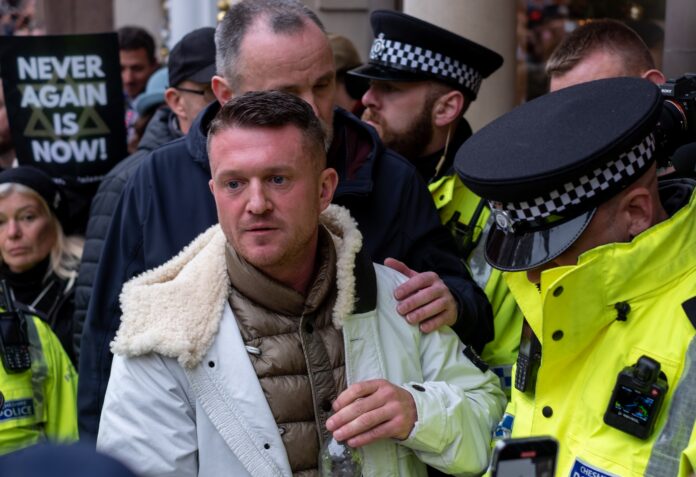
From stoking unrest to producing shoddy documentaries while profiteering off of the back of jailed supporters and victims of grooming, the Channel 4 documentary reinforces what we have already known about Tommy Robinson for years – he’s not a “patriot”, he’s a truly nasty piece of work. Robert Carter reviews the documentary which has rattled Britain’s most vile Islamophobe.
For years, Tommy Robinson, real name Steven Yaxley-Lennon, has built an entire political persona around telling his supporters that he is fighting an all-powerful establishment on their behalf. He has presented himself as a persecuted outsider, a fearless patriot, a defender of Britain and, above all, a man willing to sacrifice everything for his cause.
But there has always been another question lurking behind the spectacle: who is actually paying for it all – and where does the money go?
That is the question at the heart of Channel 4’s Tommy Robinson: Where’s the Money Gone?, an investigative Dispatches documentary by journalist Matt Shea. After spending a year examining Robinson’s fundraising, corporate structures, court documents and the people he has claimed to help, Shea produced a programme that raises serious questions about the finances surrounding Britain’s most prominent far-right anti-Islam activist.
From a Muslim perspective, this investigation is particularly significant.

Robinson’s political career was built largely around portraying Islam as a threat to Britain. He co-founded the English Defence League in 2009, an organisation whose demonstrations frequently featured anti-Muslim rhetoric and which became synonymous with confrontational street politics.
For British Muslims who have watched Robinson build what looks like a lucrative media and fundraising operation while repeatedly presenting himself as the victim of persecution, it is deeply satisfying watching him lash out angrily as the spotlight turns onto what is likely his sensitive underbelly – his money.
Subscribe to our newsletter and stay updated on the latest news and updates from around the Muslim world!
Making money from suffering English?
One of the documentary’s most striking investigations concerns Robinson’s repeated claim that he has been “debanked” in Britain. Shea demonstrates that he was able to transfer money into a Metro Bank account held in Stephen Lennon’s name. Robinson responds that it is merely a basic personal account and maintains that supporters’ donations do not go into his personal accounts.
That exchange is important because Robinson’s supposed persecution has become an integral part of his brand. Being allegedly “cancelled”, censored or excluded from the financial system reinforces the image of the heroic outsider battling a hostile establishment.
But if the story is more complicated than Robinson has suggested, his supporters deserve to know.
The documentary then moves onto some of the fundraising appeals Robinson has promoted on behalf of individuals and families. Here the programme becomes particularly uncomfortable.
Shea tracks down people Robinson claimed he was raising money to help, including a survivor of a grooming-gang and an English man jailed for his role in the summer riots 2024 who then committed suicide in jail.
The programme finds these cases but reveals that funds which were raised on their behalf were not delivered. Robinson disputes the programme’s interpretation, arguing that some recipients rejected the money or broke contact.
The grooming victim, “Kate” – a pseudonym, whose experiences were used in Robinson’s media operation and fundraising provided unsettling information about how she was treated by Robinson after he tracked her down some time ago. She admits that she feels used by him, hasn’t received a penny of any money raised for grooming victims and that he “set her mental health back.”
This is especially damning given how his alleged support for victims of grooming-gang violence is a keystone for his reputation among his supporters many of whom admit in the documentary that they donate to his cause.
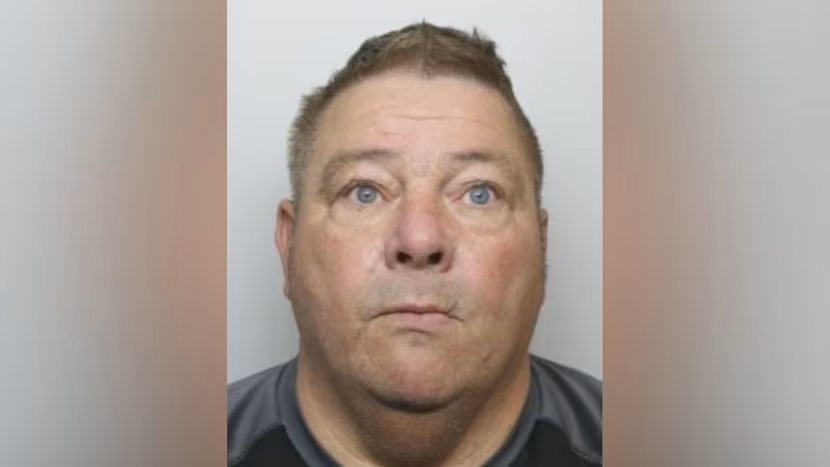
The case of Peter Lynch also stands out. A frankly tragic tale of a white British man seemingly radicalised into committing criminal action during the Summer Riots 2024 – a series of violent far-right anti-immigrant riots across England – of which Robinson was accused of stoking at the time.
Shortly after he was jailed, Lynch, a 61-year-old grandfather, committed suicide. Robinson urged his supporters to hand over money for his funeral claiming he was a “martyr.” The family reportedly rejected the money because they wanted “nothing to do” with Robinson – so, he ends up handing over the money to his own kids, according to the documentary. An amount which was several thousands of pounds worth.
The companies
Shea also examines five companies linked at various points to Robinson’s fundraising campaigns. Four apparently failed to file accounts, while three went into liquidation owing money to HMRC. Robinson says he was not a director of those companies. This is not evidence of fraud by Robinson, but it raises questions about the financial structures surrounding his fundraising.
The documentary also examines Robinson’s financial statements and evidence given under oath in connection with his libel case against Syrian schoolboy Jamal Hijazi, who successfully sued Robinson and was awarded £100,000 in damages after he shared lies about him in a dodgy documentary he produced.
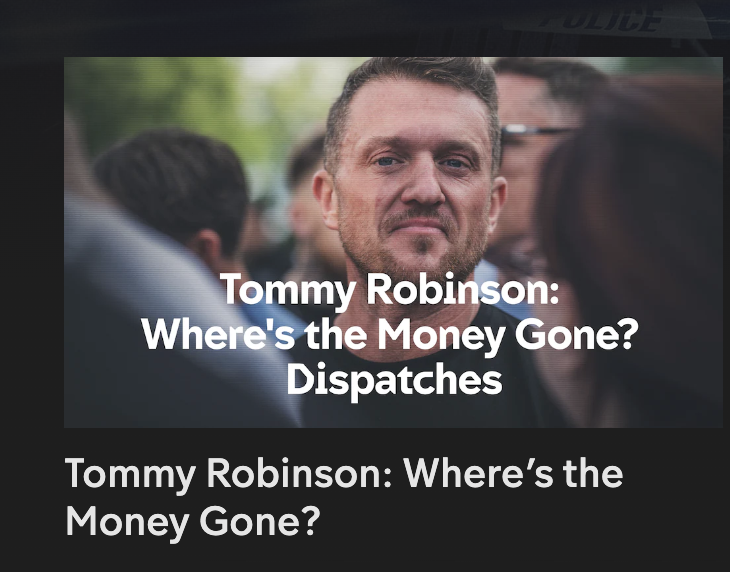
Dispatches raises questions about whether Robinson’s statements accurately reflected his finances. Robinson denies wrongdoing, while former DPP Sir Max Hill KC reportedly said some of the material could justify a criminal investigation by the police.
The programme also alleges that around £6,000 in Bitcoin from a donation wallet was transferred to a gambling platform. Robinson denies that donor money was used for gambling.
Ultimately, the documentary does what its title promises: it follows the money. Rather than simply revisiting Robinson’s well-documented history of anti-Muslim anti-immigrant campaigning, it asks a more practical question: what happens to the money his supporters loyally donate?
It does not prove every allegation, and some questions remain unresolved. But it presents enough evidence and unanswered questions to make the financial affairs surrounding Robinson worthy of renewed scrutiny.
Frankly, Robinson’s reputation speaks for itself. I have personally been to enough Unite the Kingdom rallies and spoken to enough of his supporters to know that he is a champion of an ignorant minority of troubled white Brits, many of whom come from troubled backgrounds, criminal pasts and childhoods of abuse, who are poor, angry and want to lash out at a world they bitterly resent.
Robinson, a man previously convicted of fraud, portrays himself as their hero — a brave champion who, if they support him hard enough, will hit back on their behalf. He channels their anger and hatred towards other vulnerable communities — religious minorities, refugees and immigrants — in order to gain clout, money and a seemingly lavish lifestyle.
Now the microscope is pointed at him. He hates it. He lashes out and becomes angry and abusive towards Channel 4’s Matt Shea. That, for me, was the best part of the whole programme: Robinson getting rattled.