


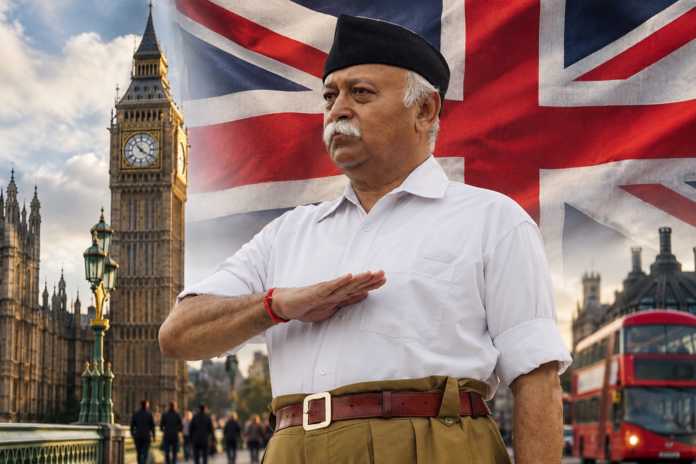
Mohan Bhagwat, supreme leader of India’s far-right Rashtriya Swayamsevak Sangh (RSS), has arrived in London for the final leg of a tour spanning the U.S. and Canada — but his long record of inflammatory statements against Muslims raises serious questions over why he is being granted a platform in Britain at all.
More than 100 British Hindu and community organisations — including the Hindu Council UK, Hindu Forum of Britain and Hindu Swayamsevak Sangh UK — have publicly welcomed the visit of the RSS chief, Mohan Bhagwat.
The Hindu organisations describe the RSS as “the largest voluntary organisation in the world, dedicated towards character building, volunteering, leadership, social cohesion and promoting global fraternity.”
Bhagwat is expected to address a large diaspora gathering of Hindus over the weekend.
But the visit has drawn immediate political scrutiny. British Indian minister Nadia Whittome asked the Home Office in Parliament whether it had fully assessed the visit against the country’s commitment to block hate preachers and extremists from entering the U.K.
Security Minister Dan Jarvis responded that entry requirements under immigration rules had been met, but stopped short of confirming whether a specific assessment had been carried out.

A coalition of civil society organisations, led by the South Asia Solidarity Group and Hindus for Human Rights U.K., had appealed to the government to block the visit entirely.
Subscribe to our newsletter and stay updated on the latest news and updates from around the Muslim world!
The Kashmir Centre also said it submitted a formal dossier to Home Secretary Shabana Mahmood on August 25 calling for Bhagwat to be excluded from Britain on the grounds that his presence would not be conducive to the public good.
Who are the RSS?
The RSS is a far-right Hindu nationalist paramilitary organisation formed in 1925, with more than five million members worldwide.

Its primary aim is the realisation of “Hindutva” — a political project seeking to establish India as an ethnically homogeneous Hindu supremacist state.
The organisation is the ideological parent of India’s ruling Bharatiya Janata Party (BJP), of which Prime Minister Narendra Modi is a member. It has been banned by Indian authorities on three separate occasions: following Mahatma Gandhi’s assassination in 1948, during the Emergency of 1975, and after the demolition of the Babri Masjid in Ayodhya in 1992.
The organisation has been described as born out of anti-Muslim sentiment, and the United States Commission on International Religious Freedom (USCIRF) has documented multiple violent attacks against religious minorities in India carried out by RSS-affiliated groups.
Genocide Watch has stated that India is in the early stages of an anti-Muslim genocide, crediting the RSS with arming and training Hindu groups to commit organised mob violence.
Bhagwat’s record — in his own words
It is against this backdrop that Bhagwat’s own documented statements demand scrutiny. The parliamentary briefing prepared by Hindus for Human Rights UK ahead of his London visit outlines a consistent pattern of inflammatory rhetoric spanning more than a decade.
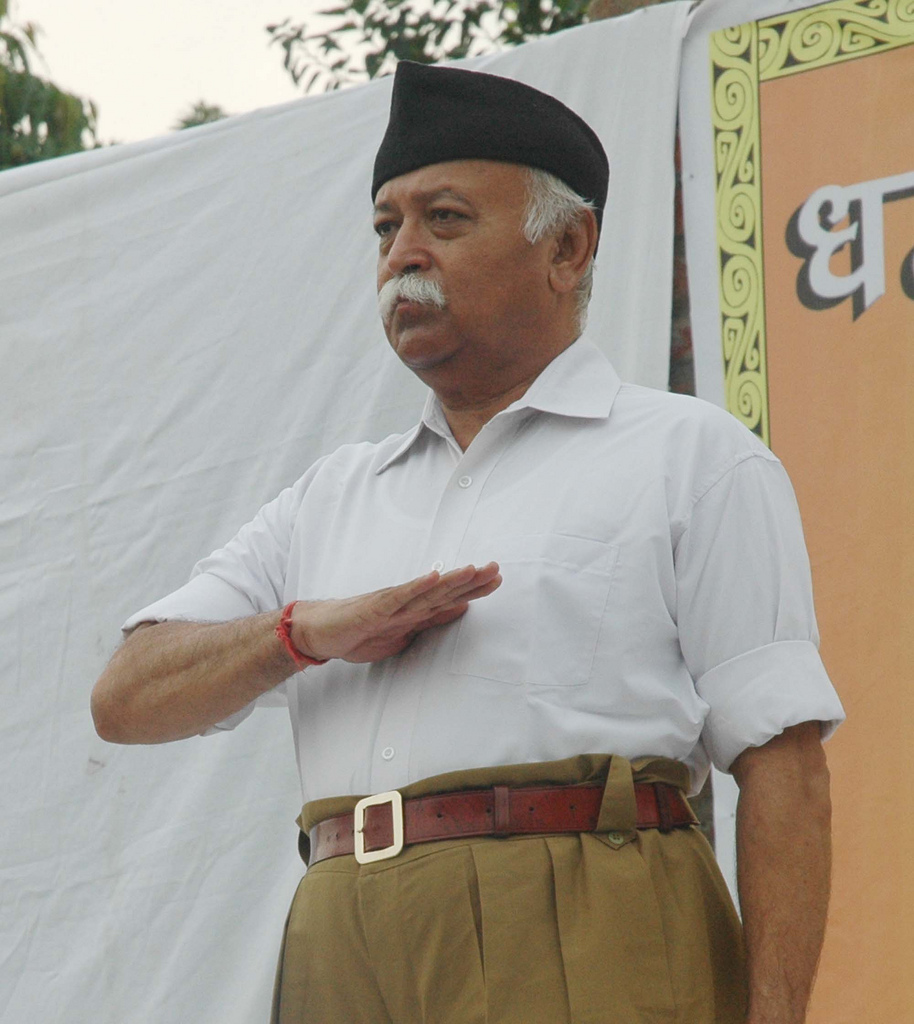
In February 2018, speaking at an RSS gathering in Muzaffarpur, Bihar, Bhagwat told the audience that the RSS could mobilise fighters in three days where the Indian Army would need six to seven months — a claim to command a parallel armed force made by the leader of an organisation with millions of drilled members.
In October 2019, in his annual Vijayadashami address in Nagpur — the RSS’s most authoritative yearly platform — Bhagwat denied that mob lynching in India is real, calling the term a “western construct” that defames the country. A former Indian minister demanded he clarify whether he condemned mob killings. He did not.
Two years later, in his October 2021 Vijayadashami address, Bhagwat attributed post-election violence in West Bengal to “appeasement of barbarous elements by the government and population imbalance,” describing a religious minority as barbarous and linking demographic change directly to violence.
In October 2022, he returned to the same platform to declare that “religion-based population imbalance is an important subject not to be ignored,” linking birth rates, conversion and migration to the partition of territory.
Fact-checkers noted at the time that fertility rates were falling across every religious group in India. This is the same population replacement argument that circulated in Leicester in 2022, when the city witnessed the most serious Hindu-Muslim violence in modern British history — violence that an independent commission found was linked to Hindu nationalist ideas and disinformation.
In January 2023, in an interview with RSS journals Organiser and Panchjanya, Bhagwat conditioned Muslims’ continued residence in India on their abandoning claims to equality and stated that Hindu society had been at war for a thousand years. India’s Communist Party of India (Marxist) said he had “virtually given a call for violence against a section of Indian citizens.”
Most recently, in January 2026 — just eight months ago — Bhagwat returned to the so-called “Love Jihad” conspiracy theory at an RSS women’s conclave in Bhopal, calling for “effective action against those committing such crimes.” He had first endorsed the same conspiracy theory at a similar conclave in 2014. The theory has been used to justify vigilante attacks on interfaith couples across India.
The UK context
The briefing prepared for parliamentarians makes clear that this visit is not a private religious trip. The RSS has stated publicly that the purpose of this tour is to foster dialogue with mainstream societies about the interests of Hindus living in them.
Since 2005, the Home Secretary has held the power to exclude any non-national whose presence is not conducive to the public good — a power expressly applicable to those who express views that foster hatred which might lead to inter-community violence in the U.K. That threshold, as the briefing argues, has arguably been met.
Universal slogans about “One World, One Humanity” may dominate the stage this weekend. But the documented record of the man delivering them tells a different story.