


Morocco has introduced a new law regulating the feeding, sheltering and treatment of stray animals, with people potentially facing fines of up to 2,000 dirhams for unauthorised care in public spaces, as the country continues to reject claims that it is carrying out a “mass slaughter” of stray dogs ahead of the 2030 FIFA World Cup.
Law No. 19.25, concerning the protection and care of stray animals and the prevention of risks associated with them, entered into force on August 10.
The legislation establishes a national framework for dealing with stray animals, particularly dogs and cats, combining their protection and care with measures intended to address public health and safety risks.
One of its most controversial provisions concerns the feeding, sheltering and treatment of stray animals.
Article 5 states that individuals may not provide such care except in accordance with the law and its implementing regulations, while Article 44 provides for fines of between 500 and 2,000 dirhams for violations involving stray animals in public spaces, including streets and shared residential areas.

The law has nevertheless caused confusion because the implementing regulations that are expected to clarify exactly what is permitted have not yet been published. Animal welfare groups have warned that the uncertainty could discourage people from helping injured or hungry animals, while supporters of the legislation say Morocco needs an organised national system for dealing with its large stray animal population.
Some have criticised the move, amid rowing concern over animal welfare in the Arab country.
Subscribe to our newsletter and stay updated on the latest news and updates from around the Muslim world!
Spanish-Moroccan sports journalist, Layla Hamed, said on X: “I’m deeply saddened by Morocco’s new stray animal law. Punishing animal cruelty is long overdue, but penalising people for feeding or treating strays when no adequate alternative exists is indefensible. That is not animal protection.”
The development comes as Morocco faces growing international criticism over allegations that stray dogs are being massacred in large numbers as the country prepares to co-host the 2030 World Cup with Spain and Portugal.
Moroccan authorities strongly reject claims that they have adopted a nationwide policy of exterminating dogs to make the country more presentable for football fans and tourists.
Allegations of abuse
CNN reported in June 2025 that residents in several Moroccan towns had described seeing the bodies of dogs in the streets and hearing shootings.
The broadcaster also reviewed footage supplied by animal rights groups which it said showed dogs being captured and killed, including allegations of animals being dragged into municipal vehicles.
Campaigners believe that Morocco’s preparations for the 2030 World Cup have created pressure on local authorities to remove stray animals from streets, particularly in areas expected to receive large numbers of visitors.
The International Animal Welfare Protection Coalition (IAWPC), which represents dozens of animal welfare organisations, has been one of the leading groups campaigning on the issue. The coalition has argued that potentially millions of dogs could be at risk if authorities rely on large-scale killing rather than sterilisation and vaccination programmes.
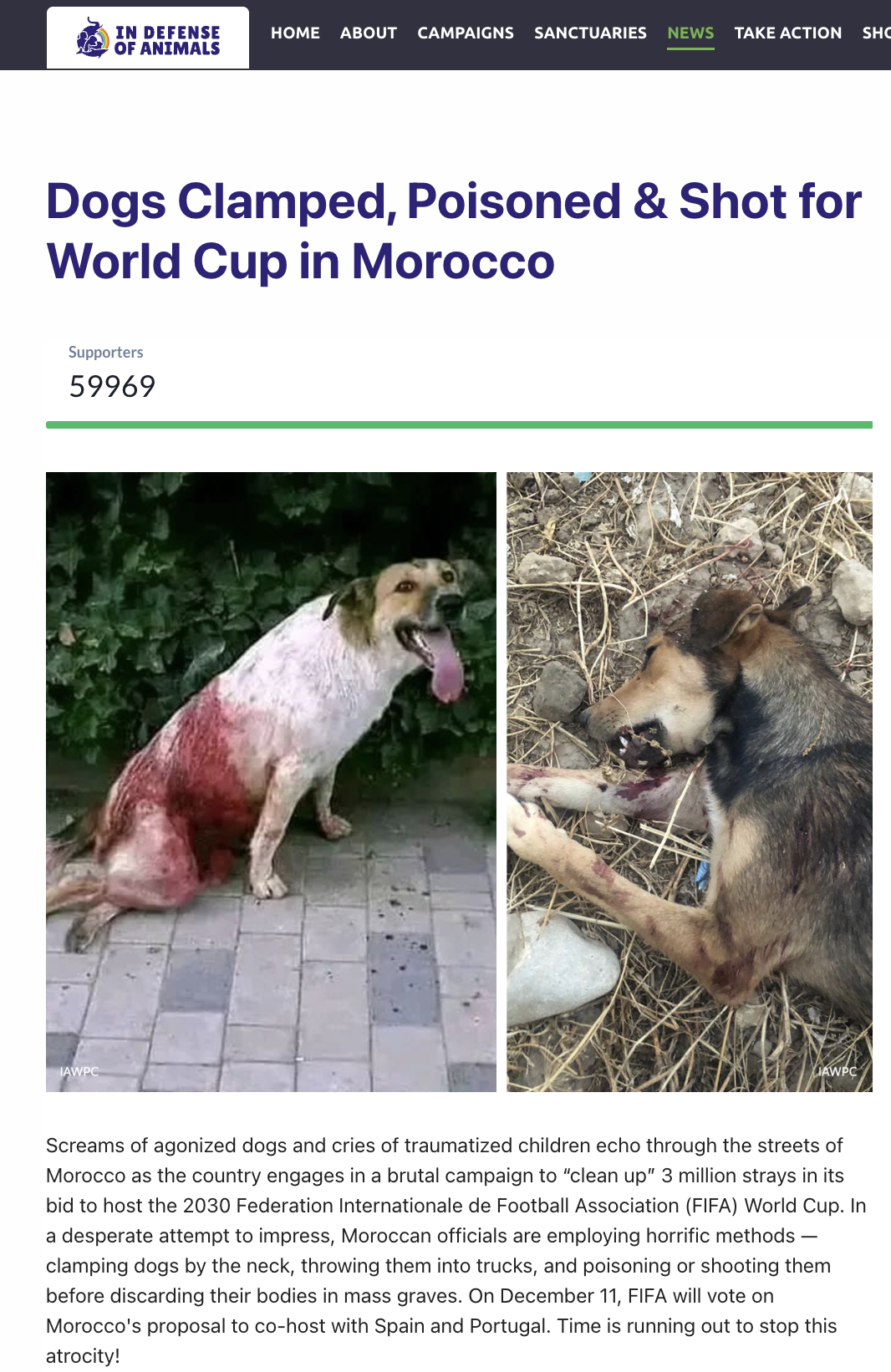
However, such figures are campaigners’ estimates rather than independently verified death tolls.
“After the [World Cup confirmation], the extermination of the dogs has increased dramatically,” the IAWPC said in a report. “As a result, the fear is that Morocco will now go ahead with their plan for the mass slaughter of 3 million dogs.”
The IAWPC claims methods include “poisoning with strychnine either through directly injecting into the dog or through placing it in food.”
Rifles and pistols are used to shoot dogs by gunmen patrolling the streets looking for the animals, the campaign group also alleges.
“The dogs are left to bleed out, often thrashing around and screaming in agony,” it said in a petition.
“Their bodies are often left to rot where they fall. Dogs are also hunted down and trapped with medieval clamping devices and thrown into the back of trucks with other terrified dogs.
“These dogs are taken to be killed in ‘fake dispensaries’. They are either burned in incinerators or taken and dumped in mass graves. Not all dogs are dead when dumped.”
Moroccan officials have strongly disputed the claim that there is a nationwide World Cup-driven campaign to slaughter dogs.
The IAWPC has also raised concerns about aspects of the new law, arguing that important details have been left to future implementing regulations and warning that the practical application of some provisions remains unclear.
Stray dogs: “A real threat to health and safety”
Mohammed Roudani, head of the Public Health and Green Spaces Division at Morocco’s Ministry of Interior, told CNN that stray dogs presented a serious public health challenge, particularly because of rabies.
He said approximately 100,000 people in Morocco are bitten by dogs each year, with children accounting for around 40% of victims under the age of 15.
Morocco introduced a Trap-Neuter-Vaccinate-Return (TNVR) programme in 2019, under which dogs are captured, sterilised and vaccinated before being returned.
Roudani said the government was working with local authorities to expand this approach in accordance with animal welfare standards.
Moroccan officials continue to reject accusations that the country is systematically killing dogs because of the World Cup. They have suggested that allegations of widespread extermination fail to take account of the country’s efforts to develop a nationwide humane management system to deal with the serious issue posed by large numbers of free-roaming animals.
A 2025 WHO Eastern Mediterranean Health Journal paper described stray dogs as posing a “real threat to health and safety” in Morocco.
It identified several risks: dog bites and injuries, aggressive behaviour, traffic accidents, environmental problems and the transmission of diseases, particularly rabies and hydatidosis.
The paper recorded 451 documented human rabies cases in Morocco between 2000 and 2022, with an annual average of around 20 cases during 2000–2021. It also noted that Morocco’s dog population has been estimated in the millions and that controlling free-roaming dogs remains a significant challenge.
The new Law No. 19.25 reflects this dual approach, with Morocco seeking to create a formal system for managing stray animals while also placing restrictions on informal care by private individuals. Parliament said the legislation was intended to establish an integrated framework covering public health, environmental protection and the management of stray animals.
Elsewhere in the Arab world, stray dogs are known to attack people, with women and children being vulnerable to serious harm. Dogs are pack animals and can roam around in large groups and may behave aggressively.
However, in some Muslim countries, like Turkiye, street dogs have established a more harmonious relationship with humans. They are a common sight in major cities like Ankara and Istanbul where they mostly lay around waiting for food handouts from tourists and shop owners.
FIFA under pressure
The controversy has placed FIFA under increasing pressure to intervene.
In its evaluation of Morocco’s successful bid to co-host the 2030 World Cup, FIFA recorded Morocco’s commitment to animal protection. Campaigners say the bid documentation stated that the culling of animals had been prohibited since August 2024, a claim they argue is contradicted by subsequent evidence of alleged shootings and poisonings.
FIFA has stated that it was in contact with animal welfare organisations regarding the issue, which has been in the news agenda since at least 2024.
The question now is whether Morocco can successfully implement its new legal framework and TNVR programme across the country while ensuring that municipal authorities follow humane standards.
The controversy surrounding the new law is also likely to continue until the Moroccan authorities publish the implementing regulations setting out more clearly when and how individuals can legally feed, shelter or treat stray animals. Article 55 provides for implementing texts to be adopted within a maximum period of two years for provisions requiring further regulations.
For animal welfare groups, reports of dogs being shot or poisoned demonstrate that promises of humane reform have not yet translated into reality everywhere.
For the Moroccan authorities, the new legislation and TNVR programme represent part of a national framework for managing stray animals, while allegations of a centrally directed World Cup “dog slaughter” are rejected.
As preparations for 2030 accelerate, the issue is likely to remain under intense international scrutiny.
Islamic stance on dogs and their treatment
Some Islamophobic activists use negative headlines about alleged Moroccan abuse of dogs as an example of “Muslim hatred for dogs” or to claim that dogs are inherently despised in Islam, but that is too simplistic. In reality, the Islamic position is much more nuanced.
Islam does not teach that dogs are to be indiscriminately slaughtered, but there is a historical tradition in the Hadith concerning the killing of wild dogs where they posed a danger to society.
In one story narrated in hadith, the Prophet Muhammad ﷺ ordered the slaying of dogs on at least one occasion around the area of Madinah. The order was linked to the dogs becoming some kind of threat to people’s safety in the area at the time. However, in the same narration it specifically mentions that the Prophet also ordered limitations to the killings.
In Islam dogs are generally regarded as ritually impure due to their saliva. This means that keeping dogs as pets inside the home poses a very real problem for Muslims, as their saliva can make anything it touches najis, which can contaminate prayer spaces too.
However, Islam permits keeping dogs for practical purposes such as hunting or guarding property, meaning that dogs are kept by some Muslims and are used to this day. Islam also teaches respect for all life. Life, after all, is a creation of Allah SWT, including animals such as dogs or pigs which are considered unclean and unsuitable for keeping as indoor pets or eating. Torturing or pointlessly harming any creature is not permissible in Islam.
Speaking to 5Pillars, Shaykh Tauqir Ishaq, explained a mainstream Islamic stance in detail.
“It is not permissible to kill any animal unless there is a genuine need such as for food or safety. With regards dogs although there are authentic ahadith regarding the killing of dogs, these were superseded and restricted by later narrations. As such dogs are permitted for hunting, guarding and for assistance such as guide dogs.
“The Qur’an specifically mentions hunting animals (dogs) in Surah al Maaidah verse 4 and our beloved Prophet ﷺ has mentioned the permissibility of keeping dogs for legitimate purposes: ‘Whoever keeps a dog, except a dog for livestock, hunting or agriculture, loses a qīrāṭ from his reward each day.’ (Bukhari & Muslim) مَنْ أَمْسَكَ كَلْبًا إِلَّا كَلْبَ مَاشِيَةٍ أَوْ صَيْدٍ أَوْ زَرْعٍ انْتَقَصَ مِنْ أَجْرِهِ كُلَّ يَوْمٍ قِيرَاطٌ
“Note that there is also guidance as to how to keep dogs in these cases. There is the famous hadith about a prostitute being forgiven for giving water to a thirsty dog (Bukhari & Muslim) and the saying of our beloved Prophet: “There is a reward for every living creature.” (Muslim).
“We also cannot forget the people of the cave and their pet dog mentioned in Qur’an. Kindness to animals is an important part of Islamic character. So, keeping dogs when there is a genuine need is permitted (with some restrictions) and killing animals is also only permitted when there is a genuine need such as health, safety or for humane purposes. If killing has to be done then it should be done humanely and needless killing is not allowed.”