


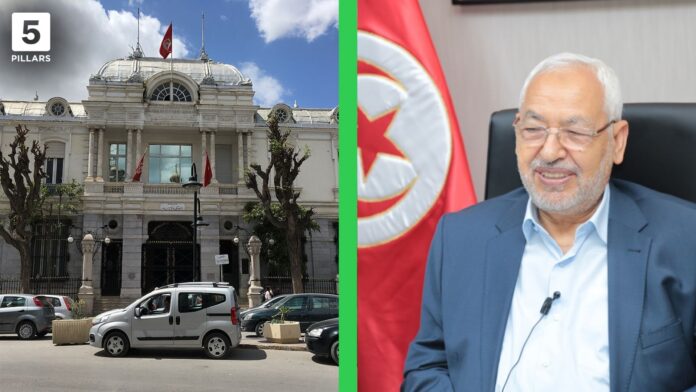
Tunisia’s main opposition leader Rached Ghannouchi has been sentenced to life imprisonment over controversial terrorism-related charges.
The ruling was delivered yesterday against the 84 year old Muslim leader and dozens of other figures linked to the Ennahda movement which combines Islamic principles and democracy.
A Tunis court specialising in terrorism cases handed down sentences ranging from ten years to life imprisonment against 35 defendants accused of involvement in what prosecutors describe as Ennahda’s “secret apparatus.”
Ghannouchi, the leader of Ennahda and one of the most prominent figures of Tunisia’s post-revolution political era, received a life sentence plus an additional 30 years. He has been in detention since April 2023.
His deputy and former Interior Minister Ali Larayedh was sentenced to 42 years in prison.

Former security official Mustafa Khedher received the heaviest punishment, a life sentence plus 96 years.
Several other defendants were handed sentences ranging from 10 to 50 years. The court also ordered all convicted individuals to remain under administrative supervision for five years after completing their prison terms.
Subscribe to our newsletter and stay updated on the latest news and updates from around the Muslim world!
The convictions were issued under Tunisia’s anti-terrorism legislation. Charges included forming and joining a terrorist organisation, assisting a terrorist group and other offences linked to national security.
The case centres on allegations that Ennahda operated a clandestine network that infiltrated state institutions and played a role in political violence. Ennahda has consistently denied the accusations.
Opposition condemnation
The verdict immediately drew condemnation from rights advocates and opposition figures.
The Freedom Observatory for Tunisia described the ruling as a “judicial and political massacre” and accused authorities of using the courts to settle political scores.

The organisation argued that the case was built on weak foundations and relied heavily on testimony from prisoners, defendants in unrelated cases and a secret witness known only as “Tarek 1.”
According to the observatory, prosecutors failed to publicly present clear material evidence linking each defendant to the crimes alleged against them.
It warned that anti-terrorism laws were increasingly being used against political opponents under the guise of national security.
The group also criticised the merging of separate legal files and the broad application of terrorism and espionage charges against a wide range of political figures and former officials.
It said criminal responsibility should be based on proven individual actions rather than political affiliation or association with other investigations.
The observatory called on appeal judges to conduct a full review of the evidence and urged the publication of the court’s detailed reasoning.
It also demanded that all defendants be guaranteed a fair trial and that convictions be overturned if they cannot be supported by credible evidence.
Assassinations
The case traces its origins to the 2013 assassinations of secular politicians Chokri Belaid and Mohamed Brahmi, two killings that shook Tunisia during its fragile democratic transition.

Lawyers representing the victims’ families have long alleged that a secret network linked to Ennahda was involved in the murders and sought to influence state institutions from within.
They have accused senior Ennahda figures, including Ghannouchi, of directing or overseeing the alleged apparatus.
The case was revived in 2022 before being transferred to Tunisia’s Judicial Counter-Terrorism Pole in 2023.
Critics say the proceedings cannot be separated from Tunisia’s broader political climate following President Kais Saied’s consolidation of power in July 2021.
Since then, opposition politicians, journalists, activists and government critics have increasingly found themselves facing prosecution, detention or investigation.
Supporters of the verdict argue that the state has a duty to uncover the truth behind the assassinations and hold those responsible accountable.
However, opponents insist that justice for Belaid and Brahmi cannot come through politically motivated prosecutions or unverified testimony.
With appeals expected, the case is likely to remain at the centre of Tunisia’s political divide. For many observers, the outcome will serve as a key test of whether the country’s judiciary is acting independently or becoming a tool in an escalating struggle between the state and its opponents.