


From online hate to restrictions framed around security and national identity, a new report by a European Islamophobia research group warns that anti-Muslim racism is becoming increasingly embedded in public life across Europe, with Muslim women and visibly practising Muslims among those most targeted, Robert Carter reports.
Published by the Brussels-based Collectif for Countering Islamophobia in Europe (CCIE), the Annual Report on Islamophobia in Europe 2025 draws on victim reports, academic partnerships, media monitoring and contributions from organisations in eleven countries, including the UK, France, Sweden, Austria and Denmark.
The report presents Islamophobia as a structural issue whose forms vary nationally but increasingly follow shared patterns across Europe.
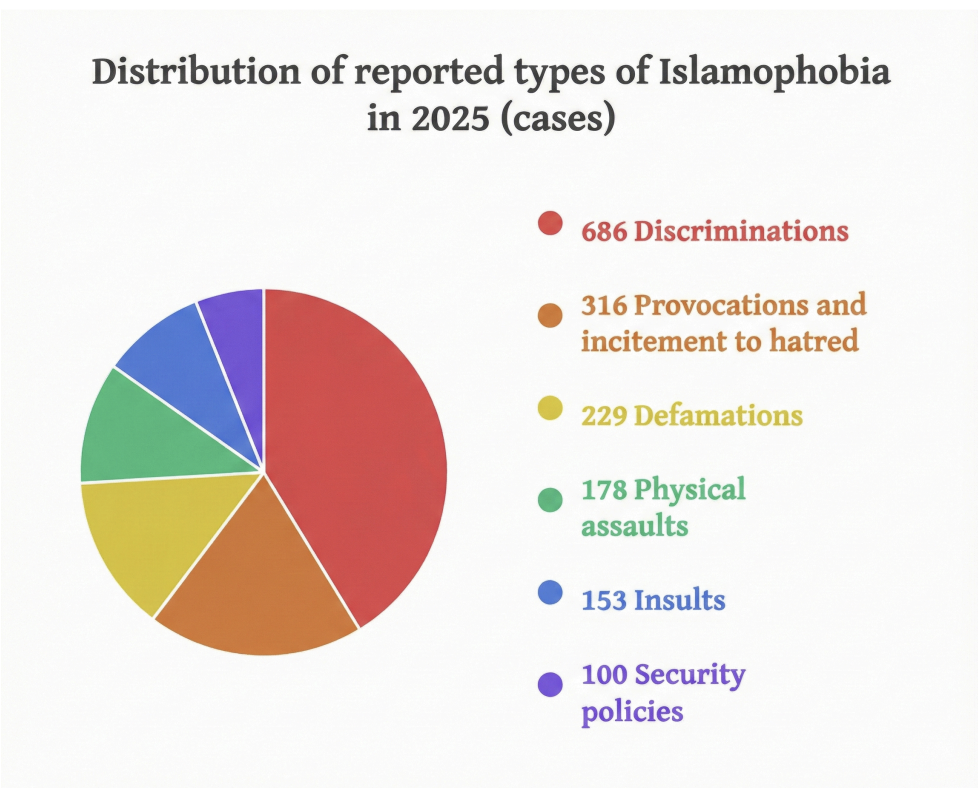
Among its headline findings, the CCIE recorded 876 reports in 2025, with discrimination accounting for the largest share of cases, followed by provocation and incitement to hatred, defamation, physical assaults and insults.
Women represented 80 per cent of reported victims, with cases linked to the wearing of the headscarf accounting for a significant proportion of discrimination affecting Muslim women.

The report also found that incidents more frequently involved legal entities, such as institutions or organisations, than individuals, leading researchers to argue that anti-Muslim discrimination increasingly operates in institutional settings.
in France. Credit: CCIE
The report stresses, however, that these figures likely represent only a fraction of incidents. Citing estimates from the European Union Agency for Fundamental Rights (FRA), it notes that only six per cent of Islamophobia cases are believed to be reported, a gap the CCIE attributes to mistrust in institutions, the normalisation of hostility towards Muslims and limited faith in legal protections.
Subscribe to our newsletter and stay updated on the latest news and updates from around the Muslim world!
Across Europe, researchers identified a common trend: the framing of Muslims through debates around security, integration, national identity and social cohesion.
According to the report, countries differ in legal systems and political culture, yet increasingly display converging dynamics, including heightened surveillance, restrictions on visible religious expression, weakened protections and the portrayal of Muslims as populations requiring special scrutiny.
The report’s country case studies argue that this pattern manifests differently from state to state. Austria documented spikes in anti-Muslim incidents around election periods, while Belgium was cited as an example of what researchers call the “hierarchisation” of discrimination, where legal protections formally exist but are unevenly enforced.
Denmark’s contribution highlighted what researchers described as the “conditionality” of Muslim rights following October 2023, arguing that civic participation and religious expression increasingly become contingent on conformity to social expectations. Sweden’s chapter examined the emergence of what contributors called a “national Islam”, where some Muslim expressions are deemed acceptable while others are framed through security concerns.
Epidemic of online hate
One of the report’s strongest warnings concerns online hate. Drawing on data from the European Observatory of Online Hate (EOOH), researchers analysed nearly 14.9 million posts between 2017 and early 2026, finding that 16.6 per cent met the platform’s criteria for “toxic” content.
Religious themes appeared in 81 per cent of toxic content analysed, while more than a third contained explicit elements of violence. The report says spikes in online hostility often corresponded with political developments and major current events, generating tens of thousands of highly toxic posts on peak days.
The report also links online hostility to offline consequences, pointing to harassment, intimidation and the amplification of inflammatory media clips on social media. It argues that digital spaces increasingly function as accelerators of anti-Muslim rhetoric rather than isolated environments detached from everyday life.
CCIE also situates present concerns within a wider historical context. The report references the killing of Aboubakar Cissé in a mosque in France in April 2025 and links remembrance efforts around the Srebrenica genocide to contemporary anti-Muslim violence, arguing that dehumanisation and public hostility should not be dismissed as abstract or symbolic concerns. Researchers stop short of drawing direct equivalence but argue that the normalisation of hatred creates social conditions that warrant serious scrutiny.
The report concludes that Islamophobia in Europe increasingly operates not through explicit exclusion alone but through what it describes as “differential governance”: distinctions between acceptable and suspect forms of Muslim identity, political expression and religiosity. It calls for stronger legal protections, better data collection, scrutiny of security policies and greater institutional recognition of Islamophobia as a specific form of racism.
UK focus: Prevent and a “climate of suspicion”
For British Muslims, the report reserves particular attention for the government’s Prevent programme, describing it as a central feature of what researchers call the UK’s institutional response to Muslim communities.
Written by researcher Layla Aitlhadj, the UK chapter argues that 2025 saw a marked intensification of Islamophobia amid wider xenophobic discourse, rising hostility in public spaces and heightened security policies.
The report cites attacks on mosques and Muslim community centres following the summer 2024 riots triggered by false online claims that the Southport attacker was a Muslim asylum seeker. According to surveys referenced in the report, 92 per cent of Muslims questioned said they felt less safe in public spaces after the unrest, while more than half reported increased stress linked to social media use. It also states that anti-Muslim incidents accounted for around 44 per cent of all religious hate crimes recorded in England and Wales in 2025, making Muslims the most targeted religious group.
Prevent, first introduced as part of Britain’s counter-terrorism framework, is described by the report as operating within a “pre-criminal” space in which teachers, healthcare workers and local authority staff are expected to identify people deemed vulnerable to radicalisation. The report argues that Muslim identity, religious practice and political expression continue to be disproportionately associated with risk indicators despite reforms to the programme.
According to the report, Muslims remain around six times more likely to be referred to Prevent than non-Muslims, despite comprising roughly six per cent of the UK population. Researchers further cite data showing 8,778 referrals in 2025, the highest level since the statutory duty was introduced, alongside cases involving children, including reports that around 200 children under the age of three had been referred over the past decade, two-thirds for concerns linked to alleged “Islamist extremism”.
For many British Muslims, the report suggests, these findings reflect a deeper anxiety: that the language of safeguarding and security increasingly overlaps with ordinary Muslim life, leaving some communities feeling watched rather than protected.