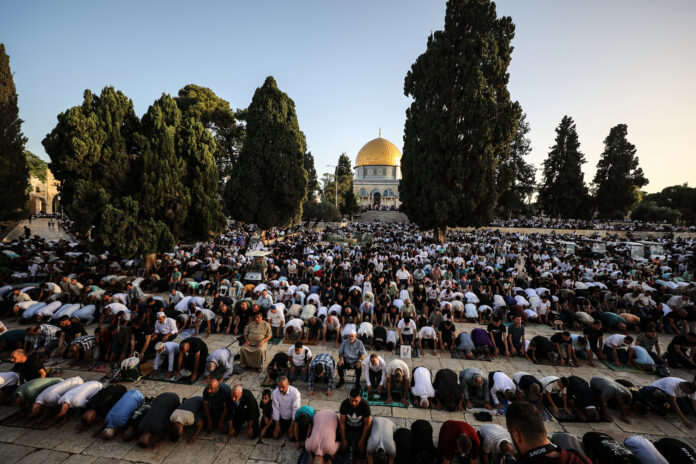
In the latest attack on Islam in the Holy Land, Israeli lawmakers are advancing legislation that would impose new restrictions on the use of loudspeakers for the Islamic call to prayer in Jerusalem, drawing strong condemnation from religious leaders and rights advocates.
The proposed law, backed by members of Israel’s far-right governing coalition, would require permits for the use of mosque loudspeakers and grant authorities broader powers to restrict or penalise their use. Supporters claim the measure addresses noise concerns, while critics say it is a direct attack on Islamic religious practice and Palestinian identity.
The legislation follows approval by Israel’s Ministerial Committee for Legislation and is expected to proceed through the parliamentary process in the Knesset.
Palestinian religious figures have warned that the move represents a dangerous escalation against Muslim religious freedoms. Sheikh Ekrima Sabri, the Imam of Al Aqsa Mosque, described the proposal as an attempt to legitimise restrictions that have increasingly targeted Islamic practices in Jerusalem.
Palestine’s Supreme Fatwa Council also condemned the bill, arguing that Israel has no right under international law to interfere with religious rites and acts of worship in occupied territory.

The proposal has revived memories of previous attempts to restrict the call to prayer. In 2017, a similar bill passed a preliminary reading in the Knesset but ultimately failed to become law after widespread opposition from Palestinian citizens of Israel, religious institutions and international observers.
Palestinian commentators say the latest initiative forms part of a broader campaign by Israel’s far-right government to reshape the religious and demographic character of Jerusalem and further marginalise Palestinian communities on both sides of the Green Line.
Subscribe to our newsletter and stay updated on the latest news and updates from around the Muslim world!
The move comes amid heightened tensions across the occupied Palestinian territories and growing international scrutiny of Israel’s policies in Jerusalem, the occupied West Bank and Gaza.
For many Palestinians, the call to prayer is not merely a religious practice but a symbol of cultural and national identity. Any attempt to restrict it is therefore viewed as part of a wider effort to erode the Palestinian presence in historic Palestine.