


Türkiye erupted in celebration on Friday as crowds marked the 573rd anniversary of the Ottoman conquest of Istanbul – the dramatic fall of the former Roman capital that reshaped the course of history and paved the way for one of Islam’s great caliphates.
A huge fireworks display was held along the Uskudar waterfront in Istanbul. Fireworks illuminated the night sky above the Bosphorus during commemorative events held across the city.
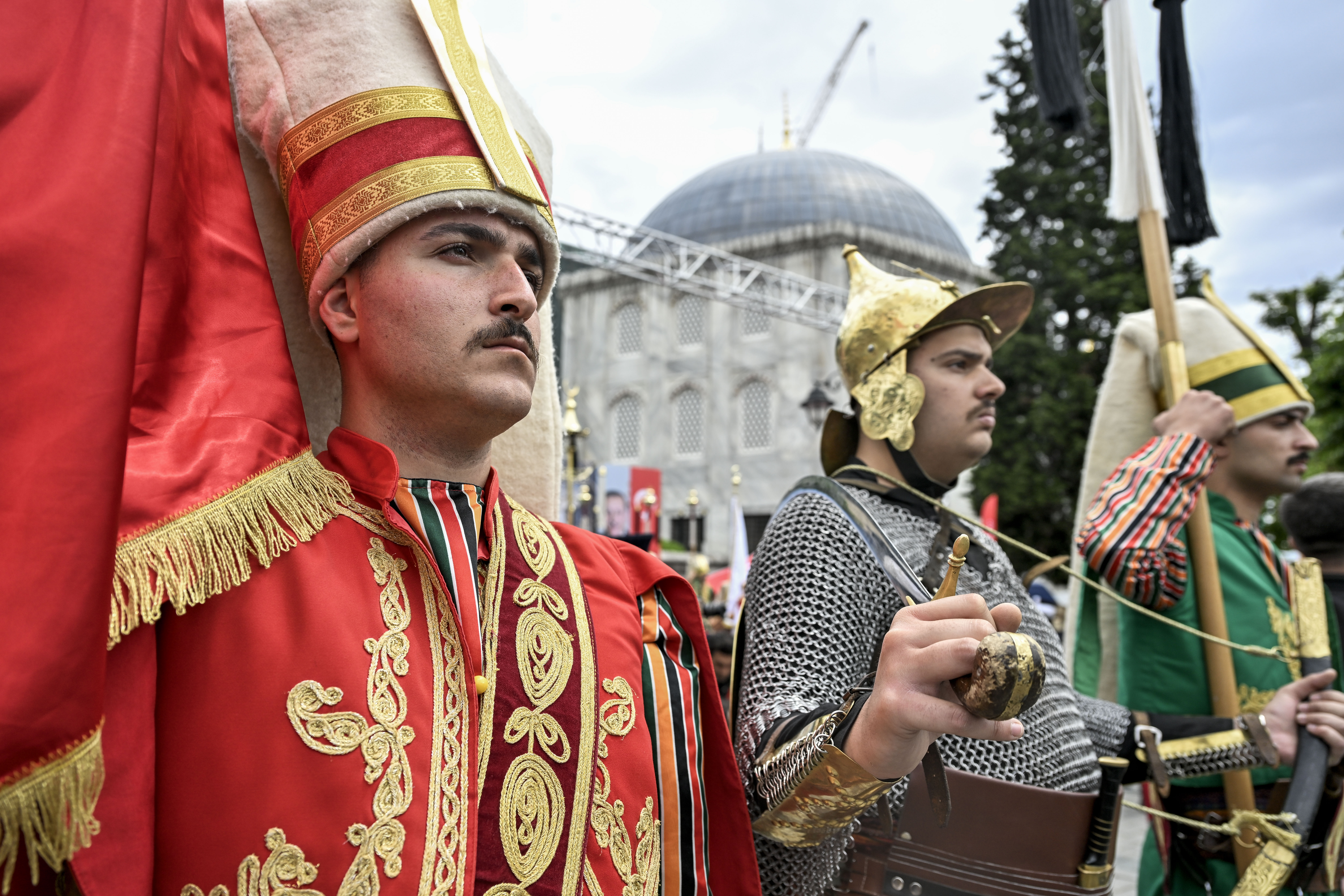
A festive procession, featuring a traditional mehter (Ottoman military band) alongside civic groups and local residents, also marched through the streets near the city’s ancient walls.
Turkish President Recep Tayyip Erdogan marked the anniversary describing the event as not only a historic military victory but also a turning point that brought peace, security, and renewal to the city.
Speaking at the “From the Conquest of Istanbul to the Conquest of Hearts” program organised by the ruling Justice and Development (AK) Party’s Istanbul provincial branch at the Halic Congress Center, Erdogan commemorated those who took part in the 1453 conquest led by Sultan Mehmed II, known as Fatih Sultan Mehmet.

“On this meaningful day, I commemorate with mercy all of our elders who participated in the conquest of Istanbul 573 years ago and who were martyred or became veterans on the city’s walls,” Erdogan said.
“I also respectfully remember that glorious commander who conquered Istanbul at the age of 21. May the 573rd anniversary of the conquest be blessed and auspicious.”
Subscribe to our newsletter and stay updated on the latest news and updates from around the Muslim world!
Erdogan said the conquest was “not merely a great victory” or an event that “opened and closed an era,” but “the transformation of darkness into light in one of the world’s most cherished cities.”

He said it established lasting peace and security, promoted tolerance toward people of different backgrounds and beliefs, and revived a city that had fallen into decline.
Quoting late historian Halil Inalcik, Erdogan said Sultan Mehmed II worked tirelessly to achieve the conquest and later rebuilt Constantinople into a magnificent Turkish-Islamic city through foundations and public institutions.
Erdogan also cited a prophetic saying often associated with the conquest of Constantinople: “Constantinople will surely be conquered. What a wonderful commander will be the commander who conquers it, and what a wonderful army will be that army.”
He described the conquest as the brightest link in the chain of victories that began with the Battle of Manzikert in 1071 and said it demonstrated what the Turkish nation could achieve in pursuit of its ideals.
The president said Türkiye would continue to protect Istanbul as the legacy of Fatih Sultan Mehmet and would draw inspiration from the conquest for future achievements.
“If we truly believe, work, and persevere in the face of difficulties, there is no task we cannot accomplish and no goal we cannot reach,” he said, invoking Sultan Mehmed’s famous determination to capture the city.
The Conquest of Istanbul
The Conquest of Istanbul, also referred to as the Fall of Constantinople, took place on May 29, 1453, and signified a crucial turning point in global history.
This event resulted in the collapse of the Byzantine Empire and the rise of the Ottoman Empire as a dominant power.
The city, one of the worlds largest and greatest cities at the time, was besieged 28 times throughout history before its conquest by the Ottoman Sultan Mehmed II.
In recognition of his hard won victory, the 21-year-old Muslim ruler was thereafter known as Mehmed the Conqueror.
The Ottoman’s would go on to form an Islamic Caliphate and would become the dominate force in the entire Islamic world, with it’s Sultans achieving recognition as the Caliph across the Muslim world.
The Ottoman Caliphate united much of the Islamic world under one centralised authority and would defend Muslim interests against European non-Muslim imperial powers and the Russian Empire.

The siege
The Byzantine army numbered around 8,000 men whereas Mehmed commanded a much larger army of around 60,000.
A technological advance also altered the balance of power – canons. A Hungarian cannon maker supplied the Ottomans with a “supergun” to attack the city walls which was dragged 140 miles from Edirne to Constantinople. It could fire canons more than one mile and made a terrible noise.
But Mehmed also understood that to take Constantinople he had to surround the city from the sea as well as the land. So he amassed a blockading fleet of around 140 ships.

In response Byzantine Emperor Constantine ordered a protective chain of mail to be laid across the harbour.
So in the third week of the seven week siege Mehmed simply ordered his fleet to be picked up and carried over land and dropped back into the water behind the defensive shield. Now he could attack from land and sea.
On the land side Ottoman losses were heavy as the walls failed to yield. But as the weeks dragged on the supergun began to exert its toll and after seven weeks a final attack was prepared.
Drummers and trumpeteers, as well as the booming supergun, created the noise that would herald the final attack on May 29, 1453. Wave after wave of the sultan’s troops attacked the walls which had been softened up by the supergun.
The walls were finally breached and Constantine and thousands of Christian soldiers were killed.
Legacy
The Hagia Sophia was then the greatest building in the world – the crowing glory of Christendom and seat of the Eastern Orthodox Church. And one of Mehmed’s first acts was to order it to be converted into a mosque, although he left other churches untouched.
The Roman Empire had finally come to an end after 1,500 years of history. It was a military and psychological blow of huge proportions to the Christian world.
As for the Ottomans, they now possessed a capital at the junction of two continents from which they could consolidate and continue to spread their domains.
And Mehmed II would go down in history as one of Islam’s great heroes – securing Muslim rule and expanding it for centuries.