

As Reform UK surged in the 2026 local elections, another major political shift unfolded across Britain: hundreds of Muslims were elected to councils, many as independents or Green Party candidates. Muslim voters are no longer retreating from politics but rather they are reshaping it, Linsay Taylor of MEND writes.
As the dust settles following one of the most seismic local election nights in recent British history, two different stories of the country have emerged. Story one: Reform UK swept up more than 1,400 council seats and took control of 14 councils, signifying the far-right party’s surging popularity. Story two: continuing the trend since the 2024 local and general elections, hundreds of British Muslims were elected to councils across the UK, largely as independents or with the Green Party.
Both of these stories matter, and considering them together is important in order to make sense of what is happening in British politics right now.
Sir John Curtice, Britain’s pre-eminent elections analyst, described these results as confirming “the fragmentation of our politics.” Reform won 26–27% of the national vote equivalent. Labour, the Conservatives, the Greens and the Liberal Democrats all hovered between 14–20%. No party commands anything approaching a majority. The old two-party system is not merely weakening — it is dissolving before our eyes.
Labour lost 1,496 councillors and control of 38 councils. Prime Minister Keir Starmer’s short-sighted strategy of pivoting rightward to chase the Reform vote, his failure to improve living standards, and his lack of a decisive response to the Israeli genocide in Gaza, have left Labour in the cold. The steady stream of failure and moral indifference has accelerated the departure of voters who once considered Labour their natural home, including, critically, millions of British Muslims who voted Labour in overwhelming numbers as recently as 2019.

A democratic awakening
Yet within this political earthquake, something remarkable has happened. Muslim communities across England have not retreated from politics in the face of disillusionment. Rather, many have chosen instead to throw themselves headlong into it.
Subscribe to our newsletter and stay updated on the latest news and updates from around the Muslim world!

In Tower Hamlets, Mayor Lutfur Rahman of the Aspire party was re-elected with 38.8% of the vote, and Aspire extended its council majority to 33 seats — its strongest ever result. In Newham, the Newham Independents emerged from nothing to win 24 council seats, reducing Labour — which has dominated the borough for decades — to just 26 seats.
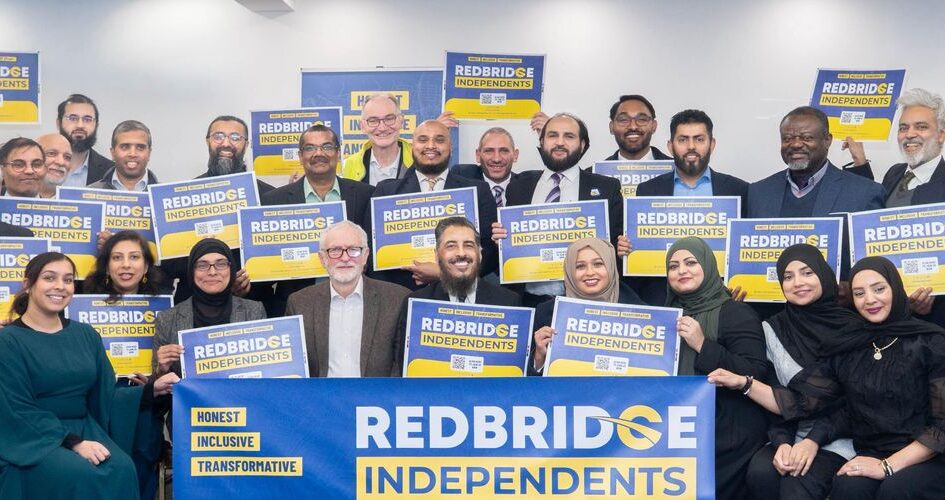
In Redbridge, the community-rooted Redbridge Independents won nine seats. Across England, strong results were recorded for independent and Muslim community-aligned candidates in Waltham Forest, Blackburn, Dewsbury and Batley. In Birmingham, Akhmed Yakoob’s Independent Candidates Alliance won 13 seats.
Roughly 212 independent councillors were elected across England — up 34 overall, with pre-election models having projected Muslim-backed independents winning around 208 seats. Across the UK, it is estimated that many hundreds of Muslim councillors now hold elected office.
This is what democratic participation looks like. Communities, fed up with being taken for granted by a Labour Party that offered warm words and delivered little, have organised, stood candidates, mobilised voters and won seats.
They have done so on platforms rooted in their communities by addressing housing shortages, the cost of living crisis and welfare cuts, all while also refusing to be silent on questions of international justice that their constituents care deeply about. Candidates like Areeq Chowdhury in Newham and Eva Tabbasam in Waltham Forest both reported that on the doorstep, voters — Muslim and non-Muslim alike — raised Gaza, the cost of living and welfare cuts at the same time.
The smear machine, running on schedule
Unfortunately, the response from parts of the political and media establishment has simply been to demonise Muslim voters and candidates. This is a pattern that goes back to the 2024 local and general elections, when Muslims began running in larger numbers and on more organised platforms.
Health Secretary Wes Streeting wrote to residents of his Redbridge seat accusing the Redbridge Independents of being “a divisive political party… more focused on foreign conflicts than on fixing potholes.” Tory leader Kemi Badenoch previously claimed Labour had “created the monster of harvesting Muslim community bloc votes,” and Reform’s Robert Jenrick decried “South Asian men instructing women how to vote.”
The ossified establishment — fearful of change and genuine political equality — has even sought to cast non-Muslim political figures as villains for organising with Muslims and welcoming Muslim candidates into their parties. Four national newspapers — The Times, The Telegraph, Daily Mail and The Sun — published grotesque cartoons of Green Party leader Zack Polanski, Britain’s only Jewish party leader, which were widely condemned as antisemitic.
This is part of a sustained effort to delegitimise the Green Party’s rising popularity and electoral successes, often by presenting it as the product of Muslim “sectarian” voting, rather than a genuine political insurgency driven by voters of all backgrounds brought together by the desire for a more equal and just Britain.
Some refuse to see this reality, and instead want to assert that some grand “Islamist” conspiracy is at play in our elections. The paranoid right-wing think tank Policy Exchange — repeatedly accused of Islamophobia over the years — quickly published a report following the local elections about “Islamopopulism.”
One of its authors, Andrew Gilligan, then sought to further this divisive nonsense by writing a piece in The Spectator titled “The disturbing truth about Britain’s Islamopopulism movement.” For these people, Muslim political activism is not a feature of a healthy democracy; it is a threat.
This framing must be challenged directly. The recent elections demonstrate not the mobilisation of a sectarian bloc but simply the organisation of citizens calling together for desperately needed political change. As Faaiz Hasan, a national elections coordinator for the Green Party, simply put it: “We are a coalition of progressive voices [that] want to build a better society.”
The challenge and the opportunity
None of this is to minimise the challenge that Reform’s rise presents. A party whose senior figures have openly engaged in Islamophobia, demonised migrants and built their entire political identity on scapegoating minorities has just won more council seats than any other party in England. For Muslim communities, and for many others, this is a deeply serious and legitimate cause for concern.
But we must not be paralysed by our anxieties. The lesson of these elections is not that the democratic process has failed British Muslims and progressives because Reform did well. It is that British Muslims are learning, with increasing sophistication and confidence, how to make the democratic process work for them, which is their right as citizens.
The importance of organisation was proven in Tower Hamlets. The need for coordination was demonstrated in Newham, where vote-splitting nearly handed a mayoralty to Labour, which did not deserve it. And alliances are critical — the relationship between Muslim communities, candidates and the smaller progressive parties needs to be deepened before the next general election.
Muslims voting and running for office based on their values are not a threat to democracy — they are showing us what democratic engagement looks like. As Vaseem Ahmed, leader of the Redbridge Independents, put it simply during the campaign: “We live here, we work here, we raise our families here, and we just want our voices to be represented.”
Linsay Taylor is the CEO of Muslim Engagement and Development