


Recent antisemitic attacks in north London have reignited debate over hate crime and public safety, but they have also triggered fresh attempts to link violence against Jews to Britain’s pro-Palestine movement. Critics say the attacks are now being weaponised by political actors to justify curbs on protest and dissent, Dr Abdul Wahid argues.
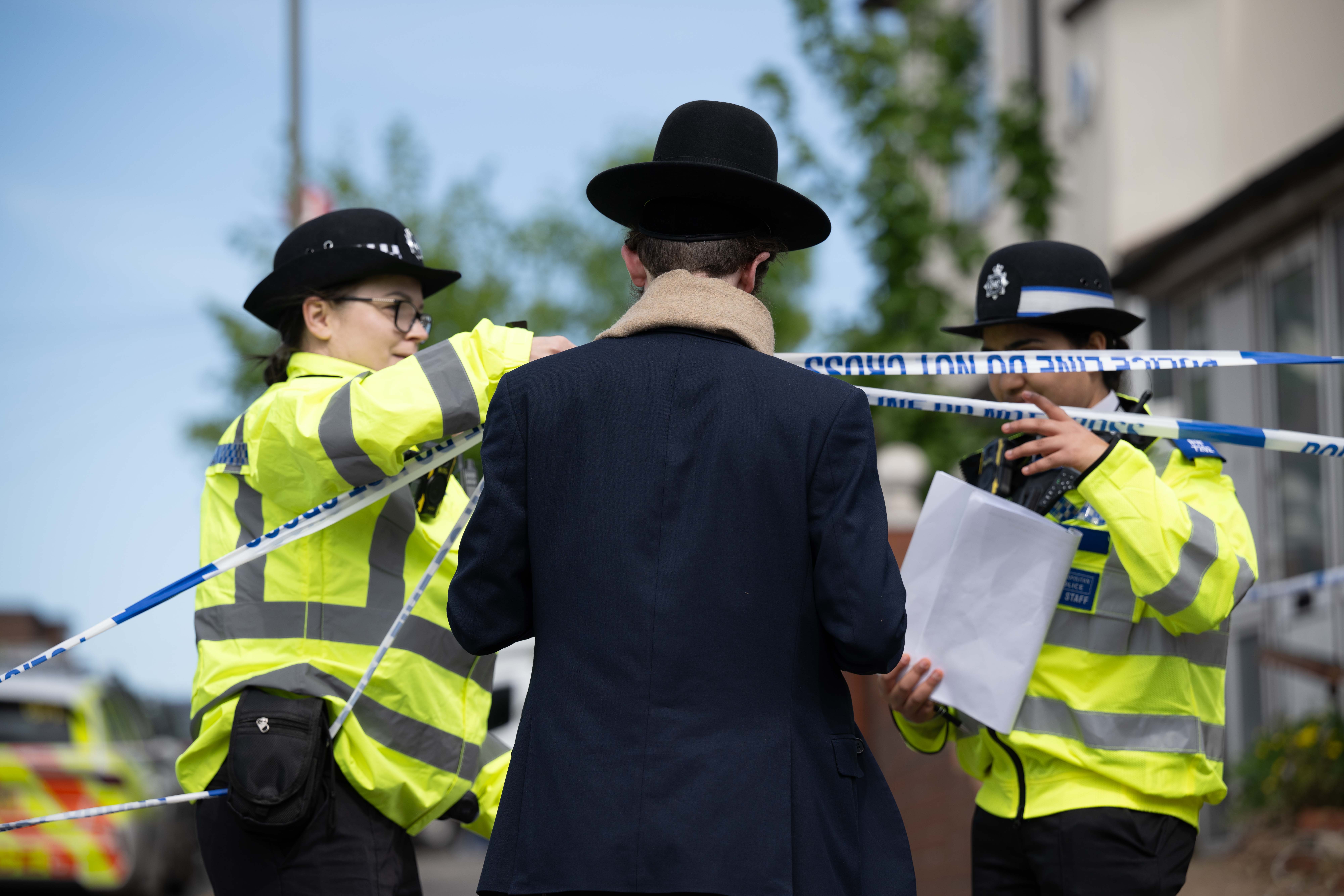
Recent weeks have seen a stabbing in London of two British Jews alongside a Muslim man, attacks on synagogues, and an assault on ambulances owned by a Jewish charity. These follow a fatal attack on a Manchester synagogue in October 2025.
No one should condone or belittle such violence. But what must be addressed is how such incidents are exploited for political ends — whilst the comparable experiences of others are ignored.
The Jewish experience in Britain and Europe
Antisemitism has deep roots in British and European history — often state-sponsored. Jews were mistreated, persecuted, and expelled across the continent. Under Prime Minister Arthur Balfour (later of the infamous ‘declaration’), Britain passed the Aliens Act in 1905 — the ‘stop the boats’ policy of its day — targeting “undesirable” immigrants, particularly Jews fleeing persecution in Eastern Europe.

In the wake of the Zionist entity’s genocide in Palestine, there has been a rise in anti-Semitism no doubt.
The question is: why do the negative experiences of others not generate the same calls for policy change?
Subscribe to our newsletter and stay updated on the latest news and updates from around the Muslim world!
Why, for example, has the Black Community in the UK not had summit in Downing Street looking at ways to tackle decades of structural racism affecting them in the workplace, criminal justice system, education, health sector? Or Muslims, in terms of discrimination they face?
Ultimately, it is because it is not about ending discrimination and harm towards Jewish people but are more about silencing voices criticism of “Israel” than anything else.
Listening to Jewish people’s experiences in the UK after 7 October 2023, much of what they describe echoes what Muslims faced in the years after 9/11.
Yet a big difference is that Muslims who have faced hostility, did so from the state and political establishment, whereas the Jewish community is not today targeted by state institutions.
Synagogues have been attacked recently, just as mosques have faced similar assaults for many years — firebombs, bricks, pigs’ heads, graffiti – although with no solidarity visits from senior politicians and usually scant media coverage – never mind major policy initiatives.
Jewish schoolchildren have complained of abuse at school; Muslim children endured years of slurs like ‘terrorist’ or ‘raghead’ – and under the government’s ‘Prevent’ programme, Muslim children were even targeted by teachers seeking to police their political and religious views because of a climate created by the political establishment.
When Jewish people have described the discomfort of a constant spotlight on the crimes of “Israel”, being asked to condemn the genocidal actions or ethnic cleansing, it reminds me of how Muslims were always being asked to condemn terror attacks or organisations – although we are told that the majority of British Jews support “Israel” (which does not justify the violence), whereas the same cannot be said that most Muslims supported those organisations that committed acts of violence.
“Protecting Israel”
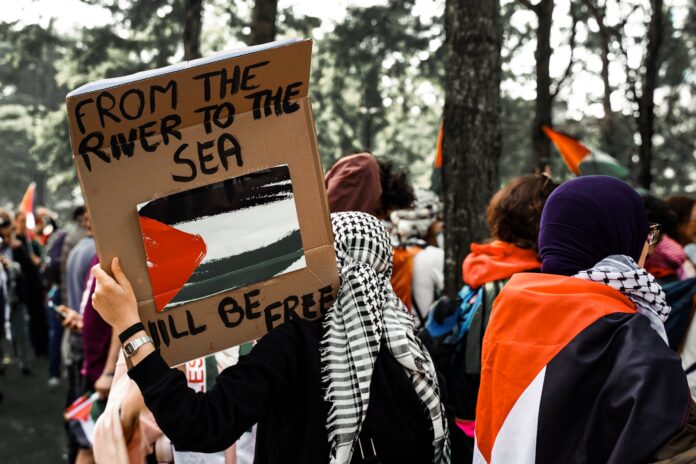
UK Prime Minister Keir Starmer — like his Conservative predecessors — has sought to portray pro-Palestinian marches as fuelling antisemitism. This has been the establishment narrative since the first demonstrations after 7 October 2023, even though most have had a strong Jewish presence.
March organiser Jon Rees noted that those making antisemitic statements or chanting “globalise the intifada” were a “minuscule” fraction of the millions who marched. Faced with a lack of evidence that the protests are themselves a problem, Starmer has endorsed the idea of a “cumulative effect” and suggested some should be banned.
This is a familiar pattern. After 9/11, false narratives conflated civilian attacks with Islam and associated political and religious views with ‘terrorism’, wrongly attributing violence to ‘extremist beliefs’ and ‘false grievances’ rather than Western foreign policy.
These narratives produced disastrous wars in Iraq and Afghanistan, detention without trial, mass surveillance, politicised terror laws, and bans on non-violent groups. They led the West to abandon the values it claimed to uphold.
Now the same logic is being applied: curtailing protest, criminalising speech, and targeting direct action groups with terror laws. A UK counter-terrorism watchdog has warned that new laws risk hitting protests and free speech.
The justice system appears compromised too. Police have refused to investigate alleged war crimes by UK citizens who served in the “IDF”, courts have declined prosecutions, and a judge has appeared to restrict defence arguments in the Palestine Action case. These measures always begin with the few but are invariably extended to others.
Weaponising antisemitism
Political actors weaponising antisemitism is not new. The occupation regime that calls itself “Israel” routinely conflates all Jewish people with its occupation, then uses attacks on Jews to deflect criticism. Starmer now attempts to silence pro-Palestine voices in protests, universities, and even the NHS in the name of fighting antisemitism.
He has called for prosecutions over chants to ‘globalise the intifada’ — bizarrely labelling it ‘extreme racism’. ‘Intifada’ means uprising, specifically against oppression and occupation in Palestine — it does not denote an exclusively violent uprising.
The call to ‘globalise’ was plainly a call to raise voices worldwide against oppression and genocide, but this has been deliberately twisted to mean a call for violence. Opposition MPs compete to out-do the government: Chris Philp has even called for bans on CAGE and 5Pillars — organisations with no connection to the attack or any call for violence.
Double standard in dealing with antisemitism?
Double standards plainly exist — particularly regarding antisemitism directed at Jews who are critical of “Israel” versus those who are not. Remarkably, Jewish Labour members were accused of antisemitism and expelled for their anti-“Israel” stance.
In the same week as the Golders Green attacks, the Times published a cartoon targeting Zack Polanski — the Green Party leader, who is Jewish but pro-Palestine — that struck many as an antisemitic caricature, with no outcry from politicians or mainstream media. His views as a British Jew are effectively negated, while the Chief Rabbi — who has described IDF soldiers as “our heroic soldiers” — is treated as speaking for every Jewish person in the UK.
The pattern is clear: a full-scale crackdown on “antisemitism” that effectively curtails criticism of “Israel”, while permitting “antisemitism” against Jews who criticise or oppose the Zionist occupation.
Other double standards
In a BBC interview on 3 May 2026, Conservative leader Kemi Badenoch claimed society would never permit protests near Black or Muslim communities or their places of worship. This is plainly untrue and an attempt to problematise pro-Palestinian activism.
After the Southport attack — committed by someone who was not Muslim — a mob laid siege to a mosque. Far-right demonstrators protested outside hotels housing asylum seekers and outside mosques across the UK throughout the summer of 2024, with barely a word from Badenoch or her party.

Badenoch claimed antisemitism has become acceptable at dinner parties — yet, when pressed, admitted she had never actually heard it. She asked whether we were waiting for millions to be killed before acting on marches — while ignoring that those marching for Gaza do so in protest against a genocide that successive British governments have been complicit in.
She argued that protesters must be driven by antisemitism because they do not march against atrocities in Nigeria or Sudan — overlooking the obvious: that Britain’s direct complicity in the occupation of Palestine is precisely why people feel so strongly about this issue.
This is not merely a double standard. It is a double standard deployed to fuel a narrative that recent attacks represent an existential threat caused by pro-Palestine activism.
How should people respond?
The very fact of this clampdown demonstrates that pro-Palestinian voices have been effective in heightening global awareness. The agenda is to use any incident that can be labelled antisemitic to silence support for Palestine. Those opposing the occupation, genocide, and ethnic cleansing must therefore continue to raise their voices — highlighting the plight of the Palestinian people and exposing the nature of the occupation.
This pattern — selective outrage, manufactured narratives, silencing of legitimate dissent — is how the state defends its interests. We must stay alert to these mechanisms, keep the focus on the issues that matter, and argue for what we believe will bring an end to the suffering.
In my view, that will not happen without a military intervention by official armies from Muslim countries to remove the forces of occupation and establish a just system for all people of the region. If that is one of the arguments they are trying to shut down, it is all the more reason to keep making it.
It is not antisemitic to believe that.
Abdul Wahid has been active in Muslim affairs in the UK for over 25 years. He has been published on the websites of Foreign Policy, Open Democracy, the Times Higher Educational Supplement, and Prospect Magazine. You can follow him on X/Twitter @AbdulWahid_X.