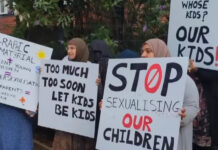



Dilly Hussain argues that Britain is, at best, a ceremonially cultural Christian country, but structurally and societally secular, and that the far right’s insistence otherwise is hollow rhetoric dressed up as the “preservation of Christian heritage.”
Yesterday, I had the displeasure of watching a painfully shallow debate on TalkTV between Reform UK’s London mayoral candidate, Leila Cunningham, and a panel of right-wing commentators debating whether Britain is a Christian country.
The whole engagement was embarrassing. Not because the question itself is unreasonable; it is a perfectly valid question, but because the discussion lacked depth, clarity and basic political literacy.
These are people who present themselves as serious politicians and pundits, yet the debate never rose above jingoistic slogans and culture war talking points.
So let’s set out the premise properly.

Post WW2 order
We live in a post-World War II global order, a so-called rules-based international system. The world today is made up of roughly 197 recognised nation states. Each has defined borders. Each supposedly has sovereignty. Each, at least in theory, is bound by international law, which prohibits territorial expansion by force. That is the structure of the existing world order.
Subscribe to our newsletter and stay updated on the latest news and updates from around the Muslim world!
Now, in reality, we all know international law does not apply equally. It does not restrain America, Israel, France, Britain, China, Russia or other nuclear powers in the same way it restrains weaker, non-nuclear states. That is the geopolitical reality. But legally and structurally speaking, the international system is built around sovereign nation states. That is point one.
Secular nation states
Point two: the overwhelming majority of these nation states are secular. By secular, I do not mean atheist. I mean that religion plays no governing role, or only a very limited or symbolic one, in how the country is run.
Laws are not derived from scripture. Governance is not based on theology. Social morality is not policed according to religious jurisprudence.
Out of nearly 200 countries, you can realistically identify only a handful where governance is explicitly grounded in religious doctrine: The Vatican, Saudi Arabia, Iran, Afghanistan and Brunei.
Perhaps there are a few other grey cases, but those five stand out clearly. In those nation states, religion is embedded into the legal structure of governance, and public morality is regulated accordingly.
The Muslim world
The vast majority of Muslim-majority countries are secular nation states. Yes, some have “Islamic” in their title. Yes, most mention Islam as the state religion in their constitutions. Yes, some even have aspects of Sharia law in their penal code, educational curriculum and public indecency laws.
But their legal systems are largely civil and secular. Their governance is parliamentary, presidential or monarchical within a modern constitutional framework. They are not operating comprehensive religious law in the way normative Islamic jurisprudence would require.
The same applies to Christian-majority countries. Every single Christian-majority country in the world is a secular nation state, with the sole exception of The Vatican. None of them govern by Biblical law. None of them derive their legislation from Christian theology. Their source of authority is parliamentary, constitutional and civil.
You might then ask: if most Muslim-majority countries are also secular nation states, why are many of them objectively more religiously conservative in public life? The simple answer is that the global Muslim population, on average, is far more religiously committed to wanting Islamic values and morality to shape public life than secular Christian-majority societies in the West, and even in the Global South.
That difference in societal commitment, not governmental or legislative structure, explains much of what people observe, along with a completely different historical trajectory and relationship with political power and religious authority, from the inception of Islam to the modern day. But that is a separate conversation for another day.
Religious pluralism
Another defining feature of secular nation states is religious pluralism.
To varying degrees, these states allow religious minorities to exist, worship, build places of worship, celebrate religious festivals and even proselytise their religion under freedom of speech and expression. Of course, some are significantly more restrictive towards religious minorities than others, but the framework of religious pluralism exists across the entire secular world.
Now, bringing this back to Britain. Britain is a secular liberal democracy with a parliamentary governing system and a constitutional monarch. Yes, the monarch is the head of the Church of England. Yes, Christianity is the established religion. Yes, bishops sit in the House of Lords. Yes, the monarch gives Royal Assent to legislation.
But the monarch does not draft laws. He does not rule by scripture. He does not govern by decree. And if a monarch (or prime minister) ever attempted to obstruct the democratic will of Parliament, the constitutional system would override him.
Britain is constitutionally, culturally and historically Christian. Its heritage, symbolism and many of its traditions are Christian. But that does not make it a Christian state. It is not governed by the Bible. It does not regulate society through Christian jurisprudence. It does not police morality according to Christian doctrine. It is not even a Christian-majority country with only 46.2% of the population identifying as Christian according to last Census.
If Britain were truly a Christian state, the implications would be profoundly apparent. A genuinely Christian theocratic state would have to regulate marriage and sexuality according to Biblical doctrine.
Same-sex and premarital relationships would not be legally recognised or publicly expressed. Pride festivals would be outlawed. Public drunkenness would be a crime. Bookies and casinos would face prohibition. Usury-based financial systems would be fundamentally challenged. Public indecency laws would be far stricter. There would likely be a Christian penal code rooted in scripture, and capital punishment would almost certainly return.
In other words, the entire social and moral architecture of modern Britain would be transformed. And none of the people shouting “Britain is a Christian country!” actually want that.
The far right’s empty religious rhetoric
Whether it is Restore Britain, Reform UK, Christian nationalists, civic nationalists or ethno-nationalists, they do not want Britain to become a Christian version of Saudi Arabia, Afghanistan, Iran or even The Vatican. Not today. Not tomorrow. Not ever, methinks, for now anyway.
Because their hollow religious rhetoric and zealotry are not about implementing a theocratic state. It’s about identity politics and cultural signalling. It is about coping with the moral vacuum created by secular liberalism and the consequences of abandoning Christianity as a comprehensive way of life.
Additionally, I feel it also has to do with demonising, discriminating against and restricting the growing presence of Islam and Muslims within Britain’s secular, pluralistic and multicultural society.
Europe itself spent centuries wrestling with religious authority and theocratic control before emerging into a secular constitutional order. The Reformation, the Enlightenment, parliamentary sovereignty and constitutional monarchy; these developments were, in part, reactions against religious absolutism, theocracy and dogma.
The far right understands this. They benefit from secular liberal democracy. They enjoy its freedoms and rely on its protections. They have no real appetite or desire for Biblical governance over their own private or public lives, because implementing a genuinely Christian state would require more than cultural nostalgia and denigrating Islam; it would require real belief, discipline and sacrifice. It would mean giving up many of the indulgences and “freedoms” that secular liberalism provides, and that is a price almost none of them are willing to pay.
So let’s be honest. Britain is constitutionally Christian; symbolically Christian in parts. But structurally and legally, it is a secular liberal democracy. And unless its entire governing system is radically reshaped and redefined to make the Bible the primary source of legislation and public morality, it will remain exactly that for the foreseeable future.