


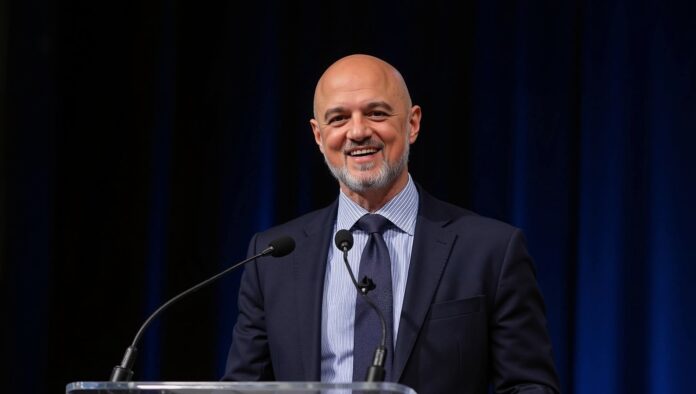
“We’ve been expecting you.” Those were the first words immigration officers said to Anas Altikriti of The Cordoba Foundation after he landed in Canada. Eleven hours later, he was forced back on a plane to London – rejected, treated like a criminal and left convinced the decision had been made long before he arrived.
I had never wished to write this but what happened to me over the past few days carries implications that reach far beyond my personal experience; implications for freedoms, rights, security, and the direction in which our societies are heading.
On the morning of Monday, May 11, I travelled from London to Toronto. My plan was to spend three days in Montreal before heading to Toronto for the Muslim Association of Canada (MAC) convention, to which I had been invited and which was the primary purpose of my visit. I had completed the necessary procedures, applied for an ETA – a visa of sorts – and received approval almost instantly. I had no reason to anticipate any difficulty.
I arrived at 10:30 local time after a seven-hour flight. At passport control, I was directed to the immigration department. This surprised me slightly, but caused no real alarm, as it is something I have experienced at various destinations over the years. I assumed it would be a routine procedural chat.
What followed was eleven hours locked inside a system that was pointless, wasteful, and ultimately futile for all parties concerned, including the Canadian authorities themselves.

The most telling moment came early. The first officer to see me greeted me with a broad smile and the words: “We’ve been expecting you. There’s been a lot written about you and your visit.”
For hours, officers asked me the very same questions I had already answered on my ETA form, including the absurd and insulting: “Have you ever been associated with narcotics, terrorist, or criminal groups?” There was no substance to any of it. No one asked about my views, my ideas, or what I intended to say at the convention. Nothing. In fact, when at one point I offered to explain or clarify something, the officer made clear that he would prefer that I did not.
Subscribe to our newsletter and stay updated on the latest news and updates from around the Muslim world!
It was clear to me within the first three hours that they had no intention of allowing me into Canada, and that the hours that followed were a search for a pretext. By 4pm, the officer had found one. I could see it in his face the moment he decided to say it.

During an earlier round of questioning, he had asked whether I had ever been denied a visa to enter any country. Without hesitation, I told him: yes. In 2023, I had applied for a US visa, which was denied. He asked for confirmation; I searched my email inbox on the spot and produced the November 2023 message from the US State Department denying my application and inviting me to resubmit certain documents should I wish to appeal the decision. I found no record of having done so.
The officer then claimed that in my ETA application I had answered “No” to the question: “Have you ever been denied a visa by any country?”
I find this extraordinary. I asked to see the question and my answer, which he appeared to be viewing on his screen. He responded with silence and a blank expression, advising me to consult my own records. I could not locate the document, and I doubt I ever retained it. But I maintain, unequivocally, that I could not have answered that question with a “No”. My US visa denial was made public at the time, and I have spoken about it openly on countless occasions since.
On the basis of this alleged discrepancy, and despite the fact that I had received prior approval to enter Canada, had flown seven hours, and had answered every question honestly – including volunteering the very information now being used against me and producing evidence of it when asked – the officer ruled that I had “misrepresented” myself in my application.
Let us be clear: this was not about a misrepresentation. This was about the opening line delivered six hours earlier that day.
I would, frankly, have had more respect for the Canadian immigration authorities had they simply said so: that they were under pressure not to admit me; that my views on Palestine were unacceptable to them; that my criticism of Israel’s crimes against humanity was intolerable; that my presence would generate negative coverage from certain quarters, and that the lobbying pressure was too great to resist.
Any of that would at least have been honest. But to reduce it to a technicality – to an alleged error in a form relating to something I disclosed openly, honestly, and immediately, with evidence – is beneath them, and deeply disrespectful to me and to my hosts.

As is my legal right, I was offered the option to request a review by a second immigration officer. But it was clear that the decision had been made before I stepped off the plane. The hours spent in that hall were not an investigation; they were a search for a coat of respectability to drape over an unjustifiable decision.
I was also acutely aware that the last flight to London was fast approaching, and that the officers would have had no difficulty keeping me in that hall – without food or water (I managed to find $15 in my pocket and asked a guard to fetch me a coffee and a biscuit) – for another twenty-four hours. The prospect of being “forcibly removed”, with all its attendant legal consequences, was not one I was willing to risk.
I signed the declaration withdrawing my application to enter Canada and boarded the 9:30pm flight back to London, where I arrived at 9:30 the following morning, almost thirty hours after my journey had begun.
Even then, the final indignity remained. Having committed no crime, and having voluntarily agreed to leave, I requested permission to enter the departure lounge to get something to eat, as I had not eaten since around 7 that morning.
The answer came back clearly: the “boss” had not authorised it. I would be escorted directly to the plane. Forty minutes before departure, two officers instructed me to collect my bags and walk with them to the aircraft. They were almost generous enough to allow me to purchase a bottle of water during the long walk to the gate, where I received the kind of looks from passengers and staff ordinarily reserved for people in handcuffs.
What is at stake?
The thirty hours I lost came at both a financial and personal cost. I had booked a flight to Montreal, three nights in a hotel, and return tickets to Toronto. Budget fares are non-refundable. Those losses I can absorb. The deeper loss is something else entirely.
We live in an era in which smear campaigns, launched by powerful, well-resourced, and often deeply questionable interests, are increasingly able to determine who may speak, where, and to whom. I welcome disagreement. I welcome debate, even fierce and uncomfortable debate. But when debate is replaced by prohibition – when the response to ideas is not argument but exclusion – something vital is being dismantled.
There was a time when public spaces were filled with contested voices and open discourse. That time is receding. Closing down, banning, proscribing, and excluding have become the dominant tools in what were once known as free societies, brimming with open spaces. The immigration officers never asked what I was planning to say at the MAC convention. I suspect the convention organisers would have been more than happy to welcome observers from the immigration service, had that been the interest. But that was never the point.

It is no longer about what I think or say. It is about who I am, or more precisely, who my adversaries have portrayed me as being, regardless of truth or fairness.
There is a serious conversation to be had about cancel culture and about what it means for societies that claim to uphold freedom, rights, and human dignity. That conversation is coming. But not here in this article, and not today.
I want to be clear: I was never threatened, and I never felt physically unsafe. The individual officers were not overtly disrespectful. When I asked to use the bathroom, to find a space to pray, to locate a power socket for my phone, or to use my last few dollars to buy a coffee, those involved were courteous enough. But the entire episode was unnecessary, and it has left a mark on my impression of a country I had genuinely come to admire, particularly in light of its Prime Minister’s principled stance towards Trump, and his memorable – historic, even – speech in Davos.
I have no doubt that Canadians will have felt no impact from my ordeal, and that most will not care. But history, recent and distant, teaches us that small things carry large meanings. The insignificant-looking mole on the forearm can be the thing that matters most.
I am back home in London, in the unusual and almost unfamiliar luxury of a few days without engagements or commitments. But this experience is worth recording for what it reveals about the direction in which entire human systems are heading.