


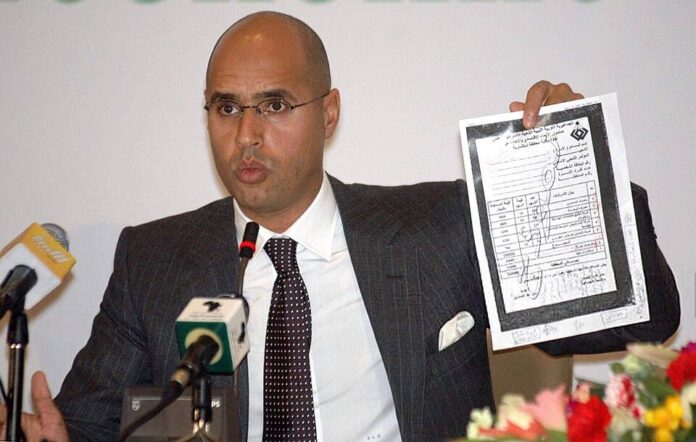
Saif al-Islam Gaddafi, the son of Libya’s late dictator Muammar Gaddafi, was shot dead at his home in the city of Zintan after masked gunmen stormed the property, according to his political team and local sources.
Saif al-Islam Gaddafi, widely regarded as the most influential of Muammar Gaddafi’s sons, was killed on Tuesday night in what his allies described as a targeted assassination. Sources close to the family, his lawyer Khaled Al-Zaidi, and Libyan media said he was shot dead inside his residence in the northwestern city.
His political team said “four masked men” forced their way into the house and carried out what they described as a “cowardly and treacherous assassination”. Mr Al-Zaidi confirmed the death in a Facebook post but provided no further details about the attackers or the circumstances surrounding the killing.
According to reports, the assailants disabled the home’s CCTV system before confronting Saif al-Islam. Accounts suggested he clashed with the attackers after the cameras were shut off, “in a desperate attempt to conceal traces of their heinous crimes”. The exact sequence of events remains unclear, and no group has claimed responsibility.
Killing details

Saif al-Islam’s cousin, Hamid Gaddafi, announced his death publicly, saying he had “fallen as a martyr”. He said the location of the compound had been kept secret, raising questions about how the attackers were able to access the property.
Zintan lies about 136 kilometres southwest of Tripoli and has long been controlled by powerful local armed groups. Saif al-Islam had lived there since his release from detention in 2017, largely staying out of public view despite his continued political ambitions.
Subscribe to our newsletter and stay updated on the latest news and updates from around the Muslim world!
The killing has raised fears of renewed instability in Libya, where political assassinations and militia violence have repeatedly undermined efforts to restore national unity since the 2011 uprising that ended Gaddafi’s four decades in power.
Political legacy
Born in June 1972 in Tripoli, Saif al-Islam was the second son of Muammar Gaddafi and his second wife, Safia Farkash. Fluent in English, he studied at the London School of Economics and was often presented as the reformist face of the regime during his father’s rule.
He played a prominent role in Libyan politics before 2011, acting as a senior adviser and informal diplomat for his father. Many foreign governments viewed him as a potential successor who might soften Libya’s international image while preserving the existing power structure.
That image collapsed during the 2011 uprising, when Saif al-Islam publicly defended the violent crackdown on protesters. After his father was ousted and killed, he was captured by anti-Gaddafi fighters in November 2011 and held by a militia in Zintan for nearly six years.
Legal battles
In 2015, a Libyan court sentenced Saif al-Islam to death in absentia for his role in suppressing protests and for the killing of demonstrators during the revolution. He denied the charges but remained a deeply polarising figure across the country.
He was also wanted by the International Criminal Court on charges of crimes against humanity linked to the 2011 violence. Despite the warrant, he was released in June 2017 after one of Libya’s rival governments granted him amnesty, a move criticised by human rights groups.
Since his release, Saif al-Islam had lived quietly in Zintan, though his legal status and freedom of movement remained contested amid Libya’s fractured political landscape.
Election ambitions
In November 2021, Saif al-Islam announced plans to run for president, a move that sparked outrage among anti-Gaddafi factions in both western and eastern Libya. Supporters saw his candidacy as a path to stability, while critics viewed it as a return to authoritarian rule.
Libya’s High National Elections Committee ultimately disqualified him from the race, citing legal and eligibility concerns. The election itself was later cancelled amid deep disputes between rival administrations and armed groups.
More than a decade after Muammar Gaddafi’s overthrow, Libya remains divided between competing governments, militias and political factions. Saif al-Islam’s killing adds another layer of uncertainty to a country still struggling to reconcile its past with an unstable present.