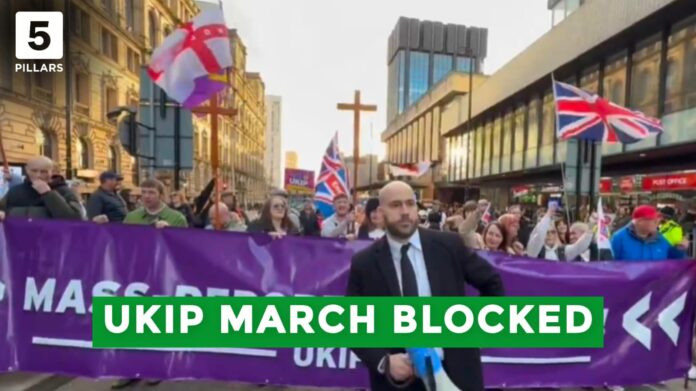
UK Police have stopped a planned UKIP hate march through a diverse part of east London amid fears of serious disorder. The Metropolitan Police say the protest can still go ahead elsewhere, but not in Tower Hamlets which has a large Muslim population.
The Met announced that the planned UK Independence Party (UKIP) march on January 31 in Whitechapel, east London, will not be allowed to proceed through the borough because of concerns it could lead to violence and disorder.
Organisers of the far-right march described the demonstration as a “crusade”, urging supporters to “reclaim Whitechapel from the Islamists” and “take our country back”.
Police said the overtly Islamaphobic rhetoric risked inflaming tensions and could lead to violence directed at Muslims, contributing heavily to their decision to block the march in an area with a large Muslim community
Tower Hamlets has one of the UK’s largest Muslim populations, and officers said permitting the gathering in that area would be “reckless,” given past tensions.


The event is one of many planned in cities including Liverpool, Newcastle and Glasgow.
Scotland Yard said the decision was about public safety and not a blanket ban on the group’s right to protest.
Subscribe to our newsletter and stay updated on the latest news and updates from around the Muslim world!
However, it indicated that UKIP supporters could stage their protest in another part of London where the risk of confrontation was lower.
Anyone entering Tower Hamlets to take part in the march could be arrested under the conditions imposed by the police.
This marks the second time in recent months that police have rejected a proposed UKIP event in the same part of the city amid fears of clashes.
In October 2025, officers used legal powers to stop a planned rally in Whitechapel and other parts of Tower Hamlets after warnings of serious disorder if it went ahead in that area.
Response from UKIP
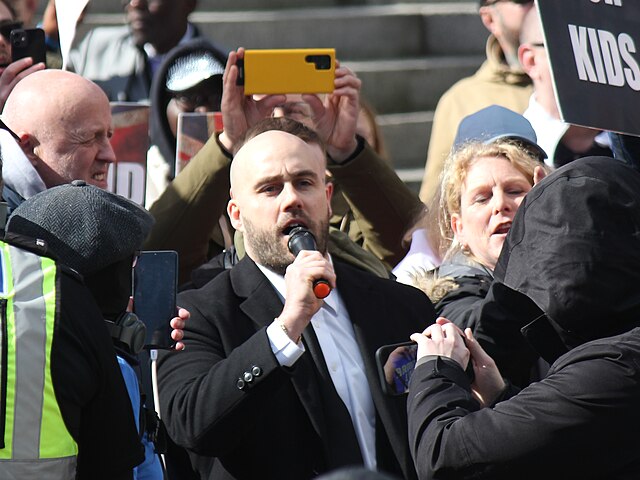
Enraged UKIP leader, Nick Tenconi, has strongly criticised the police decision, taking to social media platform X to argue that authorities had “caved into the Islamists” and violated UKIP’s democratic right to assemble peacefully.
He called the decision “two-tier policing” and said it showed a failure by the Met to uphold protest rights.
The party, under Tenconi’s leadership since February 2025, has framed the march as a demonstration of Christian values and national identity.
UKIP’s announcements describe the upcoming event as a chance to “pray, worship and march” in Whitechapel, though critics note that politics remains central to the message.
Tenconi himself has a controversial profile. Known for outspoken far-right views, he has described himself as a defender of conservative values and has opposed immigration policies – positions that have drawn criticism from anti-racism groups and mainstream commentators.
Wider reaction
Deputy Assistant Commissioner James Harman of the Metropolitan Police, explaining the decision said: “I won’t draw a comparison with Maccabi, but it’s not a ban, because on 31 January, Ukip may very well be able to undertake their protest, but to do so at a location which we do not feel, we do not assess, we do not believe, to pose a risk of serious disorder and serious violence.”
Local community leaders and anti-racist groups have welcomed the police action. Lutfur Rahman, the mayor of Tower Hamlets, said the planned demonstration would have caused disruption and intimidation within a community that values diversity and inclusion.
Rahman confirmed that a separate peaceful march celebrating unity and diversity would go ahead in Whitechapel.
In previous instances, large local counter-protests have brought thousands of residents into the streets to oppose far-right rallies, turning planned UKIP events into major clashes between groups with opposing views.
Organisers of these grassroots movements see the police decision as a reflection of strong community resistance to divisive far-right politics.
Meanwhile, campaigners from organisations such as Stand Up To Racism have continued to mobilise against UKIP, calling for peaceful demonstrations that promote diversity and oppose hate.
Anti-racist activists argue that blocking far-right marches is necessary to protect community harmony and prevent escalation into violence.