


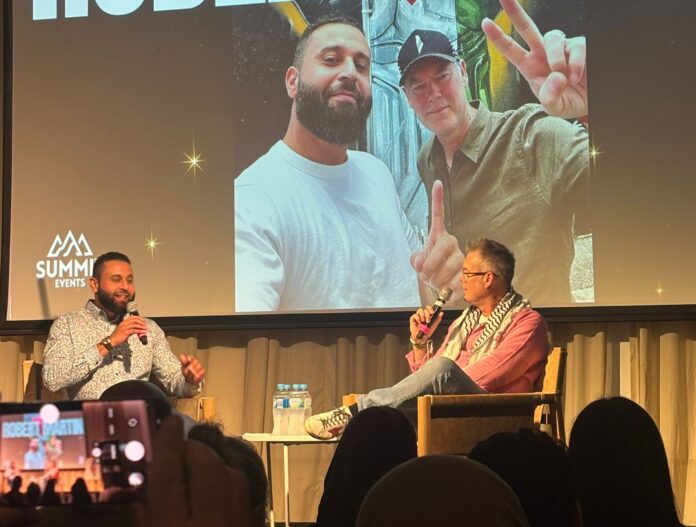
Australian activist Robert Martin, widely known for his outspoken advocacy on Palestinian rights, formally embraced Islam at a public event in Melbourne this week, following a detailed address in which he outlined his personal history, activism, and reasons for converting. Ahmed Daiyan, the founder of Ekhoni Shomoi, witnessed the spectacular event.
The event, titled “Robert Martin: I Am Ready to Become Muslim – My Story & Shahada”, was attended by more than three hundred people. It concluded with Martin embracing Islam in front of a live audience.
Early life, care and trauma
During the event, Martin provided an extensive account of his childhood, describing a background shaped by neglect, instability, and prolonged periods within state care during the 1970s. He said he was frequently left unattended as an infant, prompting intervention by neighbours and authorities before being placed into institutional care.
He was adopted at the age of four, but said his early experiences had already resulted in deep psychological trauma. According to Martin, behavioural issues during childhood were often treated as personal failings rather than symptoms of neglect, a pattern he said reflected the limitations of welfare and mental health systems at the time.

By his early teens, Martin said he was regularly consuming alcohol and struggling at school. He reported being expelled from multiple institutions and later spending time in juvenile detention, including on his 16th birthday.
As an adult, Martin was diagnosed with borderline personality disorder and complex post-traumatic stress disorder (PTSD), conditions he linked to long-term exposure to trauma during formative years. He said these diagnoses helped him later understand patterns of emotional instability and self-sabotage that persisted into adulthood.
Subscribe to our newsletter and stay updated on the latest news and updates from around the Muslim world!
Adulthood and introduction to the Palestinian cause
Despite these challenges, Martin said he maintained periods of financial stability and employment throughout adulthood, attributing this to strong communication skills and adaptability.
Martin also discussed his limited contact with biological relatives. He said he briefly reconnected with his biological sister in early adulthood, but it was not a connection he was willing to keep then. He later reached out to her, only to learn that she had been murdered before he was able to offer support. He also described a short meeting with his biological father, which did not result in an ongoing relationship.
By his late 20s and early 30s, Martin said he had distanced himself from the extended adopted family entirely, choosing instead to focus on his own family.
Martin traced his involvement with Palestinian issues to the late 1990s, when he formed a close friendship with a Palestinian colleague, Nasser Mashni, who is now the president of the Australia Palestine Advocacy Network (APAN). For many years, he said, he remained sceptical of Palestinian accounts of the conflict, relying largely on Australian and Western media narratives.
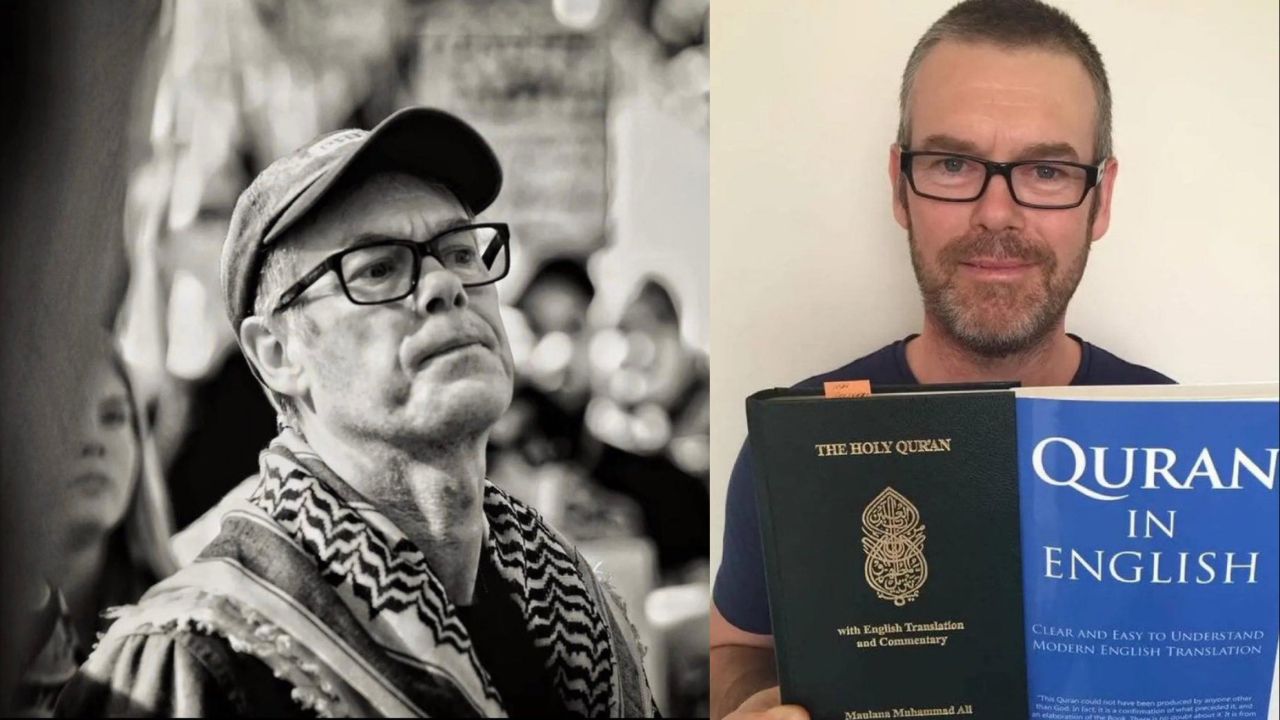
That position later began to change in the early 2010s. Martin said the emotional impact of witnessing his colleague’s distress, combined with images of civilian casualties, prompted him to research the conflict independently.
He began posting commentary on social media and engaging publicly on the issue. According to Martin, this activity resulted in him being contacted by Australia’s anti-terror authorities following public complaints. He said he cooperated fully with investigators and was informed that no further action would be taken.
Seeking firsthand understanding, Martin later travelled to the occupied West Bank. He described witnessing stark disparities in treatment between Palestinians and foreign visitors at border crossings and checkpoints.
Martin said he observed routine military activity in Palestinian residential areas, including house demolitions, settler presence, and confrontations involving Israeli security forces. He also recounted witnessing incidents involving children and families, which he said reinforced his understanding of the occupation as a system affecting daily civilian life.
During his visits, Martin formed close relationships with Palestinian residents and said he was struck by the hospitality he received, despite being a foreigner with no prior ties to the community.
Martin said his exposure to Islam began during his time in Palestine, where he heard the call to prayer for the first time and visited mosques in local neighbourhoods. He described being welcomed without interrogation or suspicion, an experience he contrasted with the treatment he had witnessed elsewhere.
The Muslim community in Australia
After returning to Australia, Martin continued engaging with Muslim communities, including religious educators and leaders in Melbourne. He began studying the Quran with commentary and said he was struck by similarities between Islamic teachings and concepts he had encountered through mental health treatment and self-help literature.
According to Martin, his interest in Islam developed gradually over several years, and he spent months considering the decision before choosing to convert publicly.
At the Melbourne event, Martin addressed the audience before formally declaring the Shahada. Religious figures present described the moment as the culmination of a long process rather than a spontaneous decision.
Audience members responded with sustained applause, and religious leaders described Martin’s conversion as significant due to his public profile and long-standing advocacy work.
Martin’s conversion places him among a small number of non-Muslim Western activists whose engagement with Palestine has intersected with a personal religious transformation. While Martin framed the decision as a private spiritual commitment, its public nature reflects his broader approach to activism and transparency.
As he concluded at the event, Martin said his life had been shaped by prolonged hardship but that he viewed his journey as cumulative rather than fragmented, and all that led “to exactly where I am meant to be.”