


Muslims across the Western world, particularly in the US, must not compromise core Islamic values and ethics in pursuit of short-sighted political gains, writes Fero Imen.
This year I have travelled extensively – Malaysia, the Middle East, several European cities, and soon my final destination, Istanbul. As a Muslim woman, each journey revealed the different ways Islam is practiced and perceived around the world.
Malaysian students preparing to study abroad shared their worries about keeping their faith in Europe. Palestinian activists in Madrid focused solely on nationalism. German Muslims worked with non-Muslim organisations, building new structures to gain influence.
Everywhere, the question of belonging and understanding followed me. The shadow of American and Western foreign policy has shaped societies and perceptions for over a century, and its imprint was visible everywhere I went.
America First or Islam first?
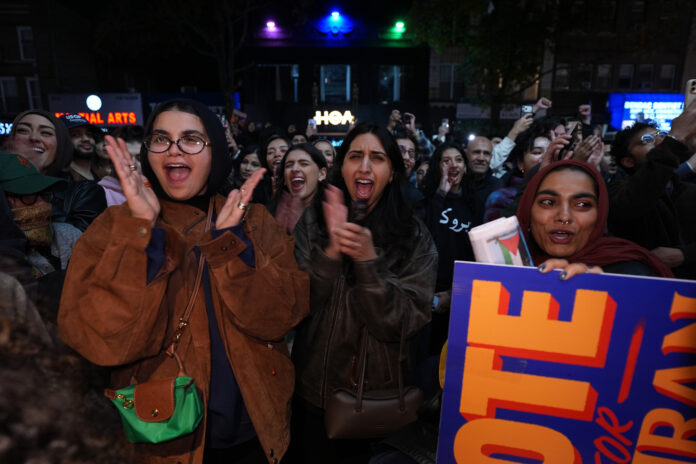
In the US, a new political moment is unfolding where Muslims are both participants and instruments. America First has shifted from a nationalist slogan to something some Muslims now embrace. For some it is frustration with AIPAC, anger at the US funding and arming the genocide of Palestinians, or a search for political leverage.

Prominent Muslim commentators speak about global injustice and notable preachers translate moral reasoning into American political debates, while advocacy groups attempt to balance civil rights work with political pressures. Across this landscape, religion increasingly becomes a tool to gain influence, justify compromises, and shape alliances.

Yet this raises a fundamental question: what remains of Islam when it is subordinated to foreign flags or state agendas? Aligning American Islam with America First may seem clever – confronting lobbies, gaining visibility, signalling independence – but on what foundation is that visibility built? On the principles of faith, or on the logic of a political system that reshapes Islam to suit its objectives?
Subscribe to our newsletter and stay updated on the latest news and updates from around the Muslim world!
Turkish Islam offers a warning: religion selectively reframed to support national projects, moral guidance subordinated to state priorities. American Islam risks the same path, bending faith to political loyalty. No Quranic verse or Prophetic teaching ever fused nationalism with moral universality. Faith cannot bend to flags without consequence.
History’s repeated warnings
Modern Muslim-majority nation states offer a clear lesson. Across North Africa, the Midle East and South Asia, political elites have repeatedly placed national and foreign interests above the Ummah. Religion has been weaponised for legitimacy and control rather than moral guidance.
Indonesia’s cautious diplomatic stance on Palestine reveals a calculated distance from broader Muslim solidarity. North African states like Egypt openly compromise Muslim interests by aligning with American and Israeli agendas. The UAE’s pro-Israel policies go further, supporting forces that wage war on Muslim populations while presenting itself as a regional leader. These are not small compromises; they are betrayals, fractures in the Ummah, and complicity with powers that harm Muslims. Pan-Islamic ideals – universal, moral, unifying – are repeatedly sacrificed for nationalist priorities.
During my travels, I saw echoes of this everywhere. Malaysian students struggled between visibility and conformity. Palestinian activists prioritised national identity at the expense of Islam’s universal message. German Muslims pursued influence through alliances that diluted religious consistency. Islam was repeatedly adjusted to external expectations, mirroring the same historical errors.
American Muslims and the path forward
This same pattern now appears in America. Muslims invoking America First as a counterweight to AIPAC, or as leverage within US politics are repeating the mistakes of past generations: trading moral principles for shortsighted tactical gains and prioritising political strategy over faith. Temporary victories may impress, but they do not create the unity our faith demands. Political power gained through compromise leads only to fragmentation. The flag replaces the Quran; political loyalty replaces ethical duty.
Muslims in America must defend their rights and engage politically, but never at the expense of religion. Islam demands loyalty to the Creator, adherence to moral principles, and commitment to universal justice. Convenience cannot replace conviction. Anything built on America First or selective alliances is temporary and illusory. Political activism must not replace religious obligations.
The West, shaped by centuries of war, colonialism, and expansion, now grapples with demographic and cultural changes it once set in motion. Formerly displaced populations now reside in the centres of former empires. Hierarchies of belonging remain, disguised by terms such as integration, assimilation, security, and Staatsräson (“reasons of state”), but deeply embedded in state structures.

Political involvement is therefore essential for Muslims in the West. Leadership protects dignity and safeguards the next generation. Silence and compromise erode identity and moral clarity. Only firm, principled engagement can resist the subtle forms of control imposed on Muslim communities.
Islam is universal, eternal, and indivisible. Nationalising it repeats predictable errors. Domesticating it sacrifices morality for political gain. Borders, flags, and state narratives cannot define loyalty.
Faith that bends eventually breaks; faith that stands becomes a light for others. America may offer opportunity, but it cannot dictate conscience. Muslims must navigate, resist, and hold firmly to universality of pan-Islamic beliefs and values.
The moment to stand is now. The next generation must engage politically, socially, and morally without compromise. They must live Islam fully, intelligently, and unapologetically, in solidarity with the Ummah. Those who bend faith for tactical gains may gain visibility but lose dignity; influence but not morality; short-term victories but no legacy. Only through firmness can Muslims protect their principles, strengthen their communities, and ensure future generations inherit integrity rather than compromise.
Fero Imen is an Afghan writer and researcher whose work explores the intersections of Islam, politics, and identity in post-colonial societies.