


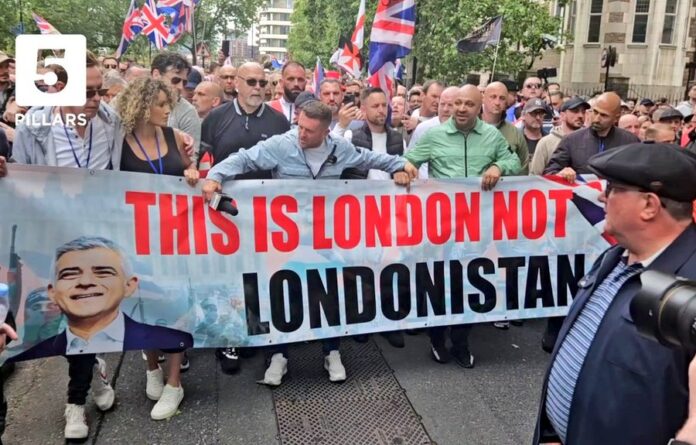
Jahangir Mohammed of the Ayaan Institute warns that discussions about an impending civil war in Western societies have shifted from the fringes of the far right into mainstream political and media discourse.
Politicians and pundits increasingly warn of inevitable national breakdown, cultural fracture or violent collapse. But behind the abstract language sits a much older and far more explicit idea: a race war. Its advocates rarely say it openly, but the meaning is obvious to anyone who understands the roots of the narrative.
The modern civil war theory is tied to the Great Replacement conspiracy, which claims that white populations in Europe and the United States are being deliberately replaced by non-white immigrants. The supposed civil war is simply the conspiratorial end-point of this worldview. It is marketed as a political or cultural crisis, but at its core it is a racial fantasy imagining white people fighting for demographic survival.
This narrative has a long history. White supremacist and fascist movements have pushed the idea of an eventual racial confrontation for decades, using it to create fear among white populations and present minorities as an existential threat. It has also been the central message of groups like the National Front and the BNP, who spent decades telling white Britons that multiculturalism would lead to ethnic war. Crime has often been weaponised by these groups to reinforce the idea that minorities are dangerous, disloyal and incompatible.
Race war fear-mongering in the West

In Britain, the most famous expression of this worldview came through Enoch Powell’s 1968 “Rivers of Blood” speech, which claimed immigration would lead to violence and social collapse. His warning about the River Tiber “foaming with much blood” remains one of the most infamous examples of racial panic being presented as political analysis.
In the United States, early neo-Nazi literature such as William Pierce’s 1978 novel “The Turner Diaries” framed race war as inevitable and presented demographic change as a provocation. The book has since inspired generations of extremists.
Subscribe to our newsletter and stay updated on the latest news and updates from around the Muslim world!
From the 1990s onwards, far-right and neoconservative writers popularised the Eurabia and Islamisation theories, framing Muslim immigration as a strategic cultural takeover.
In the 2000s, French theorist Guillaume Faye systematised these ideas by predicting an “ethnic civil war” already unfolding on cultural and demographic fronts. His thinking became foundational to the European identitarian movement and the idea of a “cold civil war”.
The reality
Yet the reality on the ground exposes these narratives. Communities in Britain have not been in a state of war with each other. For decades, people of different ethnic and religious backgrounds have lived side by side with relative peace. Almost all major instances of communal tension, from the northern riots in 2001 to the disturbances in summer 2024, were sparked or inflamed by far-right propaganda, misinformation and organised groups seeking confrontation.
The danger of this narrative has also been demonstrated in the most violent way possible. Many of the most significant far-right terrorist attacks in recent history, from Anders Breivik in Norway to the Christchurch shooter in New Zealand, were directly inspired by the Great Replacement and civil war theories. They cited them explicitly in their manifestos and comments, showing how deeply these ideas have penetrated extremist thought.
Today, the rhetoric has been absorbed into mainstream debate. Elements of Reform UK, parts of the Conservative Party and commentators on GB News often echo the same themes. Even mainstream politicians sometimes repeat its assumptions without realising it, for example by framing immigration as the source of division rather than the propaganda used to demonise minorities.
Old racist and fascist ideas rarely disappear. They return with new packaging and softened vocabulary. What is different today is how normalised they have become. The language has changed, but the message remains the same.