
Three men who plotted to bomb an Ahmadiyya worship site (which they had most likely mistaken for a mosque) in the Irish city of Galway have been jailed for up to nine-and-a-half years, after admitting to participating in a horrifying far-right terrorist organisation motivated by a disturbingly violent anti-immigration ideology.
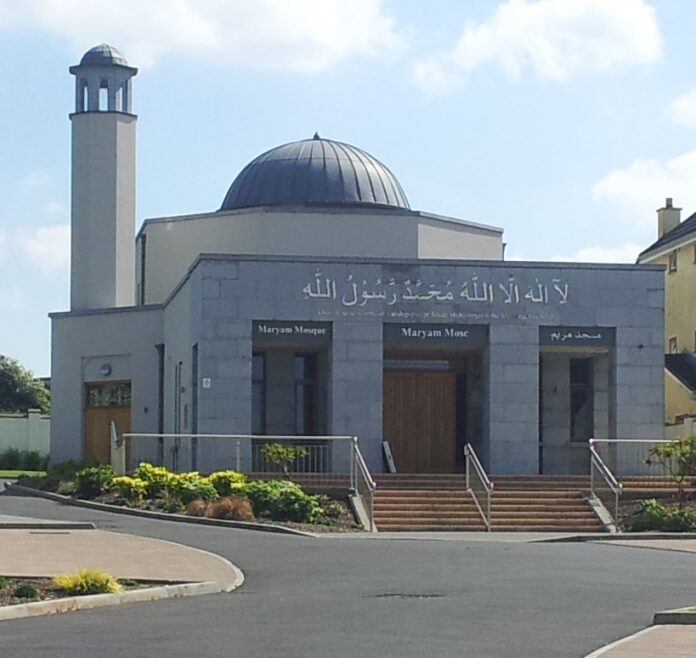
The men were sentenced at Ireland’s Special Criminal Court in Dublin on Friday (October 30), following their guilty pleas over a plot to firebomb the Maryam Mosque on Monivea Road in Galway in November 2025.
Garrett Pollock, 35, from Annalong in County Down, received a sentence of 10-and-a-half years, with the final year suspended.
His co-defendants, Darren Gorman, 34, from Portlaoise in County Laois, and Karolis Peckauskas, 39, from Drogheda in County Louth, were each sentenced to eight years, with the final year suspended.
All three admitted attempting to engage in terrorist activity by attempting to set fire to the centre between November 4 and 5, 2025.

The offence was aggravated by hatred of immigrants, particularly Muslim immigrants. Although the Ahmadiyya, also known as the Qadianis, are not recognised as Muslims in the Islamic world, they self-identify as “Ahmadiyya Muslims” in the West, and sometimes are targeted by Islamophobes who assume they are Muslims.
A similar phenomena sometimes affects Sikh communities as Islamophobic violence is sometimes directed at Sikhs due to misidentification by the attacker.
Subscribe to our newsletter and stay updated on the latest news and updates from around the Muslim world!
Pollock also pleaded guilty to possessing an explosive substance, which was discovered in four glass jars concealed in a specially constructed hidden compartment in his van.
Disturbing details of far-right terror planning
The men were members of a self-styled organisation calling itself the Irish Defence Army (IDA), which Gardaí described in court as a violent far-right extremist group.
The organisation had developed a name, insignia, manifesto and oath of allegiance, and its members communicated through a Signal messaging group called “Shadows of Eire”.
According to evidence presented to the court, the group initially considered using petrol bombs before deciding to construct pipe bombs, believing they would cause greater damage and generate a bigger public impact.
Their plans involved breaking into a mosque, throwing explosive devices inside and escaping before destroying the weapons and vehicle used in the attack.
The group had also identified potential entry and exit points and discussed the roles individual members would play.
Investigators recovered knives, hatchets, sledgehammers, balaclavas, tactical clothing, chemicals and other equipment. The court heard that some of the materials could be used to manufacture improvised explosive devices.
The men had also filmed a video claiming responsibility for the planned attack before it had taken place.
In the footage, four masked men wearing tactical clothing stood in front of an Irish flag and threatened further attacks against mosques, accommodation centres for asylum seekers, hotels and people involved in facilitating immigration.
The group specifically threatened those involved in establishing mosques and accommodation for people seeking international protection, warning that the Galway attack would not be its last.
The plot was uncovered after Gardaí carrying out what were described as random drug searches stopped a vehicle in November 2025.
Pollock and Peckauskas were travelling in the vehicle when officers discovered explosive materials and other items connected to the group.
Gardaí subsequently arrested the men and uncovered evidence of the planned attack.
The investigation involved cooperation between Ireland’s Gardaí and the Police Service of Northern Ireland (PSNI).
The court heard that investigators believed the attack was at an advanced stage of preparation, although they did not know precisely when it was due to take place.
The Ahamdi (Qadiyani) centre known as the “Maryam Mosque”, located on Monivea Road, was described in court as a place of worship with 24-hour access and an attached community centre. It had between 300 and 500 members and was situated in a densely populated residential area.
Judge condemns far-right ideology
Sentencing the men, Judge Caroline Biggs said their actions had brought “shame on us all”, emphasising that Ireland was a diverse and multicultural country.
She described the planned arson attack as carrying a “terrorising message” intended to be spread around the world.
The judge said the men appeared to have decided that they would determine which immigrants were welcome in Ireland and which were not.
She also stressed that the attack was not an isolated act of vandalism but a carefully organised operation involving the testing of incendiary devices and preparations for the manufacture of pipe bombs.
“There are no passive members of this group in this case,” she said.
The judge added that the men had shown no respect for the rule of law and had taken it upon themselves to decide who should be allowed to remain in Ireland.
She rejected any suggestion that their actions were motivated by patriotism.
The court heard that the three men had expressed remorse for their involvement in the plot.
Pollock’s defence said he had become increasingly involved in extremist online material after struggling with alcohol and cocaine misuse and spending extensive periods online.
The court was told that he had been exposed to nationalist and anti-immigration content, including material described as emotive, ill-informed and AI-generated.
Peckauskas, a Lithuanian national who had been living in Ireland since 2020, was also said to have become radicalised through online conspiracy theories during the Covid period.
His defence described the situation as particularly ironic given that he was himself an immigrant.
He apologised to Ireland’s mosque-going community, saying he understood that they must have been deeply traumatised by the incident.
Gorman’s defence highlighted personal vulnerabilities and psychological difficulties, while arguing that he had no previous history of violence or terrorism.
However, Judge Biggs stressed that the seriousness of the planned attack required substantial custodial sentences and that deterrence had to play an important role.
The judge also noted that the intended attack had been prevented through effective Gardaí work rather than any lack of effort by the defendants.
The case has highlighted the threat posed by far-right extremism and the potential consequences of online anti-immigration radicalisation escalating into organised violence against religious communities.