



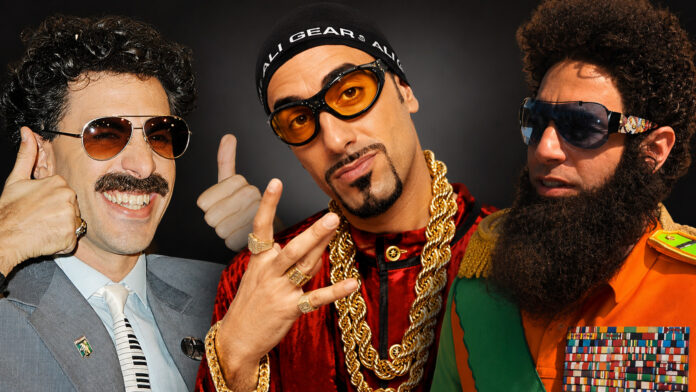
As Sacha Baron Cohen faces growing outrage over his new Ali G film, it is worth asking whether this under-fire pro-Israel British comedian has built his career over Islamophobic mockery of Muslims. Robert Carter takes a detailed look at some examples of his “Islamophobic caricatures” and whether they paint a picture of a more insidious agenda.
Sacha Baron Cohen is returning as Ali G, the character that helped make him one of Britain’s big comic exports. However, his new film, Ali G: Who Iz I?, has not been as well received as he would have hoped. Online negativity against the satirical figure and film has steadily grown. Many have taken to social media to accuse Ali G, who in the trailer is seen wearing fake dreadlocks and a Rastafarian hat and discussing his desire to be an “absent” father, of being an “outdated” and “racist” caricature.
Anti-racism activists have reportedly sent 37,000 emails to theatres urging them not to show the controversial film
Much of the outrage so far has been focused on concern over a white comedian engaging in “blackface” and whether the Ali G has crossed that threshold (wouldn’t be the first of its kind in recent pro-Israel British comedic history *cough cough David Baddiel*) but there is an equally strong case to make about Baron Cohen’s obsession with depicting insulting caricatures about Muslims and Arabs.
So, let’s examine what exactly has Sacha Baron Cohen’s comedy done to Muslims, Arabs and other ethnic minorities over the years?

Ali G
Following his first appearance in 1998, Ali G quickly became one of Sacha Baron’s most famous characters. In 2000, prominent Black comedians accused the character of offensive behaviour and argued that a white, Cambridge-educated comedian was effectively performing a caricature of Black street culture for a mainstream audience.
Subscribe to our newsletter and stay updated on the latest news and updates from around the Muslim world!
However, for years, it wasn’t clear exactly who Ali was ethnically or religiously speaking? The name Ali suggested it could be a Muslim, his uncle Jamaal certainly reinforced the belief that essentially the character was essentially a weird generic British Muslim trying really hard to be black. It wasn’t until it wasn’t until the movie Ali G Indahouse in 2000 that Sacha finally revealed that Ali’s full name was actually Alistair Leslie Graham. For years, many assumed he was a generic Muslim, and frankly, many still do.
Borat
Then along came the Borat movie.
A 2006 mockumentary comedy starring Sacha Baron Cohen as Borat Sagdiyev, a fictional and grotesquely exaggerated television reporter from Muslim-majority Kazakhstan. Borat travels to the United States to supposedly make a documentary about American life, but the film largely follows his encounters with real people, whom he provokes into revealing their prejudices, ignorance or bizarre behaviour.
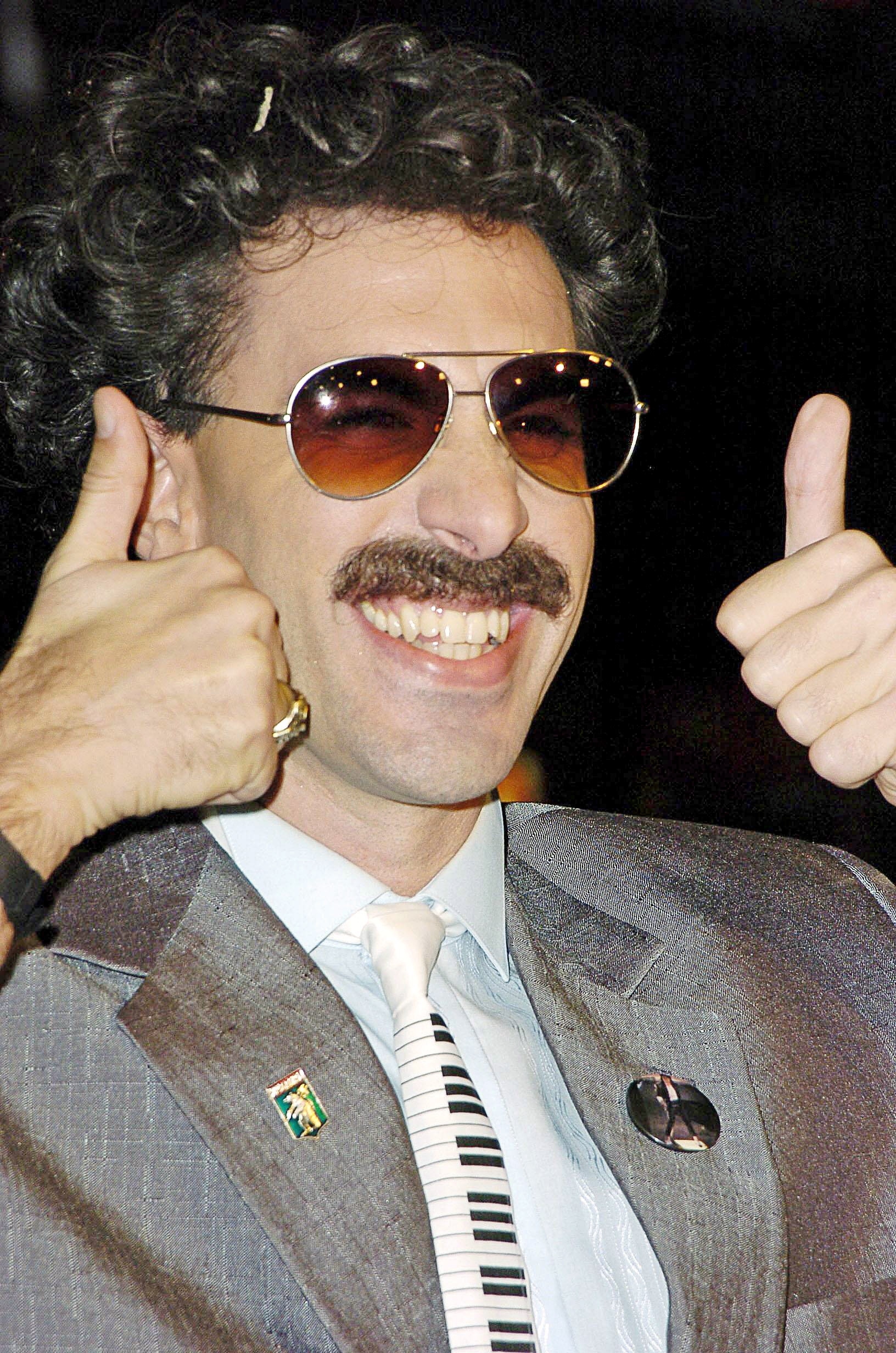
The film became a huge international success but also caused controversy, particularly in Kazakhstan, where officials condemned its portrayal of the country as insulting and inaccurate. Critics also argued that the comedy relied on stereotypes about a real, predominantly Muslim nation, despite Baron Cohen’s insistence that the fictional Kazakhstan depicted in the film was deliberately absurd and that the real target was Westerners willing to believe the caricature.
Borat provides another example. The character was presented as a grotesquely ignorant, racist and misogynistic journalist from Kazakhstan, a predominantly Muslim country whose government strongly condemned the portrayal as insulting and inaccurate.
Borat was portrayed as backwards, weird, stupid and, frankly, just dirty and his home village was also portrayed as a dirty uneducated backwater which was teeming with antisemitism and a hatred for women.
Of course, actual Kazakh culture is nothing like that and, of course, it is a Muslim majority country.
There was also further controversy over the supposed “Kazakh village” used as Borat’s hometown. The scenes were actually filmed in Glod, an impoverished Roma village in Romania, where some residents later claimed they had been misled about the nature of the production and felt humiliated by how they were portrayed. Several villagers launched legal action against the filmmakers, although the case did not ultimately succeed.
Baron Cohen argued that the joke was aimed at Westerners willing to believe his absurd portrayal of Kazakhstan. But critics could reasonably ask why a real country and real impoverished people had to provide the backdrop for the caricature in the first place. I guess any old impoverish region would do when depicting an awful character from a generic Muslim country.
The Dictator
Then there was The Dictator.
Released in 2012, The Dictator stars Sacha Baron Cohen as Admiral General Aladeen, the absurdly brutal ruler of the fictional North African state of Wadiya. After travelling to New York to address the UN, Aladeen is betrayed by his uncle, stripped of his beard and replaced by a lookalike. He then finds himself living anonymously in the United States while trying to regain control of his country.
The film portrays Aladeen as an exaggerated despot surrounded by many familiar Western stereotypes associated with Arab and Middle Eastern rulers: an oil-rich desert state, camels, a harem, nuclear weapons, terrorism jokes, a mock-Arabic language that sounds like gibberish and an obsession with violence, terrorism and, once again, generic Arabs/Muslims being antisemitic.
The film generated a significant backlash from Arab-American groups. Nadia Tonova of the National Network for Arab American Communities said the portrayal appeared to perpetuate negative stereotypes about Arabs at a time when Arab-Americans were already facing profiling and prejudice. Arab-American comedian Dean Obeidallah went further, describing the film as a “modern-day minstrel show”
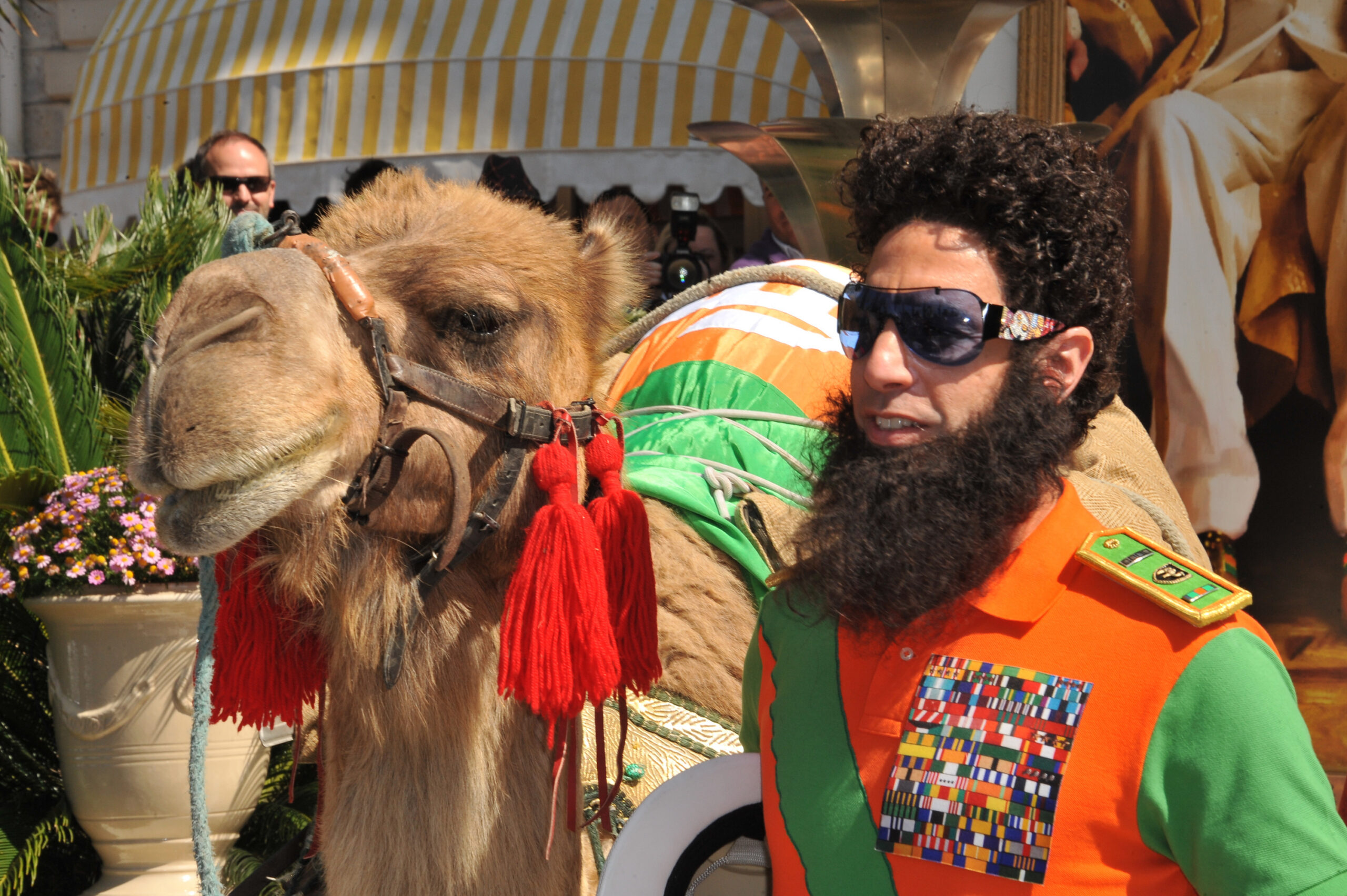
Baron Cohen has insisted that General Aladeen was not an Arab or a Muslim character and that religion was deliberately avoided in the film. Frankly, anyone who watched even 10mins of this film would find that claim laughable – unlike much of the film’s actual content.
In an interview, he said the fictional country and dictator were intended to draw from multiple influences rather than represent a specific Arab or Muslim society. However, it has widely been taken that the character, country and culture being targeted in the film was Libya and its former leader Muammar Gaddafi.
Academic research examining audience reactions to The Dictator found that some Muslim participants interpreted Baron Cohen’s work as containing anti-Muslim racism and reinforcing negative stereotypes, particularly in an already Islamophobic climate. That does not prove that Baron Cohen intended to spread Islamophobia. But it does demonstrate that the argument over his comedy is not some imaginary grievance invented by people who simply “cannot take a joke.”
When Muslims and other minorities object to being repeatedly presented through familiar stereotypes – the backward foreigner, the sexually depraved Arab, the violent despot, the ignorant immigrant or the threatening Muslim-looking man – it is not enough for a wealthy comedian to reply that his intentions were more sophisticated than the audience’s understanding.
A Zionist elephant in the room?
And Baron Cohen’s work has always occupied a strange territory. He relentlessly claims to expose racism but has also made vast amounts of money by giving mainstream audiences permission to laugh at characters constructed from the very stereotypes he supposedly opposes.
That contradiction becomes particularly striking when compared with his own public activism against antisemitism.
Baron Cohen has been outspoken on the subject. In 2019, he delivered a major speech at the pro-Israel Anti-Defamation League (ADL) event attacking social media companies for allowing hate and antisemitism to spread. He described them as an unprecedented propaganda machine and argued forcefully that hatred should not be amplified for profit.
The ADL is a well established Zionist organisation which considers anti-Zionism as a form of antisemitism.
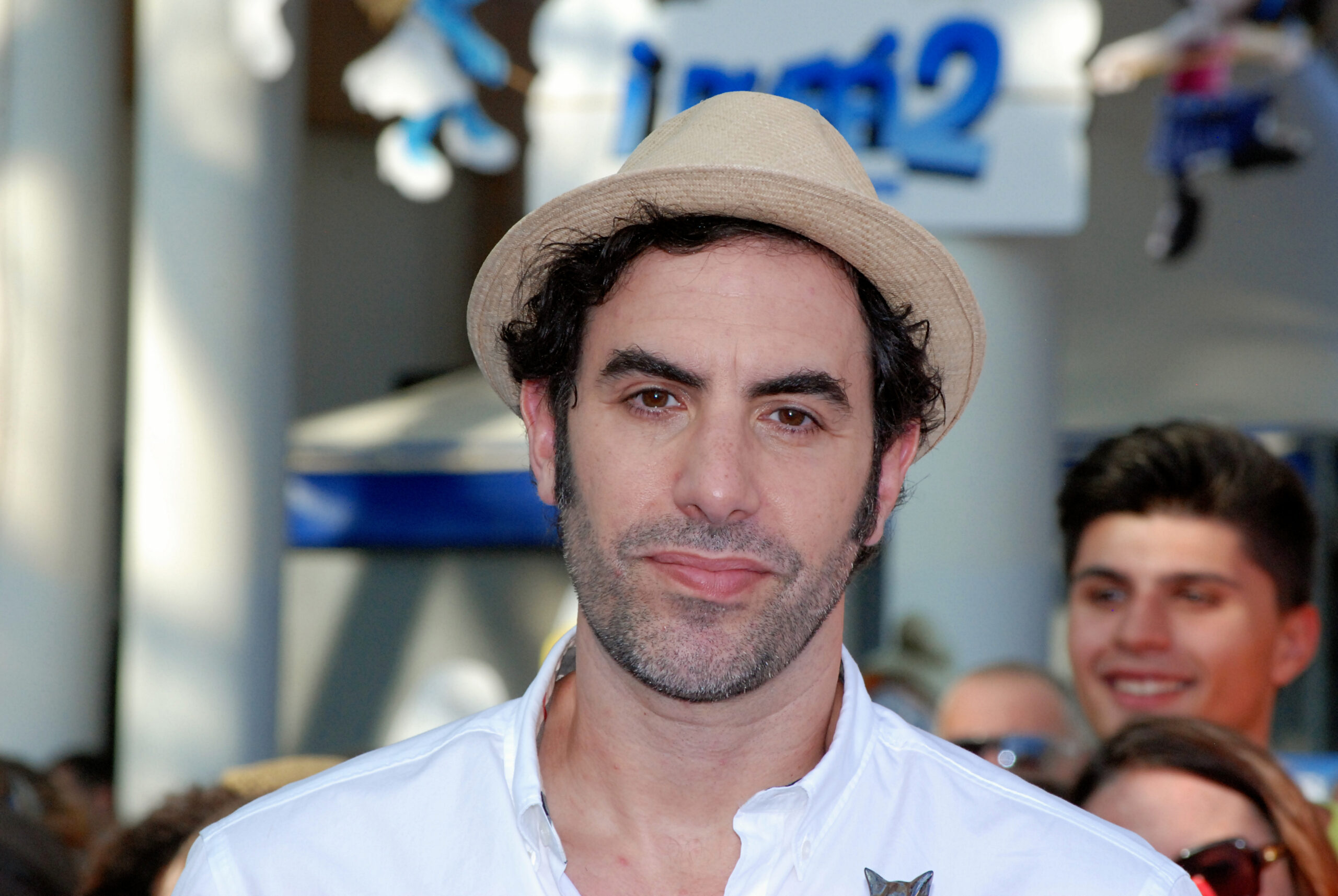
Sacha Baron has close personal, familial, and cultural ties to Israel through his mother’s birth in the country, his Jewish heritage, and satirical elements in his comedy. He grew up in London within an Orthodox Jewish household and maintains a strong connection to Jewish tradition.
At the age of 18, Cohen joined the HaBonim Dror Olami Zionist youth movement and he soon began pursuing his passion for acting in several HaBonim theatrical productions. According to the website, after joining HaBonim Dror Olami, he went to Israel in 1989 and spent a year volunteering with his friends from the Zionist youth movement in Kibbutz Rosh HaNikra.
Now, obviously, being Jewish doesn’t automatically make you Islamophobic or racist but Zionism is a political ideology – a racist colonial politically ideology which promotes and engages in the ethnic cleansing of Arabs and Muslims from the Holy Land.
So, if Sacha Baron is a Zionist, which it appears he very certainly is, it would explain why he constantly and obsessively depicts Muslims in a way which would make a Zionist racist like Ben Gvir chuckle in amusement and agreement.
Baron Cohen’s Jewish identity is well known, and his public record shows strong engagement with combating antisemitism and working with Jewish organisations. He has also played Israeli characters, most notably the Mossad agent Eli Cohen in The Spy, and an Israeli military character, Erran Morad, in Who Is America?
It is worth stating that publicly available evidence does not show Sacha Baron Cohen declaring himself a staunch Zionist outright, but reading between the lines it would be hard to assume that he is anything other than one given his career choices and family ties.
So, with pressure mounting over his film and claims of outdated and offensive stereotypes, I think now is the ideal time to add some additional, and long overdue scrutiny over Sacha Baron’s bizarre obsession with weirdo Muslim characters and whether his agenda is to simply “make people laugh” or if there is a more insidious agenda at play here….









Is it coz I is black?
Sacha Baron Cohen has been famously coy about his inspiration for Ali G. What I have heard is that a) he was influenced by late night yoof’ T.V and that 2) the character of Ali.G isn’t black, so he’s an Asian guy who wants to be black? Stepping out of Seven Sisters station and seeing the poster for the new Ali G film, I just wanted to say sometimes…yes it is coz’ I is not white.
Having done a dozen or so comedy sketches on late night yoof T.V with my cousin, on an ITV show called SHIFT (Thames T.V) shortly before Ali. G appeared on the 11’O Clock show, it seemed that Sacha Baron Cohen was ‘Influenced’ by what we did on SHIFT.
The ‘advantage Sacha Baron Cohen had was it seemed that ‘he is white’ and it seems that it’s funnier to be somebody pretending to be Asian than actually being of Indo-Caribbean, hence to him, we may have sounded ‘black’. Our comedy had nothing to do with our race, but back then Black / Asian people were only funny if we were doing comedy about being Black or Asian. Sacha Baron Cohen has made a career of racial stereotypes and often Muslim.
I’m not here to get into all the racial barriers we face as Black….Brown….Asian…Indo-Caribbeans writers, actors, comedians but yes Sacha Baron Cohen, a lot of the time it is cos’ I is black….or at least it is cos’ I is not white.