


Imagine attending the mosque every week but never understanding the khutbah. For many Deaf Muslims, this is reality. Tanisha Hussain, a young Muslim British Sign Language (BSL) interpreter who translates Islamic content into BSL, reveals the hidden barriers preventing Deaf Muslims from fully participating in Islamic life.
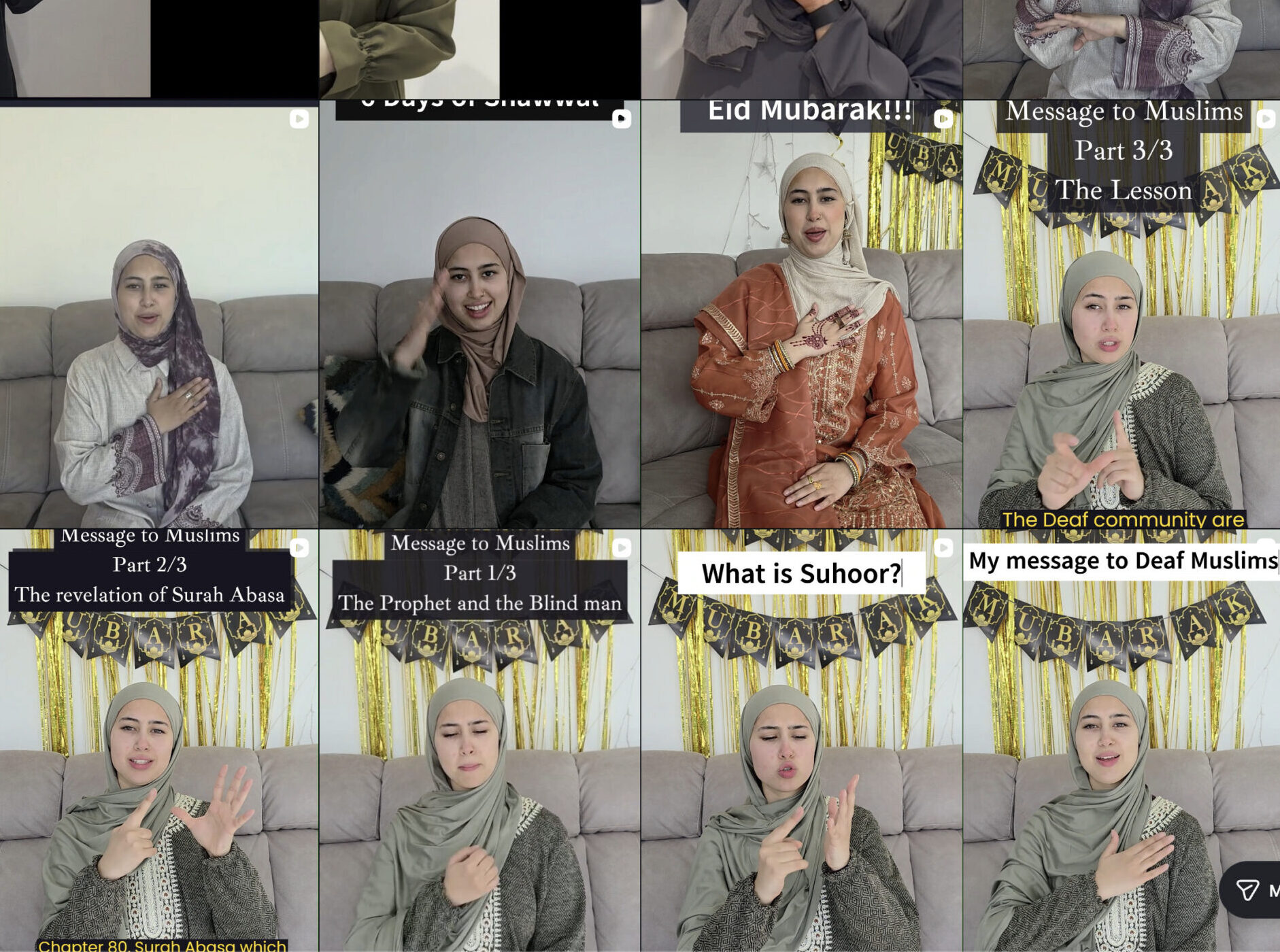
As the hearing daughter of Deaf parents who use British Sign Language (BSL), I have experienced the access and opportunities that many Deaf Muslims do not share. Witnessing the barriers my own parents have faced inspired me to use my professional experience as a qualified BSL interpreter to bridge the gap between Deaf Muslims and Islamic knowledge through my social media platform, Sign2Islam, where I share Islamic content in BSL.
Scholars Bauman and Murray describe deafness as a “biological variety in the human race, like skin colour or gender”. Deaf (with a capital D) refers to Deaf people whose deafness forms part of their identity and culture. The Deaf community is an ethnolinguistic group united not by race or religion, but by a shared culture and language.
Research suggests that the brain adapts to deafness by strengthening visual and spatial abilities, giving Deaf people heightened awareness of movement, facial expressions and their surroundings. Historically, Deaf people have inspired innovations such as the telephone and Morse code and contributed to our understanding of language development. Yet misconceptions persist. A common question Deaf people are asked is whether they can drive. Not only is the answer yes, but evidence suggests that Deaf people are in fact safer drivers.
BSL is a complete language with its own grammar and structure, not simply an accommodation for Deaf people. Research suggests that learning sign language benefits hearing people too by enhancing cognitive abilities, such as spatial reasoning, executive function, memory and visual processing. Simple signs can even allow babies to communicate before they develop speech, whilst also supporting language acquisition and motor development. As someone who uses both spoken English and BSL, I often think, “This would be so much easier if the person I’m talking to knew BSL.”

Whether communicating in a noisy environment, in a library, through a window, over long distances or even underwater, there are countless situations where sign language is the more effective form of communication.
Deaf Muslim challenges
Subscribe to our newsletter and stay updated on the latest news and updates from around the Muslim world!
To understand the barriers Deaf Muslims face, it is important to understand how Deaf people access information generally. Hearing people constantly benefit from incidental learning. This is where knowledge is absorbed by unintentionally overhearing conversations about everyday life. For many Deaf children, particularly those with hearing parents who do not use sign language, these opportunities are significantly reduced.
The World Federation of the Deaf describes exclusion from indirect family conversations and incidental learning as communication neglect. Combined with the risk of language deprivation when Deaf children do not have early access to a natural language, this can have lasting consequences for education, literacy and access to information, including faith.
These barriers can be particularly pronounced in some minority ethnic communities. Research by Atkin et al. (2002) found that communication barriers within some South Asian families, coupled with limited Deaf awareness and BSL provision in places of worship, contributed to many Deaf young people having restricted access to religious knowledge. This echoes the experience of Parveen, an Alimah and hearing mother of a Deaf daughter who now works to provide Islamic education for Deaf Muslims. She told me she has been surprised to meet Muslim parents who “don’t understand that BSL is actually a language.”
Some readers may wonder, “Why can’t Deaf people just read books or captions/subtitles?” Which, without understanding language deprivation, is a fair question. However, for many Deaf people, written English is a second language. Whilst written text and captions/subtitles can improve access, they are not equivalent to receiving information in one’s first and preferred language. Consequently, any field in which information is unavailable in sign language becomes less accessible to the Deaf community. Islam is no exception.
One participant in Atkin et al.’s (2002) study stated, “I know we eat halal meat, but I don’t know what it is.” This highlights how some Deaf Muslims learn religious rules yet may have had fewer opportunities to explore the deeper meanings, wisdom and spirituality behind Islam. Similarly, Deaf people who were not born into Muslim families may reach adulthood knowing little about Islam beyond the misconceptions portrayed in mainstream media. While hearing people may encounter Islam through online content or by having conversations with Muslims in their communities, Deaf people are less likely to access these opportunities when they are unavailable in BSL.
A gap in the Ummah
Barriers to Islam can also be influenced by misconceptions about sign language and a lack of Deaf awareness within families. Parveen described encountering the assumption that expectations around Islamic knowledge should be lower for Deaf children. She also explained that some parents want their profoundly deaf child to read the Qur’an “only through speech”. However, she emphasised that this is not always possible and, for some children, “the best option is to memorise and learn the Qur’an in BSL… they are learning in their language.”
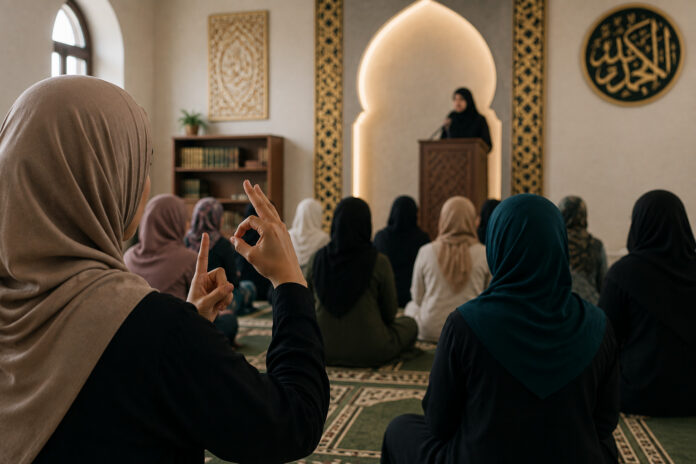
Even where Deaf Muslims receive support at home, significant barriers remain within the wider Muslim community. Imagine attending Jumu’ah every week yet never understanding the khutbah. This is a reality for my father and many other Deaf Muslims. Islamic lectures, conferences, events and online educational content are rarely available in BSL, often due to a lack of Deaf awareness and the financial challenges associated with providing interpreters.
It is important to recognise the work being done to address these barriers. Deaf Muslim UK (DMUK), Al Isharah and Islam for Deaf provide valuable Islamic workshops, lectures and resources for Deaf Muslims. DMUK and Al Isharah are also undertaking the immense task of translating the Qur’an into BSL. Parveen shared the impact of this work, explaining that during Ramadan some sisters said “it was the first time they felt spiritually connected because someone had taken the time to explain the meaning of the Qur’an”. One sister told her, “I was just about to give up on my search to learn about my religion, and you are the answer to my prayers.”
These organisations provide an essential service. However, their existence should not suggest that accessibility has been achieved. Rather, it highlights how much responsibility rests with a small number of charities. Accessibility is a shared responsibility of mainstream Islamic organisations across the UK. If Deaf Muslims continue to access Islam separately rather than alongside the Ummah, we risk creating two parallel communities divided by communication barriers rather than one strengthened by the perspectives, experiences and richness that Deaf Muslims bring.
This article only provides a snapshot of the hardships of Deaf Muslims. Inclusion is not only a benefit to Deaf Muslims; it enriches the Ummah as a whole. Parveen shared that working alongside Deaf Muslims has strengthened her own spirituality, gratitude and compassion, whilst teaching her about the “strength and courage that most Deaf people have”. She described seeing the Qur’an in BSL as “much more beautiful as the words are visually explained rather than just read.”
The first step towards a more inclusive Ummah can be as simple as learning the sign for “As-salamu alaykum.”