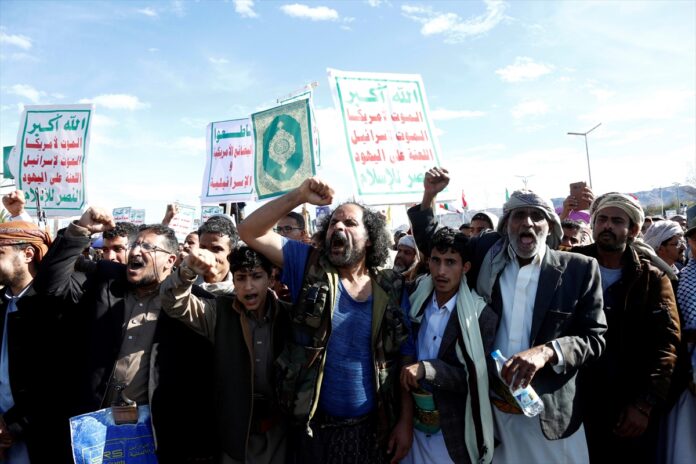
Yemen’s Houthi movement, the Ansar’Allah, has opened a new front in the deadly US-Israel war on Iran, entering on Tehran’s side with missile strikes against Israel and raising the spectre of renewed attacks on vital Red Sea shipping lanes.
On Sunday, Yemen’s Iran-aligned Houthis have said they carried out a second attack on Israel in less than 24 hours and vowed to continue military operations in the coming days.
Tensions in the Middle East are spiralling sharply following the announcement. Their entry adds a new front to a conflict that already spans multiple countries and armed groups including, Lebanon, Iran, Israel and the Strait of Hormuz in the Persian Gulf.
The announcement of a Yemenis first missile attack on Israel was publicised on Saturday. Israel confirmed that at least one missile was intercepted.
In a televised address, Houthi spokesperson Yahya Saree said strikes “will continue until the declared objectives are achieved, as stated in the previous statement by the armed forces, and until the aggression against all fronts of the resistance ceases.”


The group has not outlined the full scope of its planned campaign, but its record suggests renewed strikes targeting Israel and military activity to disrupt critical maritime routes in the Red Sea.
The Houthis have also attacked numerous US-backed Arab states in the past particularly Saudi Arabia and the United Arab Emirates.
Subscribe to our newsletter and stay updated on the latest news and updates from around the Muslim world!
The group has stated it will not allow the Red Sea to be used for “hostile operations” against Iran or any Muslim country.
Saree also warned against tightening what he called “the blockade on Yemen” and called for an immediate halt to US and Israeli attacks on Iran, the Palestinian territory, Lebanon and Iraq. These demands frame the group’s actions as part of a broader regional confrontation.
Sirens went off around Beersheba and the area near Israel’s main nuclear research centre for the third time overnight Friday into Saturday as both Iran and Hezbollah also continued to fire on Israel. No casualties or damage were reported.
The Houthi threat
The Houthis have held Yemen’s capital Sanaa since 2014 and so far have stayed out of the US-Israeli war. The militia’s attacks on shipping vessels during the Israel-Hamas war upended commercial transit in the Red Sea, through which about $1 trillion worth of goods passes each year.
The Houthi rebels attacked more than 100 merchant vessels with missiles and drones, sinking two ships and killing four sailors, from November 2023 until January 2025.
In 2024, the Trump administration launched strikes against the Houthis that ended weeks later.
The involvement of the Houthis in the US-Israeli war on Iran would complicate the deployment of the USS Gerald R Ford, the aircraft carrier that went to port in Crete on Monday for repairs.
Sending the carrier back into the Red Sea could draw it into the same high tempo of attacks seen by the USS Dwight D Eisenhower in 2024 and the USS Harry S Truman in the 2025 American campaign against the Houthis.
If they decided to move to shut down Bab al-Mandeb strait, the Red Sea and, ultimately, the Suez Canal, then we would have two major choke points closed along with the Strait of Hormuz.
The negative development has added to the trauma hitting the energy market.
Oil prices are back above $100 as geopolitical tensions between the U.S. and Iran intensify, driving inflation risks and pressuring equity markets.
The average price for a litre of petrol rose above 150p for the first time in nearly two years, with diesel over 177p, a month after the US and Israel launched attacks on Iran.
The figures from the RAC show the conflict is continuing to push up fuel prices, although they remain below the peaks seen after Russia’s invasion of Ukraine.
The cost of filling a typical family car with unleaded petrol is now £9.50 higher than a month ago, at over £82. A tank of diesel costs £19 more at over £97.