Washington and Tehran have traded fresh threats after a wave of damaging Iranian strikes on Israel, escalating fears of a wider regional conflict. The US president has given Iran 48 hours to reopen the Strait of Hormuz or face attacks on major power plants, while Tehran has vowed to broaden its targets if it comes under further assault.
US President Donald Trump threatened Saturday to “obliterate” Iran’s power plants, starting with the largest, if Tehran did not open the Strait of Hormuz within 48 hours.
“If Iran doesn’t fully open, without threat, the Strait of Hormuz, within 48 hours from this exact point in time, the United States of America will hit and obliterate their various power plants, starting with the biggest one first,” Trump wrote on his social media platform Truth Social.
He posted the threat at 7.44 pm US Eastern Time (2344GMT), meaning he provided a deadline until late Monday.
He did not specify which plant he was referring to as the largest.

Iran threatened Sunday to strike all US and Israeli infrastructure across the region if its facilities came under attack, following an ultimatum from Trump.

“If Iran’s fuel and energy infrastructure is attacked by the enemy, all energy, information technology, and desalination infrastructure belonging to the United States and the (Israeli) regime in the region will be targeted,” a spokesperson for the Khatam al-Anbiya Central Headquarters, the body overseeing Iranian military operations, said in a statement reported by Fars News Agency.
Subscribe to our newsletter and stay updated on the latest news and updates from around the Muslim world!
Iranian Foreign Minister Abbas Araghchi warned that Iran would show “zero restraint” if its infrastructure was attacked.
The latest escalation follows a significant Iran wave of missile strike on Israel.
Iranian ballistic missile barrages wounded about 100 people in southern Israel on Saturday, striking the cities of Arad and Dimona after air defence systems failed to intercept at least two projectiles.
The strikes came after the US and Israel targeted Iran’s Natanz nuclear facility, a key uranium enrichment site long viewed as central to Tehran’s nuclear ambitions. Iranian authorities said the attack caused no radioactive leakage, attempting to calm fears of a broader environmental disaster while still condemning the operation.
Officials described the strike as part of a wider campaign aimed at crippling Iran’s nuclear programme and limiting its military capabilities. The attack comes amid sustained air assaults, missile exchanges, and growing regional involvement, signalling a conflict that is expanding rather than stabilising.
Wider impact
Since the war began on February 28, the fighting has steadily expanded across the region, with repeated exchanges now a consistent feature rather than a sudden escalation. Iran has continued launching missiles and drones toward Israel, U.S. bases in the region, and energy infrastructure, while regional air defences have adapted to near daily threats.
Gulf states including Saudi Arabia, Bahrain, and Kuwait have faced ongoing attacks throughout the conflict, with several incidents targeting oil and industrial sites over recent weeks. These strikes are part of a sustained pressure campaign rather than isolated events, reflecting how deeply the war has affected regional stability.
Bahrain’s air defense forces intercepted and destroyed 244 drones and 143 missiles since the start of Iranian attacks on its territory, the Bahraini army said Saturday.
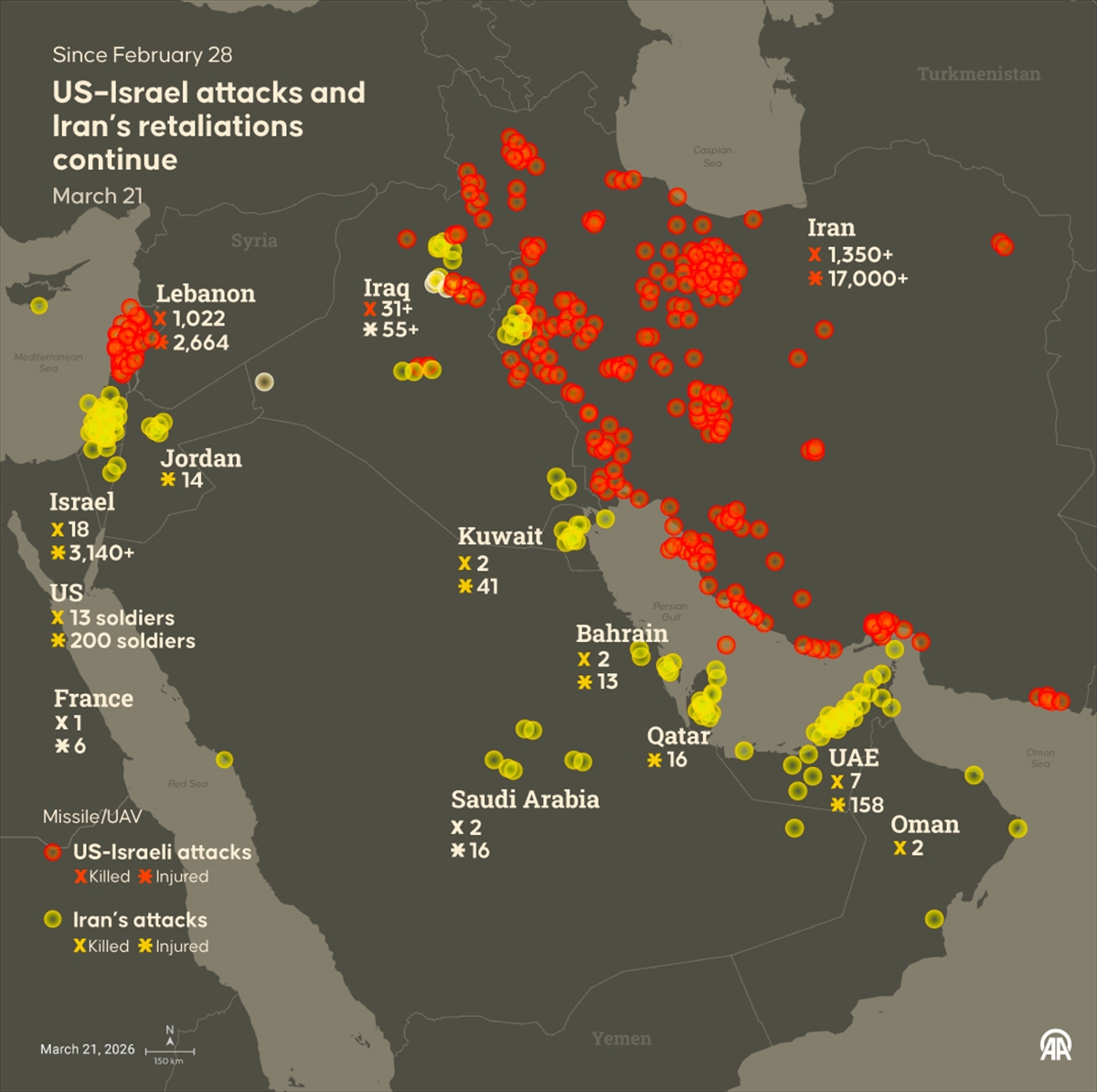
Earlier this week, Qatar expelled Iran’s military and security attaches after Iranian missiles caused extensive damage to the Ras Laffan liquefied natural gas (LNG) facility.
Citing Iran’s recent attacks, Saudi Arabia has declared the Iranian military attache, assistant attache, and three other Iranian Embassy staffers persona non grata, giving them 24 hours to leave the country.
In a statement late Saturday, the Saudi Foreign Ministry said it condemns Iran’s attacks on the Gulf Cooperation Council countries.
Iran’s attacks targeting Saudi Arabia represent “a flagrant violation of all relevant international conventions, the principles of good neighborliness, and respect for state sovereignty.”
Shipping disruptions in the Strait of Hormuz have also developed over time, with Iran moving toward a controlled and selective approach to maritime access. Instead of a full shutdown, traffic has been restricted and monitored, contributing to prolonged uncertainty in global supply chains rather than a sudden shock.
This has created a shock in the market with energy prices rising at increasing speed in Europe and the US, putting Trump’s administration under serious pressure to deescalate away from total war.
Does the US have a strategy?
The US has been sending out contradictory statements about the status of the war and whether or not it is going to start calming or continue escalating tensions.
President Donald Trump said earlier this week that he was considering “winding down” military operations, even as additional troops and equipment continue to be deployed to the region.
However, Trump said Saturday that Iran wants to negotiate a deal but he is not interested. Tehran has denied all claims that they are opting for peace at this stage.
“They want to make a deal. I don’t,” Trump wrote on his social media platform Truth Social, claiming he met his military objectives “weeks ahead of schedule” and the US had “blown Iran off of the map.”
He said Iran’s leadership, navy and air force had been eliminated and Tehran has “absolutely no defence.”
Despite Trump’s claims that Iran is effectively defeated, Iranian armed forces have continued to launch large scale attack waves, using drones and missiles, targeting a host of US-allied countries across the region.
Officials have suggested the US-Israeli campaign could last four to six weeks, with the goal of weakening Iran’s military and nuclear capabilities. At the same time, Washington has prevously ruled out a ceasefire, indicating that operations will continue until strategic objectives are met.
Military analysts note that the build-up of forces raises the possibility of further escalation, including potential ground involvement. While US leadership has not confirmed such plans, the scale of deployments suggests preparations for a range of scenarios.
War escalating in Lebanon
Speculation about the next phase of the conflict remains intense. Israeli officials have warned that strikes will increase in intensity, signalling that the current level of fighting may not represent the peak of the war.
Israel and Lebanon are also inbroiled in a vicious conflict as the Iran-backed Hezbollah continues to fire missiles into northern Israel. Israel has attacked Lebanon, targeting Hezbollah infrastructure across the country, however, Israel’s war on Lebanon has also led to significant numbers of civilian deaths too.
Israeli prime minister orders Israeli army to bomb bridges over Litani River, which divides southern Lebanon into two parts. Journalists on the ground on the Israel-Lebanon border have reported a sizeable Israeli army build up, raising speculations that Israel is planning to launch a major invasion of south Lebanon.
Economic pressures are also mounting, with oil prices surging and global markets reacting to the instability. Efforts to offset rising costs, including adjustments to sanctions, have had limited immediate impact.
Diplomatic calls for restraint continue, with international agencies warning of the risks of further escalation. However, with both sides signaling determination to continue, the conflict appears set to persist, with significant uncertainty over how and when it might end.