


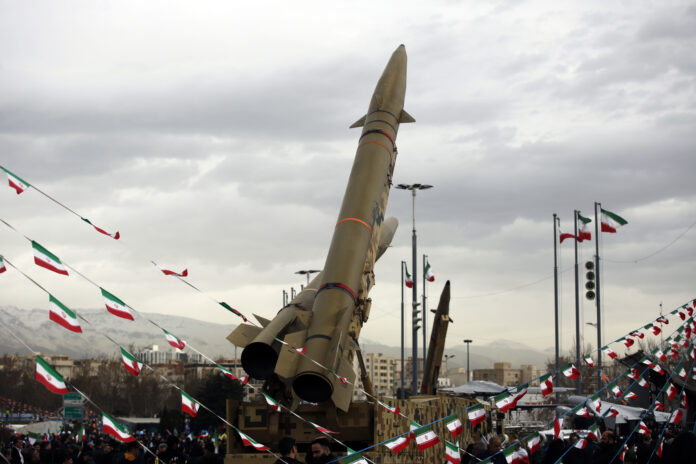
For the seventh consecutive night, the US and Iran have exchanged attacks as the region is plunged back into chaos following the near-total collapse of negotiations between Tehran and Washington.
The US military’s Central Command (CENTCOM) said on Friday that American forces ended the seventh consecutive night of strikes against Iran.
“US forces ended the seventh consecutive night of strikes against Iran on 17 July at 9.30pm ET,” CENTCOM said in a post on the US social media platform X.
The command said US forces targeted surveillance sites, military logistics infrastructure, underground weapons storage facilities and maritime capabilities during the latest strikes.
In retaliation, Iran’s army claimed on Friday that it had targeted American military facilities in the Gulf states of Jordan and Kuwait with attack drones, and claimed there were explosions at the US Fifth Fleet base in Bahrain.

In a statement carried by the semi-official Tasnim News Agency, the army said the strikes took place during the 14th phase of its “Operation Thunder”.
It said drones struck an ammunition depot at the Al-Adire camp, as well as buildings, ammunition storage facilities and communication links at the Al-Salem base in Kuwait. The statement also said fuel tanks at the Al-Azraq air base in Jordan were targeted.
Subscribe to our newsletter and stay updated on the latest news and updates from around the Muslim world!
Other reports claimed that US sites in Saudi Arabia and the Kurdish region of northern Iraq were also targeted by Iranian strikes. Footage went viral of a major strike in Kurdistan late on Friday evening.

Amid the intense escalation of violence spreading across the region, the US State Department renewed its travel warning for the Middle East, citing heightened tensions and urging Americans in the region to remain cautious.
“Due to high tensions in the Middle East, the security environment remains complex, with the potential for unforeseen escalation,” it said in an advisory shared by its Bureau of Consular Affairs on the US social media platform X.
The agency encouraged Americans in the region to monitor news reports for breaking developments and advised those travelling in or through the area to confirm flight schedules with their airlines.
Washington also urged US citizens to reconsider travel to or through the Middle East and directed travellers to review country-specific security alerts.
One of the US strikes targeted a major water desalination plant in Iran’s south-eastern coastal village of Bunji, in Hormozgan province. The attack has left around 10,000 people without water, a provincial official said on Saturday.
The attack “completely disrupted the supply of drinking water to 20 villages with a population of about 10,000 people,” Iran’s semi-official news agency Tasnim quoted the chief executive of the Hormozgan Water and Wastewater Company as saying.
“These villages are facing a water shortage crisis,” the official added.
The military escalation comes despite a Pakistan-brokered memorandum of understanding signed in June to end the war and reach a lasting peace agreement.
The return to an apparent all-out war between the two rival sides has raised fears of a lengthy conflict that could cause renewed damage to the global economy.

The fighting centres on who controls the key shipping routes in the Persian Gulf, specifically the Strait of Hormuz. The strait is one of the world’s most important energy chokepoints. Around 20% of global oil consumption passes through it, and roughly 20% of global liquefied natural gas (LNG) trade also transits the strait, with most shipments coming from Qatar.
Iran places huge strategic importance on its control of the strait. Tehran has blamed the collapse in peace talks entirely on US President Donald Trump, claiming Washington has failed to meet any of its obligations and attempted to sneak tankers through the strait without Iranian approval. Washington denies the claims and blames Iran for refusing to continue the negotiations.
More regional escalation
The Yemeni armed group, the Ansarallah Houthi movement, has warned of further attacks against American targets and Saudi interests following an exchange of strikes between Saudi Arabia and Yemen on 13 July 2026.
The exchange began after Sanaa International Airport was bombed. Yemen’s internationally recognised, Saudi-backed government said its own armed forces had targeted the airport runway to prevent an Iranian aircraft from landing. The Houthis accused Saudi Arabia of carrying out the strike, while Saudi Arabia did not immediately comment on the accusation.
In response, the Houthis launched missiles and drones towards Abha International Airport in Saudi Arabia, effectively ending a four-year period of relative calm between the two sides.
Reports from the region claim that Iran may have requested its Houthi allies in Sanaa to blockade shipping in the Red Sea as a means of applying greater pressure on the US and its partners amid deepening regional escalation.
The Houthis have previously attacked shipping around the key Bab al-Mandeb Strait with noticeable success during the height of Israel’s genocidal war on Gaza.
Elsewhere, experts fear that Iran’s allies in Iraq and Lebanon may return to the conflict to assist Iran as the US escalates its direct attacks on the Islamic Republic. Iran has relationships with various armed militia groups in both countries, including Hezbollah in Lebanon, who have the capabilities of attacking US and Israeli assets.