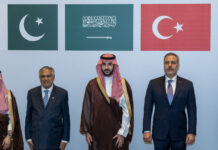



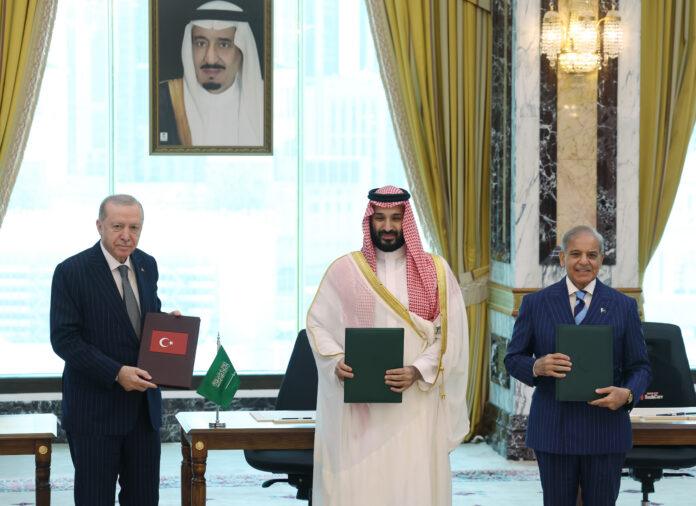
Türkiye, Saudi Arabia and Pakistan signed a joint Mecca Agreement defence pact at a trilateral summit in Mecca on Friday, pledging to strengthen collective security, deepen defence cooperation, and promote peace and stability in the region and beyond.
The Mecca Joint Defence Agreement was signed by Turkish President Recep Tayyip Erdogan, Saudi Crown Prince Mohammed bin Salman, and Pakistani Prime Minister Shehbaz Sharif during the summit held at Al-Safa Palace.
According to a statement by Türkiye’s Communications Directorate, the agreement reflects the three countries’ shared commitment to reinforcing their collective security, building on longstanding historical ties, Islamic solidarity, common strategic interests, and close defence cooperation.
The agreement aims to strengthen collective deterrence against any act of aggression and stipulates that an armed attack against any one of the three countries shall be regarded as an attack against them all.
It also provides for the enhancement of defence cooperation across all areas among the three countries. King Salman bin Abdulaziz Al Saud hosted Erdogan and Sharif in Saudi Arabia for the key summit.

A new Islamic NATO?
Experts are currently debating the significant of this move the the tree regional powers with some believing the move to be a largely symbolic gesture by three U.S.-allied Muslim nations and others who believe the new alliance could change the regional power dynamic.
Subscribe to our newsletter and stay updated on the latest news and updates from around the Muslim world!
Unlike broader organisations such as the Organisation of Islamic Cooperation, which focuses primarily on diplomacy, this agreement emphasises practical military cooperation, including defence planning, training and deterrence.
Each country brings different strengths. Türkiye has NATO’s second-largest military, a sophisticated domestic defence industry, and extensive operational experience. Saudi Arabia has one of the world’s largest defence budgets and significant financial resources. While Pakistan possesses one of the world’s largest armed forces and is the only Muslim-majority country with nuclear weapons.
It is not yet clear how the three intend to use this new pact to their advantage. Each boasts its own entirely separate national security threats and interests.
Saudi Arabia is highly involved in an ongoing conflict in Yemen for example which has expanded to a battle for access to the Red Sea against the Iran-allied Houthi rebels.
Saudi may hope that Ankara and Islamabad may become more militarily involved in supporting Saudi efforts to stop the Houthis hold over the key trading route.
Also Iran, a country with a highly tense relationship with Riyadh. How would the defence pact respond if the conflict between Iran and the U.S continues to expand? Saudi and multiple other Arab states have been routinely attacked by Iran due to the Arab’s willingness to host American military bases.
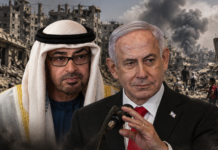
Also Israel – how will Tel Aviv perceive the move and if Israel escalates its aggression and occupation of Syrian territory, how would Turkye respond and could it drag Pakistan and Saudi into any new conflict.
Most agree that the agreement is significant for several reasons, both symbolically and strategically, although its real-world impact will depend on how fully it is implemented.