

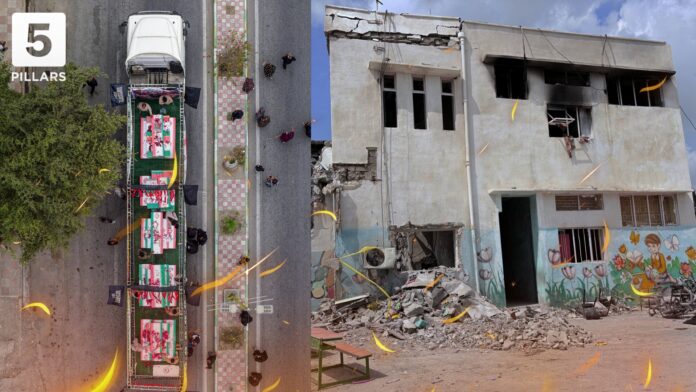
Evidence analysed by Al Jazeera’s investigation suggests the U.S. bombing of a girl’s school in Iran on February 28 was not accidental, but a distinct, separate strike on the school building itself.
Survivors and families are mourning at least 165 schoolgirls and staff killed, with scores more injured. Missiles slammed into the building just as classes were starting.
The attack has drawn global condemnation, raised serious legal questions, and sparked urgent calls for accountability and independent investigation.
Evidence
The girls were inside the Shajareh Tayyebeh school on a Saturday morning when the attack struck.

Initial claims from US and Israeli spokespeople stated they were unaware a school had been hit.
Some Israeli‑linked social accounts claimed the school was “part of a Revolutionary Guard base”, but this has been contested and rebutted.
Subscribe to our newsletter and stay updated on the latest news and updates from around the Muslim world!
Al Jazeera’s Digital Investigations Unit compiled decade‑long satellite imagery, geolocated videos, published reports, and official Iranian statements to challenge that narrative.

The review shows the school was clearly separate from a nearby military site for at least 10 years. Walls, gates, murals, playgrounds, and civilian traffic confirm it functioned completely on its own.
That separation was documented first in 2016, when internal walls were built to delineate the school from the adjacent IRGC naval base.
Al Jazeera’s timeline shows two separate columns of smoke rising simultaneously, one from the base and one from the school.
This strongly contradicts claims that the explosion resulted from debris or shrapnel from nearby strikes.
The analysis also points out that another civilian building, a clinic nearby, was left untouched in the same assault.

This pattern suggests more than a chaotic battlefield error, given that precision strikes hit both military and school structures.
If the attackers had up‑to‑date intelligence, the school would have been clearly identified as non‑military before any strike.
This contradiction leaves only two possibilities, the investigation says: the bombing resulted from either grave intelligence failure or a deliberate strike treating the school as a legitimate target.
Both outcomes prompt urgent questions about operational planning and adherence to international law.
Experts note that even if a building has ties to military families, it remains a civilian facility under international humanitarian law unless used for military purposes.
International law prohibits attacks on civilians and civilian infrastructure. Schools and children are specially protected during armed conflict.
The Iranians argue the strike was “deliberate” and part of an intent to maximise civilian harm. They cite both the timing and precision of the hits.
Wider Implications
Minab sits in Hormozgan province, a region of strategic importance overlooking the Strait of Hormuz.
Nearby facilities include the Sayyid al‑Shuhada complex, which houses the IRGC’s Asif missile brigade.
Iran’s authorities say the strike forms part of a broader campaign that has damaged hundreds of civilian sites.

International voices, including United Nations human rights officials and UNESCO, have called for a thorough investigation into the strike and responsibility for civilian deaths.
Analysts say if the US or Israel were responsible, failing to distinguish clearly between civilian and military sites could amount to serious violations of international law.
The timing and precision of the strike mean that no definitive conclusion can yet be drawn about intent, but the evidence clearly challenges claims of mere accident or collateral damage.
Simplified accounts of the event have circulated online, but detailed analysis shows a complex pattern of cause, effect, and potential accountability.