


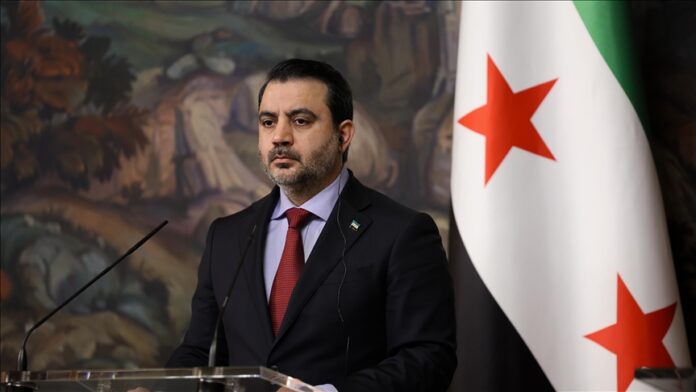
Syrian Foreign Minister Asaad al-Shaibani admitted on Saturday that direct talks on a “security deal” with Israel were focused on areas Israel has recently occupied and excluded the Golan Heights territory, leaving the area firmly under illegal Israeli control.
Al-Shaibani claimed the talks with Israel are aimed at ending Israeli interference and military actions in southern Syria, not at accepting a new reality imposed by force.
Speaking at a panel discussion at the Munich Security Conference, Shaibani said Syria had adopted a “realistic path” towards Israel, focused on reconstruction and national recovery following the December 8, 2024 fall of the Assad regime.
Israel and Syria’s new authorities have held several rounds of face-to-face talks in recent months, and after negotiations in January. According to various reports, under US pressure, Damascus agreed to establish an “intelligence-sharing mechanism” as they edged towards a security agreement.
When asked at the Munich Security Conference about the scope of the talks with Israel, Shaibani said discussions were on “the withdrawal of Israel” from Syrian territory occupied after Assad’s ousting, “not from the Golan Heights, and this is another issue.”

To reach a security deal, Israel should “respect the security of Syria and withdraw from these territories” recently occupied, he added.
Israel, which has demanded a demilitarised zone in southern Syria, has also launched hundreds of strikes on its neighbour and has carried out regular incursions.
Subscribe to our newsletter and stay updated on the latest news and updates from around the Muslim world!
According to Syrian authorities, Syria has faced more than 1,000 Israeli airstrikes targeting civilian and military facilities, as well as ground incursions and new territorial advances in the south.
Israel and the Golan Heights
The Golan Heights was internationally recognised as part of Syria and administered as one of its provinces. It had Syrian towns, villages, and farms, and was strategically important because it overlooks southern Syria, Lebanon, northern Israel, and the Jordan Valley.
During the 1967 Six-Day War, Israel occupied the territory from Syria and later displaced a large portion of the local Syrian population.
Today, Syria regards the area as occupied territory under international law. This position is supported by United Nations resolutions such as UN Security Council Resolution 242, which calls for Israeli withdrawal from territories captured during the war.
Israel’s 1981 move to apply its own law and administration there, a move described as the Israeli annexation of the Golan, is viewed by Damascus and most of the international community as illegal and not internationally recognised.

Following the shock defeat of the former regime headed by Bashar Al-Assad, Israel has captured additional territory in southern Syria and conducted attacks across Syria hitting key military and political infrastructure.
Syria is now engaging in direct negotiations with the ambition of ending Israeli aggression and regaining control of the recently lost territory.
The lack of effort by Damascus to liberate the Golan Heights highlights the weak position Syria finds itself in after years of a bloody civil war which has left huge parts of the Arab country in ruin.
Israel has exploited the regime change for its own benefit but many onlookers speculate that the new Syrian leadership may be on a path towards normalisation with the Israeli regime, a claim Damascus has previously denied.
Protests have been witnessed in Syria as locals demand harsher action from the new authorities, headed by President Ahmad Al-Sharaa, in confronting the Israeli threat and pushing for the full liberation of all Syrian territory – including the occupied Golan Heights.
Under Al-Sharaa, Syria has pursued a policy of rebuilding ties with the West in exchange for sanctions relief and international recognition of the new government.