


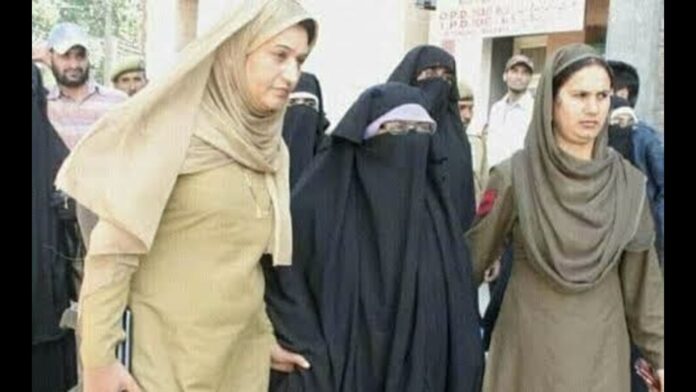
A court in India’s capital has convicted a prominent female Kashmiri separatist leader under the country’s anti-terrorism legislation, more than seven years after she was arrested during a major crackdown on dissent in Indian-occupied Kashmir.
On Wednesday, an additional sessions court in Delhi found Asiya Andrabi guilty under the Unlawful Activities (Prevention) Act (UAPA), a law that allows the Indian state to designate organisations as terrorist groups and permits prolonged detention with limited access to bail.
Two of her close associates, Sofi Fehmida and Nahida Nasreen, were also convicted under the same provisions. Sentencing is scheduled for January 17.
Judge Chanderjit Singh convicted Andrabi under Sections 18 and 38 of the UAPA, relating to criminal conspiracy and alleged membership of a banned organisation.
The case was brought by India’s federal investigation agency, the National Investigation Agency (NIA), which accused Andrabi of waging war against India through speeches, public meetings and political activities promoting separatism in Jammu and Kashmir.

Prosecutors claimed that Andrabi and her associates mobilised support for separatist causes and maintained links with organisations banned under Indian law. The NIA argued that their activities were intended to undermine India’s sovereignty and territorial integrity.
After reviewing the evidence, the court said the prosecution had proven the charges beyond reasonable doubt and upheld the case against all three defendants.
Subscribe to our newsletter and stay updated on the latest news and updates from around the Muslim world!
The verdict is among the most high-profile convictions delivered under the UAPA against a Kashmiri separatist figure in recent years, highlighting the Indian state’s continued reliance on anti-terror legislation to prosecute political dissent related to Kashmir.
Andrabi is one of the most prominent female figures in Kashmir’s separatist movement. She founded Dukhtaran-e-Millat in 1987, an all-women organisation that advocates Kashmir’s independence or its merger with Pakistan and rejects Indian rule in the region.
She rose to prominence for mobilising women in protests and public campaigns and for her outspoken opposition to the Indian state. Supporters regard her as a symbol of resistance in Kashmir, while Indian authorities have long labelled her ideology as extremist.
The Indian government banned Dukhtaran-e-Millat in 2019, around a year after Andrabi’s arrest.
Andrabi was detained in April 2018 during a wider crackdown on separatist leaders and networks in Jammu and Kashmir, following years of mass protests and an armed rebellion against Indian rule.
She and her co-accused have remained in custody since their arrest, with the trial continuing for several years. Human rights organisations monitoring political detentions in India have repeatedly criticised the UAPA, arguing that it enables prolonged detention without conviction and is frequently used in politically sensitive cases.
The conviction comes amid ongoing restrictions on political activity in Kashmir, particularly since India revoked the region’s semi-autonomous status in 2019, a move criticised by international human rights organisations and followed by extended security measures across the territory.