



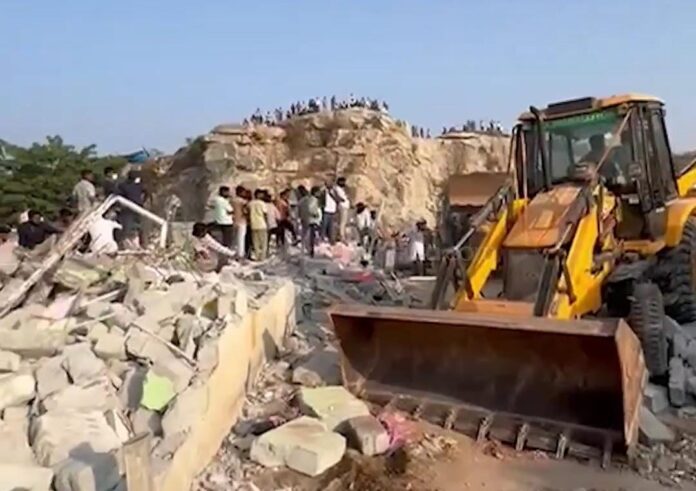
Hundreds of Muslim families were left homeless after authorities in the Indian city of Bengaluru carried out pre-dawn demolitions in two Muslim-majority settlements.
Bulldozers moved into Fakir Colony and Waseem Layout in Kogilu village at around 4am on Saturday 20 December, reducing large parts of the neighbourhoods to rubble by sunrise. Residents said the operation took place without any prior notice.
More than 400 homes were demolished by the Greater Bengaluru Authority, displacing an estimated 3,000 people. Those affected included elderly residents, women and hundreds of children, many of whom were forced to remain outdoors as temperatures dipped during the winter morning.
An elderly Muslim woman sat beside the debris of her home, wrapped in a thin shawl, repeatedly describing her shock at the demolition.
“We are fakir. We have been here for thirty years. We have voter ID cards, Aadhaar cards and PAN cards. We have all the documents that are required. And today they did this to me,” she told Maktoob Media.

The Fakir community is a historically marginalised Muslim group in India. Many families rely on begging, devotional singing, street performances or irregular daily labour for survival. Long-standing social exclusion has limited access to stable housing, education and formal employment, forcing many to live in informal settlements without basic amenities.
Stranded and unprotected
Subscribe to our newsletter and stay updated on the latest news and updates from around the Muslim world!
Residents said they believed their long-term residence and possession of government-issued identity documents would protect them from eviction. Instead, bulldozers arrived before dawn.
“If we had known, we would have taken some things,” the woman said. “The children were outside. I was alone at home. They did not allow us to take anything. Even our carts were destroyed.”
Families said they had been left sitting in the open since early morning without food, water or shelter.
“We have small children with us. Look at us in the winter,” she added. “For the sake of Allah, tell us where we should live or give us a place to live.”
Nearby, another resident stood with his children on the roadside, watching people walk past what had once been their neighbourhood.
“They have demolished our houses and left us on the roads,” he said. “There is no one to support us.”
He said no government official or local representative had addressed residents following the demolition. “Only journalists are coming. No one else has come to help us.”
Residents estimated that at least 125 homes were demolished in the immediate area, with more than 400 structures cleared across both settlements.
“We have been living here for 20 years,” the man said. “Everything has been cleared. We have received no compensation. We want justice.”
For Amir, another resident, the demolition marked the loss of an entire lifetime.
“I grew up here. I got married here 12 years ago,” he said. “This place is our life.”
Like many others, Amir said his family held Aadhaar cards, voter ID cards, ration cards and PAN cards, and had regularly participated in elections. He added that residents had faced increasing pressure in recent years.
“For the last three years, there has been harassment,” he said. “On Friday, they cut off our electricity and internet.”
Greater Bengaluru Authority
Officials from the Greater Bengaluru Authority said the demolished structures were built illegally on encroached land near a small pond adjacent to a government Urdu school and lacked official permission.
Residents rejected the claim, saying they had lived in the area for nearly three decades and were never served formal eviction notices. Under Indian legal norms and multiple court rulings, long-standing settlements are generally required to be given notice and considered for rehabilitation before eviction.
The operation was carried out under heavy police deployment, with around 150 officers present. Four large earthmovers were used to flatten the homes after officials removed LPG cylinders and other flammable items from inside the structures.
Authorities also alleged that many residents had migrated from neighbouring states such as Andhra Pradesh and Telangana and belonged to the Durvish community. Residents disputed this, saying the claim was being used to question their long-standing ties to the area.
They said more than 500 children from Fakir Colony and Waseem Layout attend government and private schools, and that families have voted in local and national elections for years.
Residents further alleged that district administration officials were present during the demolition but offered no explanation, assurance or immediate relief.
As night fell, families remained near the debris of their former homes, clutching identity documents while waiting for assistance.
As of Saturday evening, authorities had not announced any compensation, temporary shelter or rehabilitation plan for the displaced families.