




Muhammad Umer Khalid has now joined other Palestine Action prisoners observing a hunger strike over their detention bringing the total number of hunger strikers to seven. While several others have now been hospitalised amid complaints over their treatment and deteriorating health.
Kamran Ahmed is one of several prisoners who first launched the rolling hunger strike on November 10 after UK Home Secretary Shabana Mahmood failed to meet their demands in a letter relating to their treatment.
The demands included immediate bail and an end to the prison repeatedly blocking their personal contact with their families and friends, as well as lifting the ban on Palestine Action, which was banned in July under terrorism legislation, making it a criminal offence to be a member or show support for the organisation.
Ahmed was arrested in November 2024 and is due to stand trial in 2026 over charges of criminal damage, aggravated burglary and violent disorder.
But on 4 December, 22-year-old Khalid announced he will also begin an open-ended hunger strike, joining the Prisoners for Palestine campaign.

Umer is currently on remand at HMP Wormwood Scrubs, where he had been held without trial since 22nd August 2025.
This comes after 24 activists, known as the “Filton 24”, had allegedly broke into an Elbit Systems factory in Filton on 6 August, 2024, causing over £1 million in damage to the Israeli weapons firm, demanding that they shut down their UK sites.
Subscribe to our newsletter and stay updated on the latest news and updates from around the Muslim world!

Deteriorating health
Ahmed was hospitalised on November 25 after he had reportedly collapsed a few days earlier with severely low blood sugar levels of 2.0–2.5 mmol/L, which indicated he was hypoglycaemic and required immediate attention.
5Pillars spoke to Ahmed’s sister, Shahmina Alam, who described her brother’s concerning physical condition. According to Alam, he was “finding it difficult to breathe and talk” even after he was discharged from hospital on November 28.
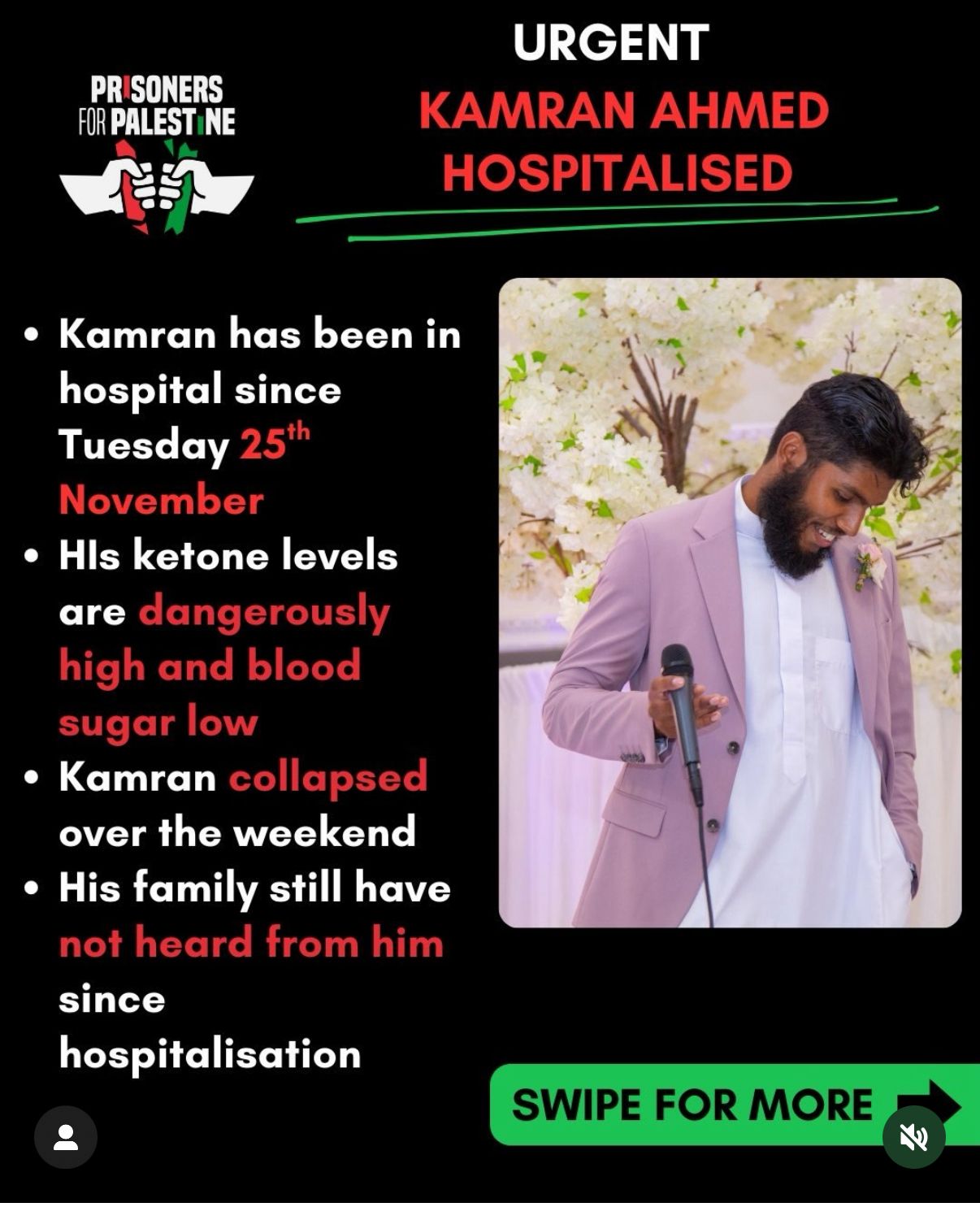
Before his hospitalisation, Alam said his “physical body was deteriorating,” as he suffered with “dizzy spells,” and difficulty walking as he would be “stumbling and passing out.”
Ahmed had reportedly passed out in his cell, falling and hitting his head on the bare prison floor. After he told a nurse about the event, she allegedly responded: “That’s what happens when you don’t eat food,” taking no further action.
A few days later on November 23, his sugar levels dropped to 2.3 mmol/L and Alam expressed that there were concerns that he would pass away in his sleep if this wasn’t immediately addressed.
An ambulance was called for Ahmed on Sunday but the paramedics declined to take him in due to his hunger strike, stating that there was nothing they could do if he wouldn’t eat.
Alam said she and her solicitors, who consulted other medical professionals, were “alarmed” by this.
On 3 December, Green Party deputy leader Mothin Ali visited HMP Bronzefield where several Prisoners for Palestine are being held.
Ali expressed outrage at the treatment and condition of Amu Gib and Qesser Zuhrah. He alleged they had been mistreated while on hunger strike and that Zuhrah had been disrespected by male officers while she was trying to pray or read Quran.
Mothin told 5Pillars that the prisoners ought to be released on bail until their court date and that their human rights are being abused.
5Pillars has reached out to HMP Bronzefield for comment but have not yet received a reply.
Hospitalised with ‘no communication’
According to his sister, after his sugar levels dropped back down to 2.0 mmol/L he was then taken to hospital, where he was kept for three days with no contact with his family.
At the hospital, after having an ECG and blood tests, the nurse had told him that there was an arrhythmia (irregular heart beat) and that his blood was acidic, after which he was immediately admitted.
Alam reported that her brother felt that his basic healthcare in custody was being affected by the pressure that the prison staff was putting on the nurses and paramedics.
Speaking on why the prison guards were adamant to get Ahmed treatment, Alam said she feels as though the sensitive political nature of Ahmed’s allegations had led to staff being reluctant to tell people, family included, where Ahmed was due to “security reasons.”
Describing the potential political leanings of the guards, Alam said that within the prison, you have people who understand the solidarity with Palestine, and others who are completely against it, noting that some guards have made remarks to the Palestine Action prisoners.
During his hospitalisation, the entire ward was locked down because of Ahmed’s presence, and his solicitor and family tried to call the hospital but were unable to reach him, with doctors saying that they were “directed not to give any updates about anyone on the ward at all.”
Ahmed was reportedly mistreated in the hospital, according to his sister, as his shoes were taken away, leaving him having to use a shared hospital bathroom in his bare socks. He was also allegedly handcuffed so tightly that his arm began to swell.
Alam expressed her confusion and frustration over her brother’s treatment, arguing that he wasn’t being treated as a remand prisoner.
“Why would they do that for someone who’s not convicted? He’s still on remand. As a remand prisoner they’re supposed to be treated as if they were on the outside, anything you would have as a free person they should technically be having that.”
Keeping faith through the difficulties
Speaking on her brother’s declining health, Alam told 5Pillars that their faith was the only thing getting them through the difficulty of the situation.
“The only thing I had was dua in that moment, and knowing that Allah is looking after him, that’s the only thing I could think of,” she said.
“The amount of difficulty we’ve gone through and how emotional it has been. I feel like the only reason I was able to think clearly or be sustained is because of people’s duas, of our own duas, and it’s through Allah’s mercy. I cannot imagine anyone being able to navigate this same path.”

( Raşid Necati Aslım – Anadolu Agency )
Referring to the Palestinians, which is the reason why Ahmed and others are striking in the first place, Alam said: “We draw strength from our Palestinian brothers and sisters, who are constantly in dua and whatever happens, they know that Allah is favouring them whatever happens.”
Out of the six prisoners on hunger strike, Teuta Hoxha was also hospitalised on Thursday November 27 after 20 days on hunger strike, according to campaign group Prisoners for Palestine (PFP).
Hoxha joined the hunger strike on November 9, a day before Ahmed.
The hunger strikers’ demands remain in question, as they still haven’t been fulfilled, including ending all prison censorship and the withholding of letters, phone calls and books, and for the Israeli arms firm Elbit Systems to shut its UK sites down.
Over 2,000 people have been arrested under terror legislation for protesting the ban on Palestine Action, the majority of whom simply held up signs reading “I oppose genocide. I support Palestine Action.”
5Pillars has contacted the prison authorities for comment.