



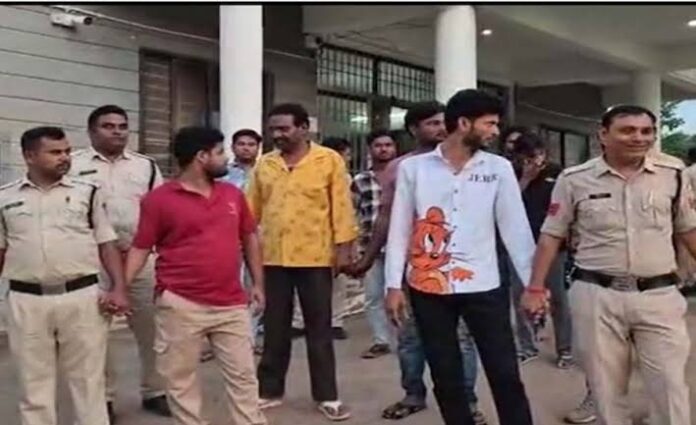
Rights groups have come out and condemned Indian police’s bias and public humiliation rituals against Muslims following the arrest of nine Muslim men after a false cow slaughter rumour.
In yet another sign of India’s deepening communal divide, police in the central state of Madhya Pradesh arrested and publicly paraded nine Muslim men through the streets after a false rumour of cow slaughter sparked mob violence.
The incident has drawn outrage from rights groups, who say it reflects how state authorities increasingly side with Hindu nationalist mobs instead of protecting minorities.
The arrests took place in Damoh district on Sunday, after members of Hindu nationalist groups attacked a Muslim-majority neighbourhood known for its meat trade. Shops were vandalised and several residents were beaten as rumours spread that a cow had been killed in the area.
When officers arrived, they found the severed head of a buffalo, an animal whose slaughter is legal in the state. Despite this, police detained nine Muslim men, including local Congress leader Mursaleen Qureshi, and charged them under the Madhya Pradesh Cow Slaughter Prohibition Act.

“This is a one-sided action,” Qureshi told reporters before being taken away in handcuffs.
“We were attacked first, but the police are treating us as culprits. They found a buffalo head, not a cow, yet they charged us under the cow slaughter law. Those who came with sticks to kill us are roaming free.”
Subscribe to our newsletter and stay updated on the latest news and updates from around the Muslim world!
Residents said police forced the men to march handcuffed through the streets before presenting them in court — an act they described as public humiliation. “We have never seen anything like this before,” said a local shopkeeper who requested anonymity. “It was done to please Hindu groups and send a message to Muslims.”

Muslims attacked by Hindu mobs prior to arrest
The violence began on Friday after the cow slaughter rumour circulated widely. By the time police reached the area, Hindu activists had already stormed the market, chanting religious slogans and attacking Muslims with sticks and iron rods. Eyewitnesses said police then arrested only the Muslim residents, ignoring the attackers.
Despite video evidence showing the mob assault, officers registered cases solely against the nine Muslim men. None of the Hindu attackers were detained.
“This is not law enforcement, it is intimidation,” said a social activist from Bhopal. “Instead of arresting those who led the mob, the police targeted the victims. Publicly parading Muslim men is a way to instil fear.”
Indian state justifies arrests
When contacted, the Damoh Superintendent of Police said the arrests were made “in accordance with the law.” Opposition politicians and community leaders, however, accused the police of communal bias and demanded a judicial inquiry.
“In a democracy, justice cannot be one-sided,” said a Congress worker from Damoh. “If Muslims are arrested, then those who attacked them must also be held accountable. Anything less is open discrimination.”
Cows hold religious significance in Hinduism, and several Indian states, including Madhya Pradesh, have strict laws banning their slaughter. Rights groups say these laws are often used to target Muslims and Dalits, communities traditionally involved in the meat and leather trade.
The rise of BJP and anti-Muslim attacks
Since the rise of the Hindu nationalist Bharatiya Janata Party (BJP) in 2014, cow-related rumours have often been used to justify violence against Muslims. Human rights organisations say such incidents have become part of a broader pattern in which mobs act with impunity while police fail to protect victims.
Sixty-year-old Rahmat Ali, a resident of Damoh, said Muslims in the area now live in constant fear. “We have lived here peacefully for decades,” he said. “Now one rumour is enough to destroy our lives. The law is no longer protecting us; it is being used against us.”
Even some Hindu residents expressed concern over the police response. “Those who spread fake news and attacked people should be punished,” said a Hindu shopkeeper. “Otherwise, this hatred will only grow.”
Analysts say the Damoh incident reflects a wider trend of impunity for hate crimes. In recent years, dozens of Muslims have been lynched or assaulted by cow vigilante groups, most of whom have faced no serious punishment.
Rights organisations, including Amnesty International and Human Rights Watch, have warned that such incidents are eroding trust in India’s legal system and deepening communal divisions.
For now, nine Muslim men — including a local leader — remain behind bars. Their families insist they are innocent and victims of political appeasement.
As he was led away, Mursaleen Qureshi said quietly, “We want justice, not humiliation. If there is law in this country, it should be the same for everyone.”