


Beyond Sudan’s brutal two-year civil war, we must recognise and analyse the bigger game being played behind the conflict, writes Najm al-Din.
As Gaza continues to suffer, a conflict of equally devastating proportions is unfolding in Sudan, where tensions have been brewing since 2019 after longtime dictator Omar al-Bashir was ousted by the Sudanese Armed Forces (SAF) and the paramilitary Rapid Support Forces (RSF).
While a fragile military-civilian council was formed with SAF commander General Abdel Fattah al-Burhan as its head and RSF leader General Hemedti as deputy, Sudan’s planned transition to civilian rule failed to materialise, with a major point of contention being the integration of the RSF into the regular army.
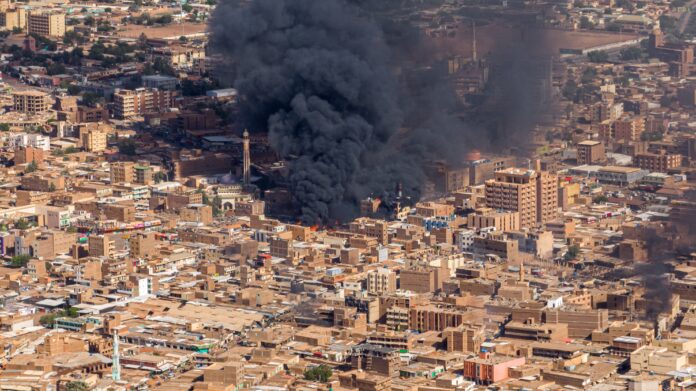
In April 2023, a bloody power struggle ensued between the SAF and RSF, plunging the country into civil war, with the RSF garnering attention for its human rights abuses and nefarious connections with external powers.
So who are the RSF, and how has the group managed to capture the last major city in the Darfur region?

Rapid Support Forces (RSF)
Having originated from the Janjaweed militias unleashed in the early 2000s against suspected rebels, it was during this period of violent counterinsurgency that Hemedti rose through the ranks.
Subscribe to our newsletter and stay updated on the latest news and updates from around the Muslim world!
The militias were formalised into the RSF in 2013 under the command of Hemedti, who exploited a law that designated the RSF as operating outside the SAF’s authority to legitimise atrocities and consolidate power.
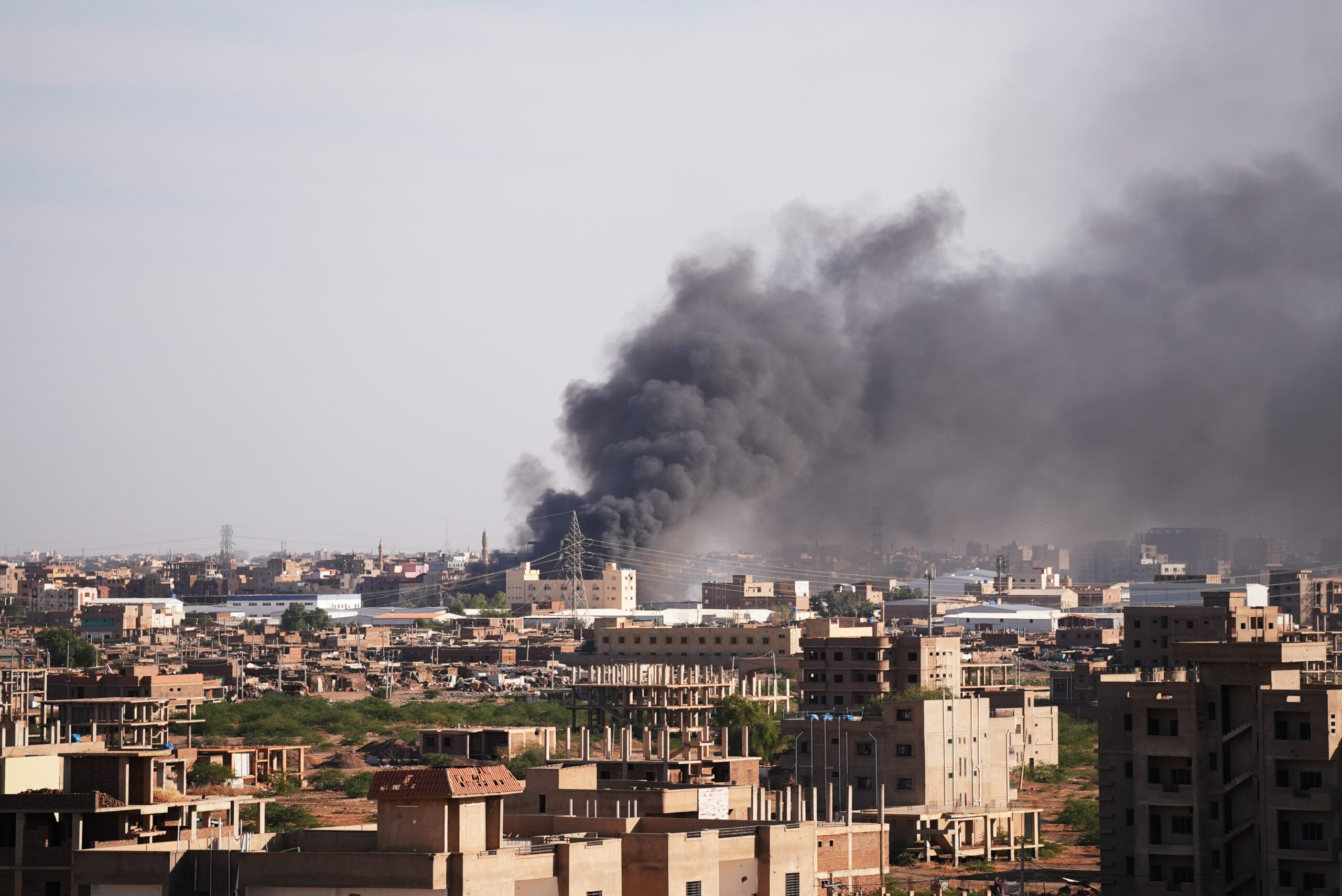
For years, human rights groups documented the RSF’s crimes — including the systematic targeting of the Masalit and other non-Arab ethnic groups, mass executions of civilians in El Geneina, and a string of arson attacks that rendered entire villages uninhabitable.
In addition to obstructing humanitarian aid, looting medical facilities, and forcing famine upon millions of displaced people, Amnesty International recently accused the RSF of sexual violence, citing incidents of gang rape and sex slavery.
After being made deputy leader of the Sovereign Council, Hemedti built a parallel political and financial structure that has seen the RSF largely outgrow its status as a government-allied militia.
However, this has only been possible due to the meddling of foreign powers that are fuelling the conflict.
The United Arab Emirates (UAE)
As part of its regional power projection — which involves securing long-term economic interests and suppressing the resurgence of “Islamist” factions — the UAE has emerged as a crucial sponsor of the RSF.
As Gulf nations increasingly shift their economies away from a reliance on fossil fuels, Sudan’s lucrative gold reserves have lured international actors like the UAE, which remains the foremost destination for gold extracted from RSF-controlled areas. This has helped Abu Dhabi solidify its position as an international gold-trading hub while offering a vital lifeline to the RSF to purchase weapons, pay fighters, and sustain military operations.

Furthermore, as the UAE imports close to 90% of its food, Sudan’s fertile land and abundant water resources are indispensable to the sheikhdom’s food security, with the UAE leveraging its foreign investments and strategic partnerships to exercise greater control over Sudan’s agricultural sector.
With Emirati-owned firms like Al Dahra managing vast tracts of land in the country for producing livestock and crops, Sudan occupies a central role in guaranteeing the long-term food supply for the Gulf powerhouse.
The profits accrued by investors contribute to the UAE’s sovereign wealth fund — largely at the expense of Sudan’s local communities.
Broader foreign policy goals also explain the UAE’s entanglement in Sudan’s internecine wars.
For decades, the UAE’s leadership has viewed mainstream and moderate organisations such as the Muslim Brotherhood and grassroots movements dedicated to the revival of Islamic governance as ideological threats to its authoritarian ruling system.
With the presence of radical “Islamists” and jihadist networks in the Sahel, the kingdom’s counterterrorism efforts have intensified. It continues furnishing Hemedti — a reliable security partner who has assisted UAE operations in Yemen and Libya — with British and Chinese-manufactured weapons to obstruct Islamist factions closely aligned with the former Bashir regime from assuming power.
It is for this reason that the UAE has sabotaged any civilian-led government from taking root in Sudan.
Covert War
Another overlooked element in the UAE’s strategy in Sudan is the deployment of private military contractors (PMCs) that function as guarantors of Gulf security.
Reports indicate that the UAE is outsourcing its aggressive foreign policy to clandestine networks consisting of Colombian fighters who are being smuggled into Sudan from Chad and Somalia and were recently spotted fighting alongside RSF insurgents in El-Fasher.
These mercenaries are central to the UAE’s covert war strategy, which began in 2010 after Erik Prince — the disgraced founder of the infamous US PMC Blackwater, which gained notoriety for its actions during the Iraq war — was given a new lease of life when hired by Mohammed bin Zayed to assemble a private cadre of militias to pacify uprisings during the Arab Spring, further blurring the lines between state military personnel and private actors.
British Empire
However, accusing the UAE as the sole culprit in the Sudanese quagmire ignores the conflict’s multifaceted dynamics.
The civil war bears the hallmarks of imperial machinations dating back to the British Empire, where ethnic and religious divisions were exacerbated through policies that concentrated power and wealth in the hands of a privileged elite.
The British hindered efforts toward national integration by governing Sudan as two separate regions. Promoting English as the lingua franca in the South fuelled cultural and linguistic divisions with the Arabic-speaking North, many of whom were aggrieved by colonial policies that marginalised Islam while facilitating greater Christian missionary activity in the country.
Furthermore, empowering specific ethnic groups by incorporating them into governing structures while leaving regions like Darfur largely undeveloped established asymmetrical power dynamics that have persisted since independence — resulting in social, economic, and political fractures inherited from Sudan’s colonial past.
Great Game
Today, various nations have exploited these fault lines and are jostling for position in the latest scramble for Africa.
As part of Ankara’s strategy to expand its strategic footprint in the Red Sea region, Turkey has supplied Bayraktar TB2 drones to the SAF, heightening its regional rivalry with the UAE.
Iran is providing Mohajer-6 combat drones to the SAF to secure a naval foothold on the Red Sea coast and gain a competitive edge in its proxy war with Saudi Arabia, while Russia has hedged its bets with both the RSF and SAF in pursuit of the same objective.

Meanwhile, American and Israeli diplomatic efforts in Sudan are motivated by broader strategies across the Horn of Africa, with independent and overlapping objectives.
These are geared toward degrading the capability of Islamist insurgents, preventing geopolitical adversaries like China and Russia from forming a security architecture in the region, ensuring long-term access to vital trade routes, advancing normalisation agreements through the Abraham Accords, and severing financial and weapons-smuggling routes via Egypt that aid the Palestinian resistance.
With Zionists agitating to redraw borders from the Nile to the Euphrates, Tel Aviv may exploit the conflict to imperil Egypt’s water security and thereby foster greater energy cooperation with Nile upstream countries as a bargaining chip in diplomatic relations with Cairo.
While the UAE’s role in the conflict has been magnified due to the scale and nature of its involvement, the sad reality is that Sudan is the new Great Game of the 21st century.