


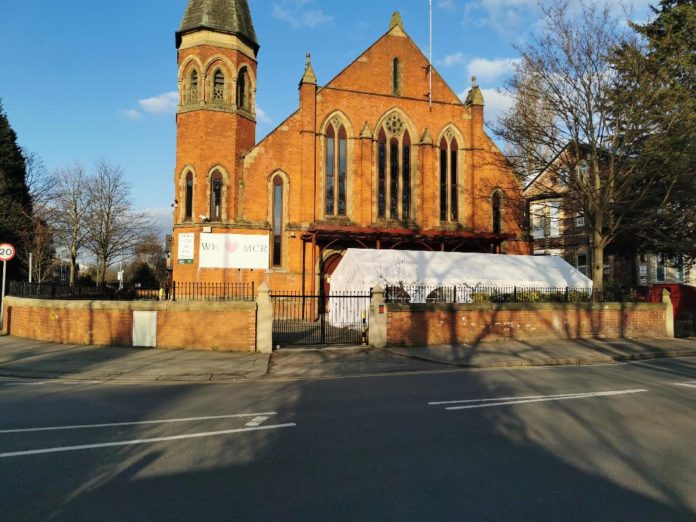
Didsbury Mosque in Manchester has pushed back against “online misinformation” after a right-wing backlash against a job advertisement for a “Shariah Law Administrator” it posted on a government job portal.
The Department for Work and Pensions advert, which was withdrawn following a public outcry, sparked accusations from politicians and commentators that it promoted a “parallel legal system” incompatible with British law.
Didsbury Mosque’s statement, reproduced in full below, condemns what it describes as “malicious misrepresentation,” but the mosque has withdrawn the advert to reword it to “prevent further misinterpretation and misunderstandings.”
Didsbury Mosque statement
The MIC (Manchester Islamic Centre) advertised for an administration role within our Shariah (religious service) section. Some individuals on the far-right and politicians have maliciously misinformed the public about this post to incite hate and for political gain, or out of ignorance. We wish to clarify the situation.

- This is not a government-funded post; the mosque pays for it out of community donations. The DWP advertises many jobs to help people obtain employment. It is an administrative role, and they advertised the job for local people. It was open to anyone to apply.
- We do not operate outside UK law or operate a parallel legal system which would be unlawful. We operate within UK law and all our policies reflect respect for UK laws.
- Under the law, some different faith communities operate a religious arbitration and counselling service within the law.
- The term Sharia law is misleading; it is not a legal court. Instead, it offers members of the Muslim communities two separate services – civil arbitration and religious guidance on numerous religious matters – neither of which constitutes a parallel legal system. Under the Arbitration Act (1996), all British citizens have the right to resolve civil – and not criminal or family – disputes through arbitration. They cannot provide rulings contrary to the law, but can resolve disputes.
- Some mosques in Manchester are registered to provide lawful civil marriages and perform a religious marriage as part of a lawfully conducted marriage service.
- It has been suggested in one online post that we are going to charge Christians for being non-Muslims. This is incorrect, inflammatory and xenophobic. There is no desire, intention or capability to demand taxes from anyone.
- We have reported online misinformation and threats to the Police. We will continue to do so, whether they are ordinary people or politicians. We intend to pursue those who spread false information under the Malicious Communications Act and the Online Safety Act.
- We have withdrawn the job in question and have asked the DWP to remove it from its website. The job advert will be reworded to avoid future misunderstanding.
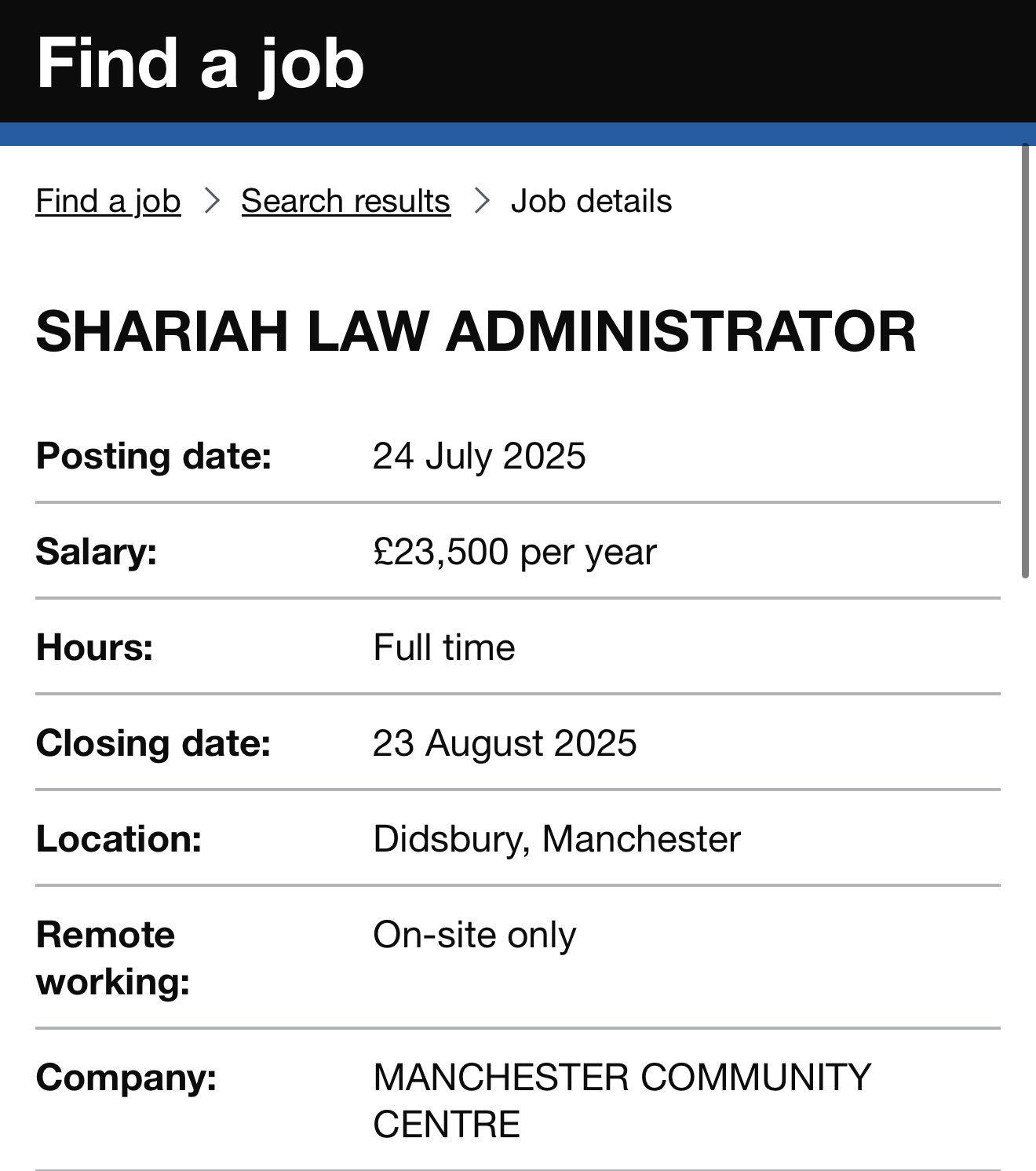
The job advert, offering a £23,500 annual salary for a role at the Manchester Community Centre in Didsbury, required a degree in Shariah law and experience in Shariah courts in Muslim countries.
Subscribe to our newsletter and stay updated on the latest news and updates from around the Muslim world!
It involved administrative tasks for the Manchester Shariah Council, such as conducting interviews and managing community services.
However, the listing drew sharp criticism from figures like Reform UK leader Nigel Farage, who claimed it signaled the “destruction” of British values, and Independent MP Rupert Lowe, who expressed “alarm and disgust.”
Conservative MP Peter Bedford linked it to an “out-of-control civil service,” while Reform UK’s Zia Yusuf and GB News presenters called for banning Shariah councils, citing concerns over gender inequality and the estimated 85 such councils in the UK.
Shariah councils in the UK, estimated at around 85, are religious bodies based in mosques or community centres, offering guidance and arbitration for Muslim communities, primarily on marriage, divorce, and civil disputes.
Staffed by Islamic scholars, they operate within UK law, with no legal authority, and their rulings require civil processes to be legally binding.
Under the Arbitration Act 1996, they can mediate civil disputes if both parties consent, and some registered councils facilitate religious marriages, though civil ceremonies are needed for legal recognition.