



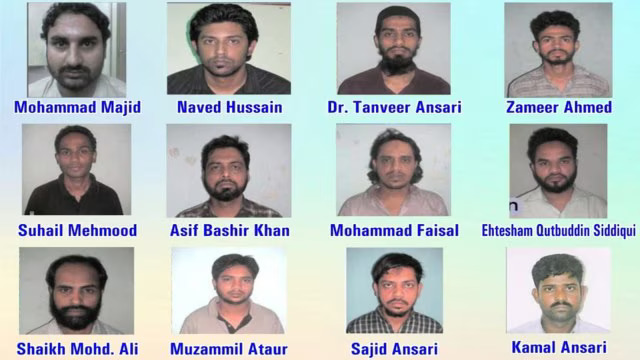
Twelve Muslim men who spent nearly two decades in prison for the 2006 Mumbai train bombings have been acquitted by the Bombay High Court, which ruled that the prosecution failed to prove its case beyond reasonable doubt.
The judgment, delivered by a special bench of Justices Anil Kilor and Shyam Chandak on Monday, overturned the 2015 convictions, which included five death sentences and seven life sentences. The court found the evidence unreliable and noted serious failures in both the investigation and trial process.
The seven coordinated bomb blasts on July 11, 2006, tore through packed commuter trains on Mumbai’s Western Railway line, killing 189 people and injuring more than 800. Indian authorities swiftly arrested several Muslim men, accusing them of orchestrating the attacks.
But after six months of hearings, the Bombay High Court found no credible link between the accused and the bombings.
“There is no evidence to prove their guilt,” the court observed. It criticised the prosecution for presenting key witnesses—such as taxi drivers and passengers—nearly 100 days after the attacks, with no plausible explanation as to how they could have identified the accused.

Prosecution’s failures
The court also dismissed the alleged recovery of firearms, explosives and maps, stating that investigators had failed to even establish the type of bomb used in the attacks.
Subscribe to our newsletter and stay updated on the latest news and updates from around the Muslim world!
In 2015, a special court established under the Maharashtra Control of Organised Crime Act (MCOCA) sentenced Kamal Ansari, Mohammad Faisal Ataur Rahman Shaikh, Ehtesham Qutubuddin Siddiqui, Naveed Hussain Khan and Asif Khan to death for allegedly planting the bombs. Seven others were sentenced to life imprisonment.
One of the accused, Kamal Ahmad Ansari, died in custody in 2021 due to COVID-19. Another, Wahid Shaikh, had been acquitted by the trial court in 2015 after spending nine years in prison.
The appeals, filed in 2015, were pending until July 2024, when a special bench was finally constituted to hear them.
Former Chief Justice of the Orissa High Court and senior advocate, Dr S. Muralidhar, represented two of the convicts: Muzammil Ataur Rahman Shaikh from Bangalore and Zameer Ahmed Latifur Rehman Shaikh from Mumbai.
In court, Muralidhar delivered a scathing critique of the state’s handling of the case, arguing that the investigation was deeply flawed, biased, and influenced by media pressure.
“These men have been in jail for the last 17 years. They haven’t stepped out even for a day. The majority of their prime life is gone,” he told the bench.
He said the accused were subjected to media trials and presumed guilty from the outset. “Police officers hold press conferences, and the way the media reports the case, it virtually decides the guilt of a person,” he added.
Muralidhar also warned of the long-term damage caused by such accusations: “It is not just the accused who suffer. Their children, their parents, their relatives, all of them get tainted. And once tainted, Milords, this society is too cruel to them.”
He concluded: “We have a history of failures in investigations of terror cases. But it is not too late. The court can still set it right.”
The case has reignited debate over India’s treatment of Muslims accused in terrorism cases, and the use of controversial laws like MCOCA, which allow extended detention without trial.
Critics argue that these laws are routinely used to criminalise Muslim men based on weak or fabricated evidence.
Despite the acquittals, none of the men have received compensation or a formal apology.
Families say their lives have been shattered and their reputations destroyed.