



5Pillars correspondent Haris Tagari was on the ground marking the 30th anniversary of the Srebrenica genocide. He witnessed and took part in the burial of several martyrs. What follows are his deep reflections and experiences from the day.
Today felt eerily like a scene from the Day of Judgement.
Mothers wailed, grief was etched into the faces of families, the sun scorched down on fields of mourners drifting over the remains of thousands already buried beneath their feet, and seven fresh graves lay open in wait.
Families began arriving as early as 4am, finding shade beneath trees, resting quietly as they awaited the hour of salah.
I had risen at 1.30am and departed Sarajevo soon after, making my way toward Srebrenica along winding mountain roads. The sunrise cast a golden light over the peaks – a rare moment of stillness before the weight of the day ahead.

By the time I arrived and found parking, it was around 5am. The cemetery – now the final resting place for over 6,000 of the 8,372 victims – lies in the town of Potočari, near Srebrenica, on the grounds next to what was once a UN base.
Whilst making my way to the cemetery, I passed by tents belonging to those who had camped overnight, watching as they brushed their teeth and readied themselves for what lay ahead.
Subscribe to our newsletter and stay updated on the latest news and updates from around the Muslim world!
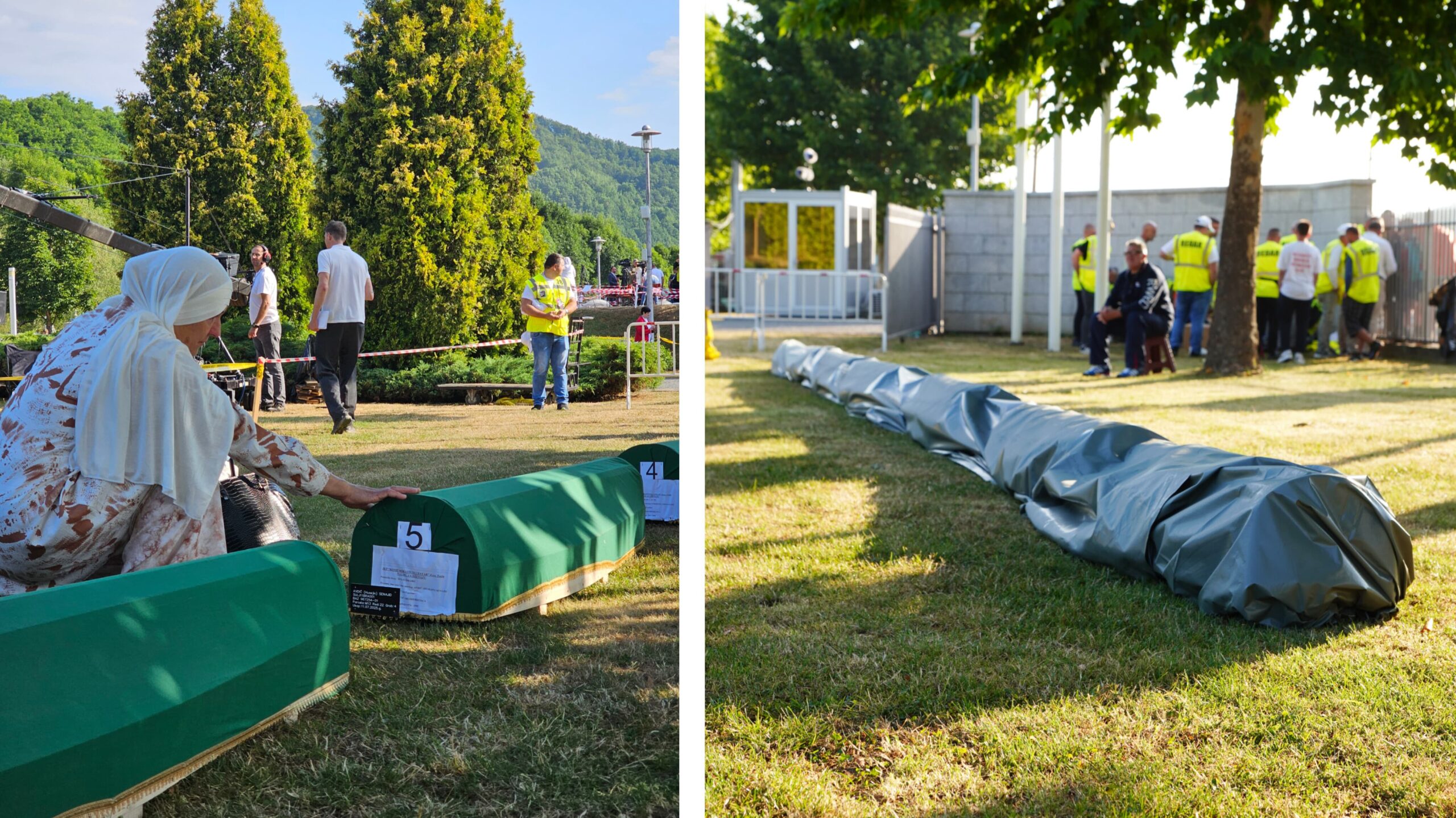
I laid down on the grass for a while close to the seven caskets that were spread out at the front of the field. I observed the crowds walk past — people completely wiped out, sunk into the ground and barely keeping their eyes open.

It would be another seven hours until the janazah salah would be performed. But during those seven hours, some of the most unforgettable moments occurred.
Mothers leaning on the stumps of trees, groups of elderly uncles sitting in circles. The smell of grass. Occasionally, I would get up from my makeshift headquarters and stroll around the cemetery to witness the differing scenes of the day.
Small picnics of mothers draped in white hijabs, children sleeping on their fathers’ laps. I couldn’t understand the speech, but one can imagine the types of conversations held in these small groups.
The talk of the personal dimension to this genocide. The unravelling of family stories from the 1990s. The memories of the generation before the aggression.
This was was not a geopolitical crisis in the Balkans, but rather a very real and personal juncture in the lives of millions.

I would often hear German being spoken, or catch an American or Australian accent in the wild as I continued my short march around the vast field. These were Bosniaks living in the diaspora.
While I found moments to capture with my camera, an elderly Bosniak mother from Austria turned around to look at me.
She turned her head away, then glanced at me once more and spotted the Srebrenica flower I had pinned to my shirt. She smiled and began to speak in German (I was lucky this time, it’s the only language other than English I can almost speak).
She thanked me for being there. She held my shoulder and rubbed it, her smile glowing even brighter.
This wasn’t the first occasion I had been thanked or gifted a warm smile. Everywhere I strolled that day, fellow Bosniaks shook my hand, recognising the work of spotlighting Bosniak history for the masses.
My eyes were drawn to those standing in singularity, solemn and bereaved – holding a Qur’an in one hand and their emotions wrapped around the tombstone in the other.
As I walked with my head lowered, scanning the landscape, a certain man caught my attention. Kneeling down, surrounded by hundreds of white pillars. His face fixated towards one particular tombstone. I politely enquired who the grave belonged to. He answered, “My father.” His eyes were bloodshot red from his tears.
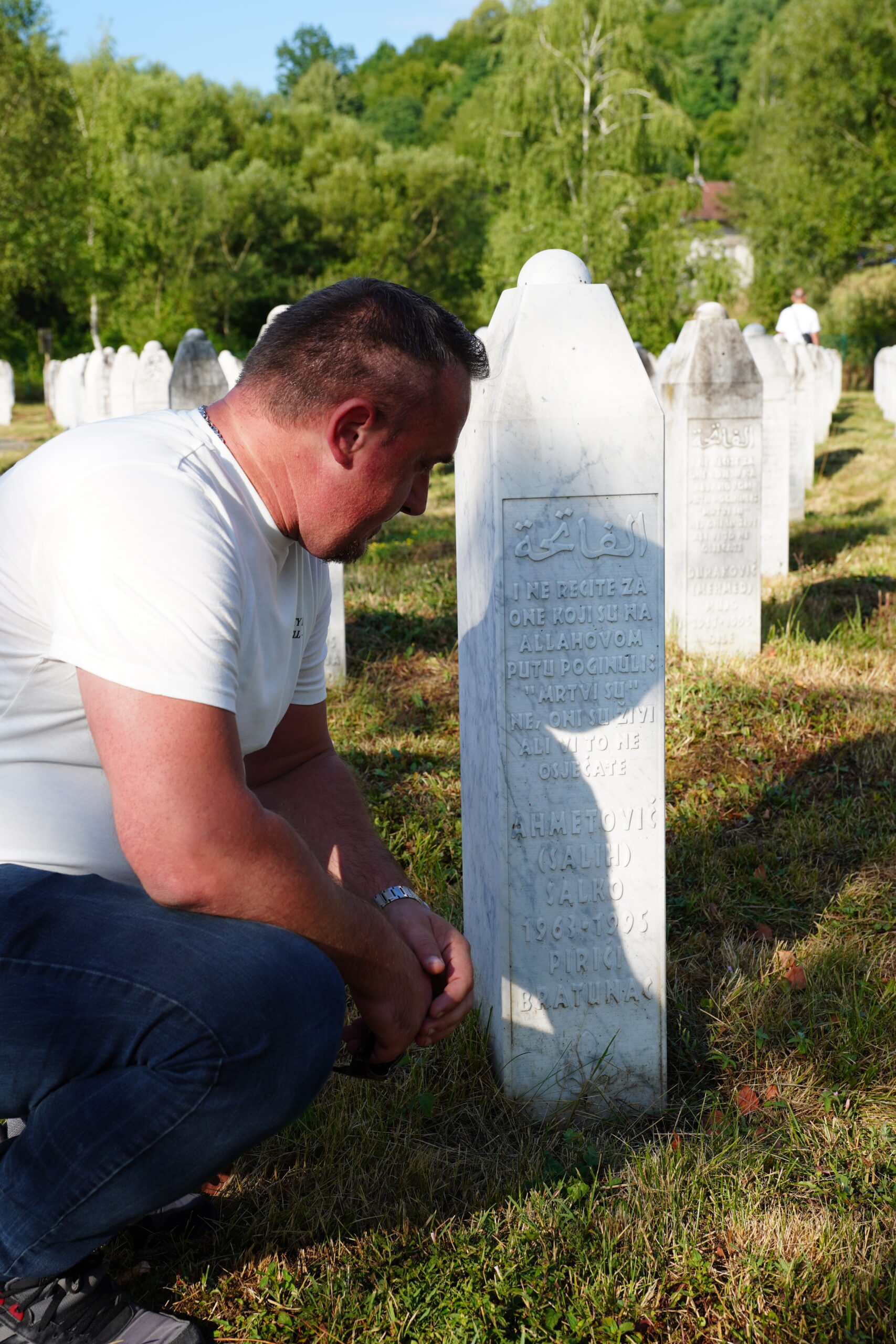
I asked him about his childhood memories of his father. “I remember the most when he used to pick me up from school. I used to be so happy to see him every day. Everybody always had good things to say about him.”
After I had visited all the newly prepared graves for the seven to be buried, I returned to my belongings closer to the front.
The caskets were now visible, and mothers and family members began gathering around the iconic thin green shield-shaped caskets.
To see a mother cry so profusely, overcome with her sorrow that she sprang up from the floor to hug a tree in exhaustion – shattered the final ounces of reality within me.
I shed tears as I slowly raised my camera to capture the moment. It didn’t feel appropriate, but I reminded myself the duty of a journalist. To capture, to preserve, and to remind those who are not present. To platform the plight and pain of the oppressed.
This mother has spent the last 30 years uncomfortable, agitated, and stuck in purgatory. She watched that young 19-year-old grow up. She nestled him in her arms, fed him, played with him. She cared for him like nobody else would.
And for her to be charred with the knowledge of how crooks and thugs desecrated that same body she once hugged – that same head she once kissed, those same hands she once wrapped her fingers around and held tight.
 In those moments, it was as though I was not at a ceremony for the 30th commemoration of this slaughter fest, but rather it felt like I had been there in those very dark moments of the 1990s.
Almost as if her pain and sorrow had been frozen — and then amplified and resumed 30 years later. The reason many refer to the aggression against Bosniaks as a “frozen” and “unresolved genocide.”
The moment that mother returned to the casket after resting on the tree, she cried and laid her forehead on the forehead of the casket, rocking from side to side.
These thoughts I narrate to you now flashed before me in nanoseconds. In that flash, before my tears escaped, I imagined what her life was once like before all of this. It is not as if she signed up to be a mother of Srebrenica.
It’s not as if she gave consent. It’s not as if she chose this.
The moment the time for salah approached, suddenly thousands of people awoke, rising to form the rows. After both the Friday salah and the janazah salah which took place shortly after, I rushed to the caskets to hold and see them to their final resting place in this world.
I held the closest casket to me, camera recording in one hand and holding the tip of the casket in the other.
I had two responsibilities that day – to be a first hand witness for these martyrs, and to also capture it for those not present.
The body I was holding up was the 64-year-old Fata Bektic. She was killed by Serb shelling, and her body’s whereabouts were unknown for decades.

She was dropped and buried in a ditch by orders of Serb Orthodox militants. When the casket was laid down into the grave, I realised how similar this was to an ordinary funeral. The shovels. The dirt. The crowd eagerly assisting the process.
The tense sounds of digging. The rushed, stressed voices passing instructions back and forth. The process was not sanitised one bit. Raw and emotive. But this was no ordinary funeral. This was the funeral for victims of genocide that, although not long ago, was older than I.
As I got closer, I grabbed the nearest shovel and dug with all the remaining energy I had reserved for this very moment. I dug deep into the soil. With every thrust, I hoped to honour and make up to this mother for the last time she was buried in horror and violence.
After I had given it my all, the brothers behind me told me to rest, and so I passed the shovel on to the next observer. But there was one brother that day I really wanted to see off – Hariz, who was just 19 when they killed him.
A man with a similar age and name to my own. I rushed out of the crowd and began pacing across the field to find his coffin – bobbing my head above the crowd, moving between the thousands of people.
Out of fate, I arrived at the front. I picked the shovel up and began digging. This time I stopped myself to comprehend what I was doing.
 I recited Surah Ikhlas loudly. Overcome with the gravity of the moment, I twisted my wrist but continued shovelling. This time for a little longer.
I waited for someone to tap me out (which is how it usually works), but it seemed the other diggers were also tired.
I continued and recited Allah’s remembrance under my breath until a brother from the back of the crowd moved to the front to take the shovel from me. I stood back and shed another tear.
I am sorry for what they did to you, but just know that Allah loved you so much He brought a man halfway across the world to see you off one final time. A man who never knew you, nor did you ever know him. He was not family. He was not Bosniak. But he was bound to you through iman.
Allah loved you so much He brought thousands upon thousands of people to pray your janazah.
I stepped to the side and walked to the other brothers, who by now were under the soil, with imams gathered around reciting the final du’a.
Beyond the slogans of vowing to “never forget,” beyond the public optics, there remains a deeply urgent and uncomfortable lesson to pay heed to: the hatred for Islam and Muslims, and the defence every Muslim must offer.
To never feel entirely at ease living in lands where our very existence is questioned, where we are dehumanised as fifth columnists and bandits, just as the Bosniaks once were.
We don’t “remember Srebrenica” only on the 11th. We don’t hold talks or ceremonies thinking that alone counts as remembrance.
To truly remember Srebrenica is to live consciously, aware of the ever-hostile narrative against Islam and to offer what you can, first to recognise that reality, and then to defend against it.